
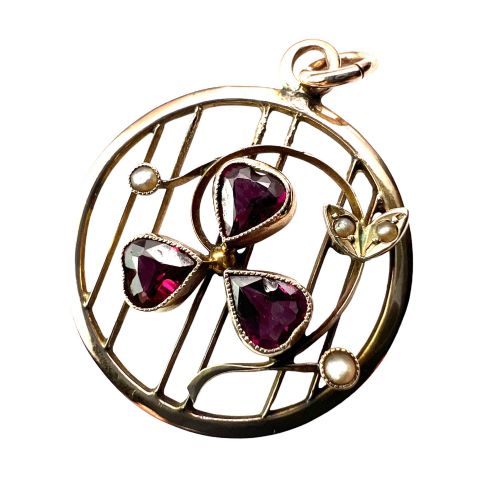


9ct Gold Garnet Pendant
A 9ct gold garnet pendant brings deep crimson colour and warm goldwork together, offering wearable history from the Victorian, Edwardian and mid-century eras.
9ct Gold Garnet Pendant
A 9ct gold garnet pendant spans several distinct periods, most commonly appearing in Victorian, Edwardian and mid-century designs. Buyers examine pieces shaped as clover hearts, starburst clusters, lavalieres and delicate floral drops set in yellow or rose gold.
The selection ranges from antique Edwardian creations with flowing Art Nouveau lines to mid-century modern interpretations. Many pieces incorporate seed pearls alongside the central stones, reflecting period preferences for contrasting textures and tones.
Origins stretch from late nineteenth-century workshops through to twentieth-century commercial output. Collectors encounter both standard pendant necklaces and heavier conversion pieces originally fashioned as brooches.
Materials and Construction
Makers utilised nine-carat yellow and rose gold as the primary metal base for these jewels, often pairing the alloy with durable claw or bezel settings. Stones such as almandine, mandarin, imperial and standard garnets provide the deep red to orange hues characteristic of the category.
Goldsmiths integrated seed pearls and occasional diamonds as secondary embellishments, securing them with fine wirework and delicate collets. Art Nouveau and Edwardian examples demonstrate intricate piercing and sweeping whiplash curves executed in gold sheet and wire.
Some Victorian birds managed to smuggle themselves into the lineage by wearing garnet bellies.
Assessing the Pieces
Superior examples display precise stone matching, where individual garnets share consistent saturation, cut quality and depth of colour across a cluster or starburst arrangement. Superior goldwork shows crisp casting or hand-carving without excessive solder visible at the joins.
The distinction between ordinary and exceptional relies upon the integrity of the design and the preservation of delicate seed pearls or fine claw settings. Pieces retaining original chains and untouched period patination hold greater interest for serious collectors.
The 9ct Gold Garnet Pendant Glossary
- Lavaliare
- A pendant featuring a suspended drop stone or tassel hanging below the main body, popular during the Edwardian period. These pieces often swing freely on fine gold chains.
- Almandine
- A dark red variety of garnet rich in iron and aluminium, frequently found in Victorian cluster and starburst jewellery. This stone provides a deep, saturated crimson tone.
- Cabochon
- A gemstone cut with a smooth, rounded convex top rather than faceted edges. This shaping highlights the rich, glowing colour of the garnet without sharp reflection.
- Seed pearl
- A very small, naturally occurring or cultured pearl used widely in Edwardian and Victorian multi-stone jewellery. They are typically threaded or pegged onto fine gold mounts.
- Conversion piece
- An antique item, such as a brooch or earring, adapted into a pendant for modern wear. These objects retain their original period mountings while serving a new function.
9ct Gold Garnet Pendant: Frequently Asked Questions
How do I date a 9ct gold garnet pendant?
Dating relies heavily on stylistic markers, such as the flowing organic curves typical of Edwardian Art Nouveau work or the tighter geometric clusters seen in mid-century pieces.
Examining the construction methods, clasp types and the specific hue of the nine-carat gold helps narrow down the decade of manufacture.
Are these pendants suitable for everyday wear?
Garnet is a durable stone suitable for regular use, but antique settings require mindful care due to their age and delicate nature.
Removing the pendant before swimming, sleeping or heavy physical activity protects the fine gold claws and any accompanying seed pearls from accidental damage.
What is the difference between rose and yellow 9ct gold?
Rose gold contains a higher proportion of copper alloyed with the gold, giving it a warm, pinkish hue that was particularly favoured during the Victorian era.
Yellow gold maintains a traditional warm metallic appearance and remains the standard choice across Edwardian and mid-century designs.
How should I clean my antique garnet jewellery?
Cleaning requires warm soapy water and a soft cloth, avoiding harsh chemical dips or ultrasonic cleaners that can dislodge seed pearls or weaken old settings.
Gently wiping the gold and stones restores the natural lustre without risking harm to fragile antique components.