
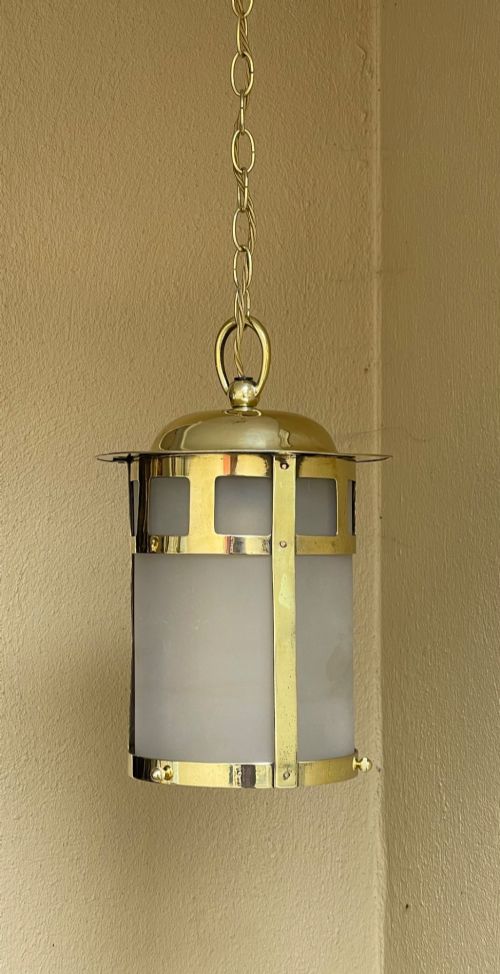
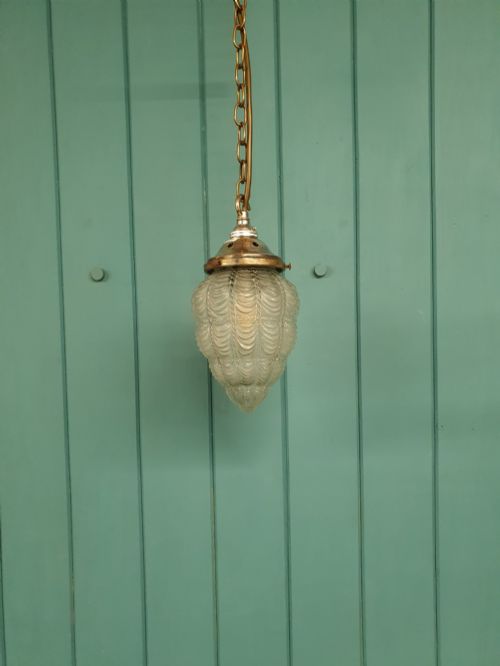


Frosted Glass Hall Lantern
These frosted glass hall lanterns command an entryway with diffused light and solid metalwork.
Frosted Glass Hall Lantern
A frosted glass hall lantern brings architectural presence to a narrow space while softening the glare of a single bulb. These overhead fixtures range from compact early twentieth century pendants to substantial French gilt bronze and brass examples designed to hang high in a vestibule.
The pieces seen here span the Victorian era through to the nineteen thirties, with Edwardian brass mountings and Arts and Crafts interpretations appearing most frequently. Buyers encounter hexagonal frames, oval bodies, and Gothic shapes suspended from simple chains or decorative ceiling plates.
Metals and Glass Treatment
Construction relies heavily on structural brass and bronze, often cast or gilt, paired with blown or pressed panes of glass. Workshops utilised acid etching and sandblasting to create the characteristic frosted or opalescent finish that diffuses illumination evenly.
Framing components are joined by mechanical fasteners, soldering, or hinged doors that allow access to the interior burner or bulb holder. Early specimens occasionally retain evidence of conversion from candle or gas lighting to electric wiring.
Listings demonstrate a strong representation of Edwardian brass work alongside French nineteenth century gilt bronze examples.
Distinctions in Execution and Age
The distinction between standard production and superior work lies in the weight of the metal casting and the crispness of decorative chasing. Heavier gauge brass and finely detailed gilt bronze retain their structural integrity and decorative sharpness over generations of use.
Glass quality also marks the difference, as uniform thickness and deliberate surface texture create a richer diffusion of light than thin, later replacement panes. Original patination on the metal components demonstrates age better than overly polished surfaces.
The Frosted Glass Hall Lantern Glossary
- Frosted glass
- Glass treated to scatter light and reduce transparency, often achieved by acid etching or sandblasting the inner or outer surface.
- Gilt bronze
- Bronze metal treated with a thin layer of gold or gold-coloured alloy to give a rich, durable metallic finish.
- Hall lantern
- An overhead lighting fixture specifically proportioned for narrow circulation spaces, vestibules, and entrance corridors.
- Arts and Crafts
- A design movement prioritising traditional craftsmanship, visible construction methods, and simple, honest materials.
- Pendant light
- A solitary lighting fixture suspended from the ceiling by a single cord, chain, or rigid metal rod.
Frosted Glass Hall Lantern: Frequently Asked Questions
How do I hang a heavy brass lantern?
Suspension requires securing the ceiling rose directly into overhead joists using appropriate fixings rather than plaster alone. The weight of bronze and brass frames demands sturdy structural support.
Chain length can be adjusted by opening links to position the fixture at the correct height for the entryway ceiling clearance.
Can these antique lanterns take modern bulbs?
Most surviving examples have been rewired with standard lamp holders that accommodate modern low energy or LED bulbs. This update ensures safety while preserving the historic exterior appearance.
Check the interior dimensions to ensure the chosen bulb fits comfortably within the enclosed frosted glass panels.
How do I clean frosted glass panels?
Maintenance involves removing the glass panels from the metal frame if possible, or wiping them carefully in situ using a mild soap solution. Avoid harsh abrasive pads that might scratch the etched surface.
Dry the glass thoroughly with a lint free cloth before reassembling to prevent water marks on the treated finish.
Are these fixtures suitable for low ceilings?
Certain designs feature shorter chains and flush ceiling plates that suit modest ceiling heights without obstructing passage. Compact hexagonal or oval models keep the vertical drop to a minimum.
Measure the distance from the floor to ensure adequate clearance beneath the lowest point of the hanging fixture.