





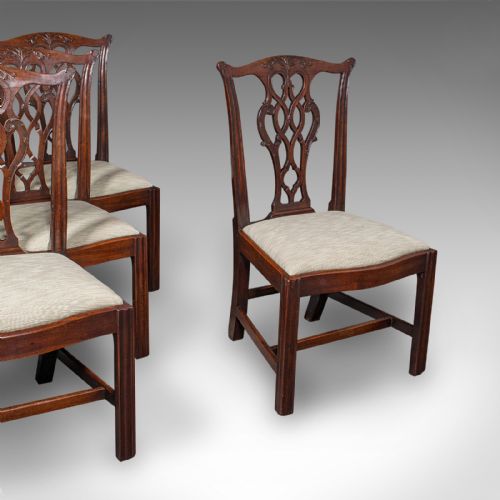


Fretwork Dining Chairs
Fretwork dining chairs bring striking open-work backs and timeless mahogany craftsmanship to the table.
Fretwork Dining Chairs
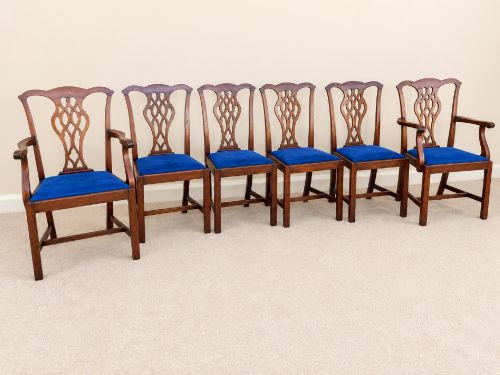
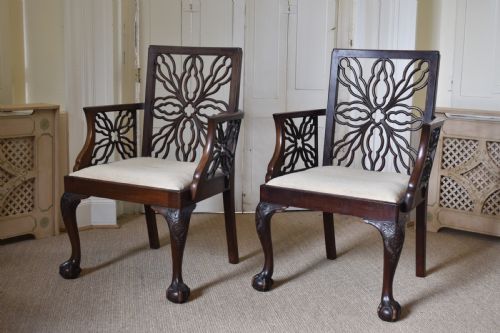
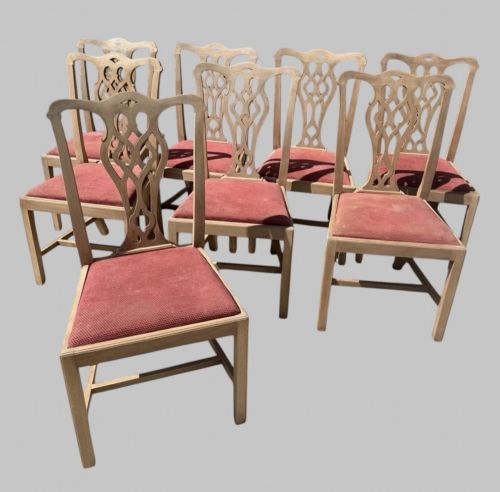
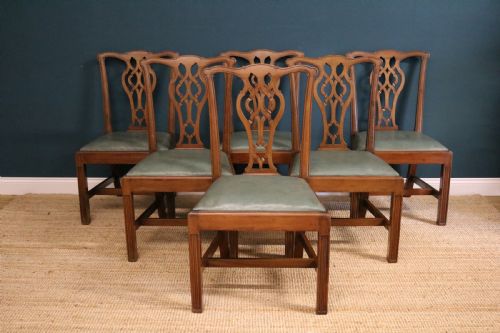
Fretwork dining chairs encompass dining chairs, armchairs, and side chairs featuring pierced wooden splats and intricate lattice patterns. Buyers seeking fretwork dining chairs will find pieces ranging from Georgian originals to later revival iterations.
The selection includes matched sets and pairs originating from the eighteenth, nineteenth, and early twentieth centuries. Mahogany forms the primary structural foundation across the majority of these seating options.
How they were made
Cabinetmakers constructed these chairs predominantly from solid mahogany, occasionally utilising bleached mahogany or Chinese hardwood. Frames frequently incorporate carved details alongside the characteristic pierced fretwork back splats.
Seating portions display a variety of materials including fabric, velvet, leather, cane, and standard upholstery fabric. Some refined examples integrate brass elements or bergere seats into their construction.
Fretwork Dining Chairs Retail Price Guide 2026
Typical asking prices for fretwork dining chairs among the pieces listed under this phrase on Sellingantiques today, from the lower quarter to the upper quarter. They describe what is for sale here now, not the wider market.
One remarkably niche offering in the archive includes a towering porter's chair built for keeping draughts away from eighteenth-century servants.
What varies in quality
Quality reveals itself in the crispness and depth of the carved ornament and the precision of the pierced fretwork. Superior examples exhibit harmonious proportions and carefully selected timber grain that enhances the overall silhouette.
The integrity of the joinery and the execution of revival styles versus period originals dictate the standing of individual pieces. Longevity and visual impact depend entirely upon the original maker's mastery of proportion and material.
Thomas Chippendale·Robert Manwaring
The Fretwork Dining Chairs Glossary
- Fretwork
- Ornamental design perforated or cut with a fretsaw, commonly found on the back splats of these chairs. It provides the defining visual characteristic for this group.
- Splat
- The vertical central strip of wood in the back of a chair, which receives the intricate pierced carving in Chinese Chippendale and revival pieces.
- Klismos
- An ancient Greek chair style featuring curved, sweeping legs and a concave backrest, represented here in nineteenth-century interpretations.
- Bergere
- An enclosed upholstered armchair with a wooden frame, frequently featuring cane panelling on the back and sides.
Fretwork Dining Chairs: Frequently Asked Questions
How do I identify a Georgian original?
Georgian originals display the timber patination, hand-cut joinery, and proportional refinement characteristic of eighteenth-century workshop production. Examining the underside and interior frame reveals the construction methods specific to that period.
Revival pieces from later centuries often copy these forms closely, but typically show machine-cut precision or differing secondary woods upon close inspection.
How should I care for mahogany frames?
Mahogany requires minimal intervention, benefiting primarily from dusting with a soft, dry cloth and occasional application of appropriate wax polish to maintain the surface sheen. Keeping chairs away from direct heat sources and strong sunlight prevents the timber from drying out.
Upholstered and cane seats need gentle vacuuming or specialist cleaning depending on whether the material is leather, velvet, or woven cane.
Are large sets difficult to find?
Extended sets spanning six, eight, or more chairs usually originate from nineteenth or twentieth-century revival periods rather than the eighteenth century. Finding uniform sets in larger numbers reflects the dining requirements of later eras.
Period eighteenth-century examples more commonly survive as singles, pairs, or smaller groupings.