
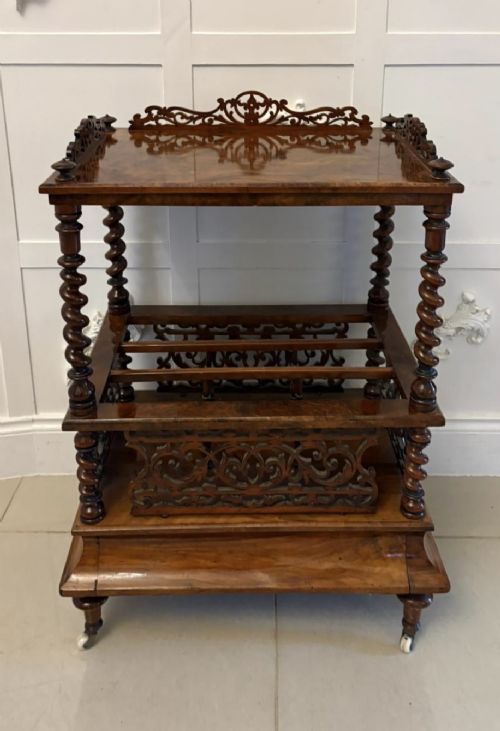
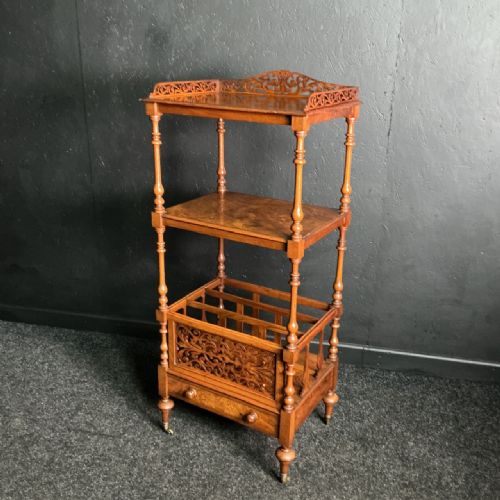


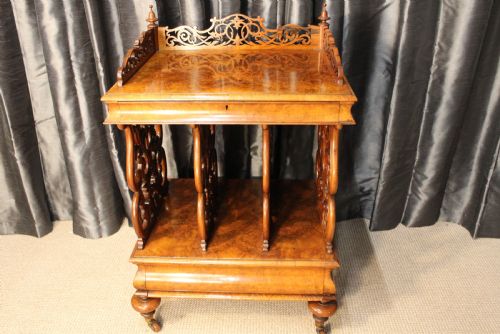


Fretwork Canterbury Table
These fretwork canterbury table pieces combine traditional sheet music storage with display surfaces, bringing Victorian craftsmanship directly into your home.
Fretwork Canterbury Table
When you search for a fretwork canterbury table, you are looking at multi-functional Victorian furniture designed to hold folios, magazines, and books while providing an occasional table top. The versions most commonly met on this page date from the mid to late nineteenth century, spanning the decades between eighteen sixty and eighteen eighty.
These forms combine the compartmented rack of a traditional music canterbury with the tiers of a whatnot or the surface of a lamp table. They serve simultaneously as storage units and display surfaces, appearing in formats ranging from oval lamp tables to multi-tiered whatnots.
Materials and Construction
Cabinetmakers constructed these pieces primarily using burr walnut and rosewood, frequently incorporating satinwood, boxwood, brass, and ceramic or porcelain elements. The rich grain of burr walnut provides the visual foundation for the majority of examples seen here.
Inlaid decorative techniques and delicate pierced fretwork define the styling of these items, alongside carved wooden details. Cabinetmakers united these decorative elements with sturdy structural frames built to support both books on the lower tiers and lamps on the upper surfaces.
Victorian musicians kept their scores neatly vertical while lighting their parlour rooms from the very same piece of furniture.
Variations in Quality
Quality in these pieces is dictated by the complexity of the timber selection and the precision of the inlay work. Burr walnut figures with exceptional grain patterns separate superior examples from plain builds, while fine boxwood and satinwood stringing demonstrates the maker's hand.
The integration of multiple functions also dictates standing, as pieces combining a music rack, lower shelving, and an oval table top require sophisticated joinery. The crispness of the carved details and the condition of the brass fittings further distinguish the upper tier of the range.
The Fretwork Canterbury Table Glossary
- Canterbury
- A low piece of furniture fitted with divisions to hold music books, folios, and newspapers. Originally devised in the late eighteenth century, the form persisted strongly into the Victorian era.
- Whatnot
- An open set of shelves used for displaying ornaments and small objects. In these listings, the whatnot often merges with the canterbury to create a combined storage and display unit.
- Burr Walnut
- Timber taken from a growth on the walnut tree, prized for its swirling, highly figured grain patterns. It forms the primary material for the majority of Victorian tables recorded here.
- Fretwork
- Ornamental perforated carving or pierced work cut through thin wood panels. This technique creates intricate openwork patterns along the galleries and dividers of the tables.
Fretwork Canterbury Table: Frequently Asked Questions
What is a fretwork canterbury table?
It is a Victorian multi-functional piece of furniture designed to hold sheet music or magazines in vertical partitions while offering a surface on top for lamps or display items.
These pieces combine the utility of a music rack with the tiered structure of a whatnot, showcasing the decorative woodwork typical of the nineteenth century.
How were these tables used?
Victorian households utilised them in drawing rooms and parlours to keep scores, folios, and periodicals tidy yet accessible beside a piano or seating area.
The upper surface served as a convenient platform for table lamps, decorative ceramics, or small ornaments during evening gatherings.
How do I date these tables?
Dating relies on examining the timber veneers, structural forms, and stylistic markers recorded across the Victorian period from eighteen sixty to eighteen eighty.
Burr walnut veneers combined with pierced fretwork and specific turning styles point directly to mid and late nineteenth-century British workshop practices.
Where should I place one?
They fit naturally beside a sofa, armchair, or piano where their combination of storage compartments and a top surface remains practically useful.
Their finished backs and detailed woodwork allow them to sit freestanding in a room rather than strictly against a wall.