
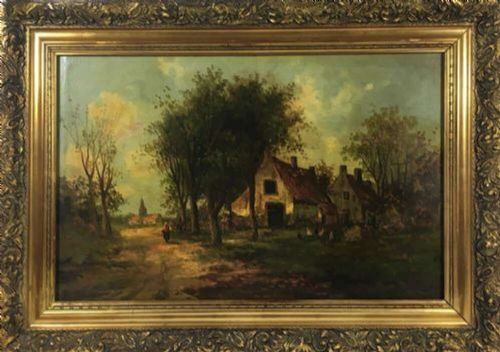


French Village Scene
These french village scene works capture rural life through the brush of Impressionism, Post-Impressionism and the Barbizon School, offering a tangible window into continental country communities.
French Village Scene
A french village scene typically depicts rural streets, market squares, and farming communities across France, recorded in paint or on paper. These works capture the rhythm of country life, from figures gathering winter fuel to quiet morning markets.
The pieces on this page span from the nineteenth century into the mid-twentieth century. You will encounter works executed in oil on canvas, watercolour, gouache, and even hand-painted porcelain plaques.
Stylistically, the selection moves from the naturalism of the Barbizon School through Impressionist light studies to post-impressionist and avant-garde interpretations. Each format offers a distinct perspective on the enduring character of rural France.
Materials and Techniques
Oil on canvas remains the dominant medium for these rural landscapes, allowing artists to build rich surface textures and deep tonal contrasts. Painters also worked with oil on board or utilised watercolour and gouache on paper to capture lighter, more immediate impressions of provincial life.
Framing forms an integral part of the physical object, with period pieces frequently housed in giltwood or gilded wood frames. These surrounds complement the painted surface and protect the fragile paper or canvas supports.
Periods represented in the historical record span from eighteen-sixty through the nineteen-forties.
What Separates the Best from the Rest
Quality rests in the confidence of the brushwork and the artist's ability to convey atmosphere rather than mere topographical detail. The finest examples demonstrate a sure command of light, colour harmony, and spatial depth, turning a simple street corner into a compelling study.
The standing of the artist and the integrity of the original support also dictate distinction. Works tied to recognised schools, named makers, or specific regional movements hold greater art-historical weight than anonymous student pieces.
Gaston Cornil·Mercedes Legrand·Joseph W Milliken·Robert McGregor·Maurice Asselin·Eugene Battaille·Martin Lamotte·Ferrandier·Maurice Vaumousse
The French Village Scene Glossary
- Barbizon School
- A nineteenth-century French art movement dedicated to realism in landscape painting, emphasising direct observation of nature. Painters associated with this group worked outdoors to capture the unidealised rural environment.
- Gouache
- An opaque water-based medium that provides denser, flatter colour than traditional watercolour. Artists often combine it with watercolour on paper to heighten luminous highlights.
- Post-Impressionism
- A predominantly French art movement developing roughly between the late nineteenth century and the early twentieth century. It extends impressionism while rejecting its limitations, focusing on more symbolic content and heavier weight of form.
- Giltwood
- Wood that has been coated with a thin layer of gold leaf or gilt powder. Antique frames treated this way provide a warm metallic border to paintings on canvas and paper.
French Village Scene: Frequently Asked Questions
What periods do these paintings cover?
The available selection spans from the nineteenth century through the interwar years and into the mid-twentieth century. You will find nineteenth-century Barbizon works alongside early twentieth-century impressionist and modernist interpretations.
This broad chronological range reflects how generations of artists returned to the same rural French subjects, shifting their techniques from academic realism toward more experimental palettes.
Are these works always executed on canvas?
While oil on canvas is common, artists also utilised paper, board, and even porcelain. Watercolours and gouaches on paper appear frequently alongside traditional oil paintings.
Support materials often dictate how the work should be displayed and framed, with paper pieces requiring careful protection under glass.
How do I identify a Barbizon influence?
Barbizon-influenced pieces typically focus on earthy tones, rural labourers, and moody atmospheric skies. These works prioritize a sincere engagement with the countryside over picturesque convention.
Look for loose, naturalistic brushwork that records the texture of fields, farmyards, and lone figures without unnecessary idealisation.
Where should I hang a framed watercolour?
Watercolours and works on paper demand protection from direct sunlight to prevent the pigments and gouache from fading. Hanging them in rooms with stable light levels and moderate humidity preserves the paper support.
Matching the period frame to the interior setting helps anchor these smaller provincial studies within a room.