
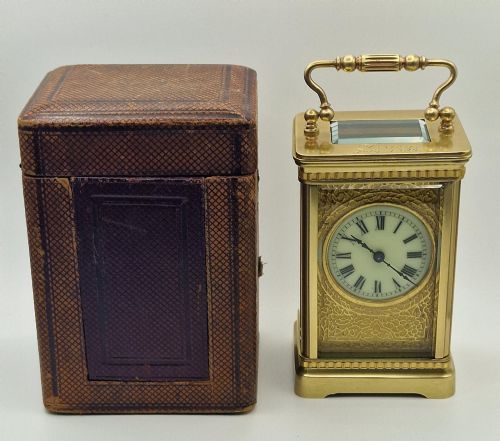
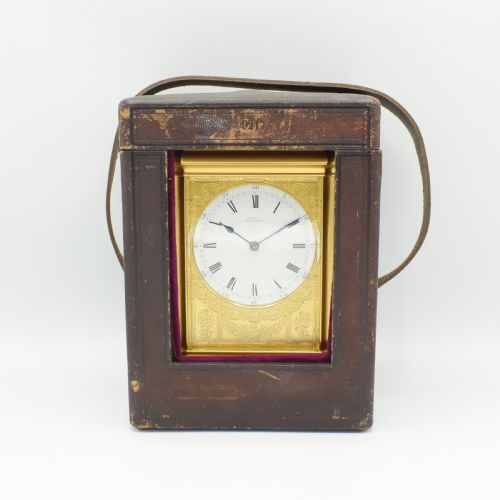
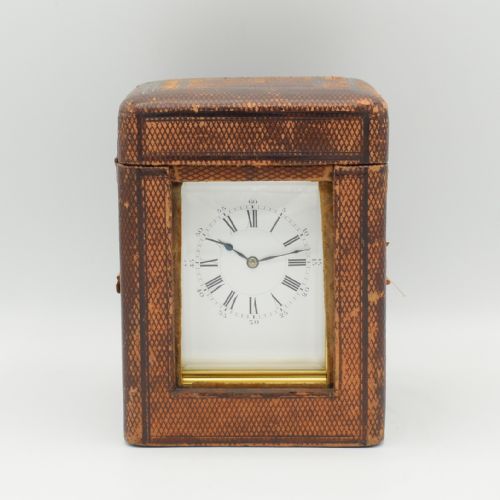
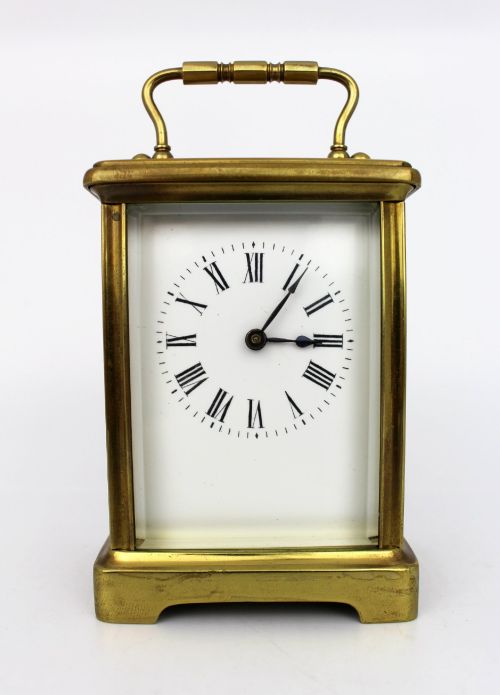


French Travelling Clock Case
A french travelling clock case protects portable timepieces built for journeys across the nineteenth and early twentieth centuries.
French Travelling Clock Case
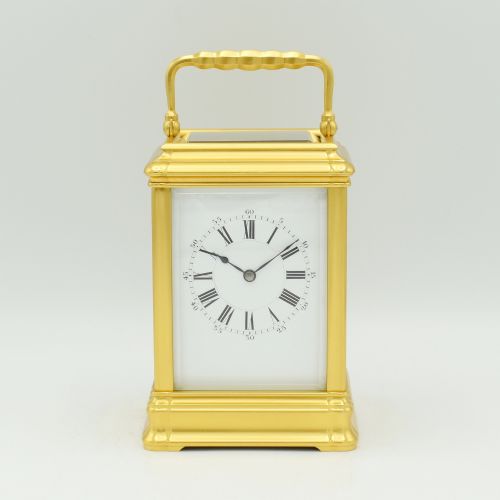
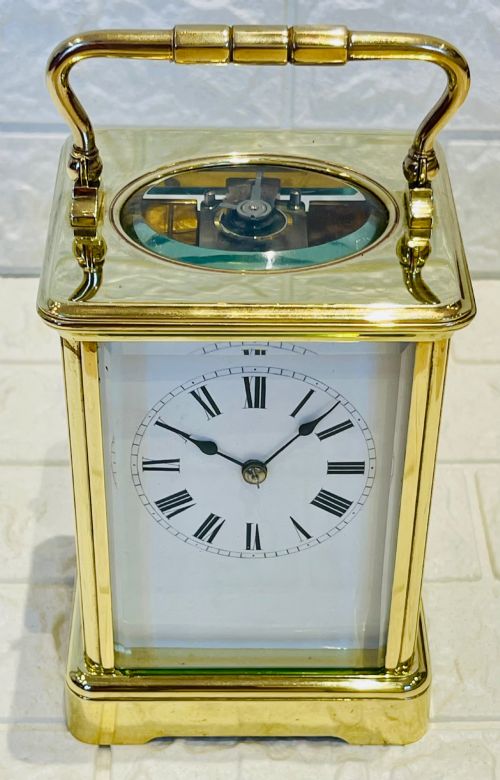
A french travelling clock case houses a portable timepiece designed for mobility during the nineteenth and early twentieth centuries. These protective vessels accompany carriage clocks through Victorian and Edwardian travels, preserving delicate mechanisms and glass panels.
The selections on this page span several decades from the mid-nineteenth century to the early twentieth century. Examples incorporate periods such as the Victorian era and styles including Rococo Revival and Art Deco.
Formations include rectangular gorge cases, miniature housings, and oval enclosures designed to fit specific clock dimensions. Many pieces accompany the original leather outer box or travel case.
Materials and Construction
Brass and gilt brass form the structural framework for the majority of these housings, often shaped into gorge or cast gilt profiles. Glass panels allow visibility of the movement within, whilst steel components reinforce interior mechanics.
Outer travel protection relies on fitted leather cases lined with velvet or silk to cushion the brass frames. Enamel details and intricate hand engraving frequently embellish the metal surfaces.
The documented periods span from the eighteen-sixties through to the Edwardian era.
Quality and Craftsmanship
Refinement in a french travelling clock case rests upon the crispness of the cast brass work and the depth of the hand engraving. Superior examples display fully engraved surfaces with sharp, precise lines rather than shallow or worn decoration.
The presence of an original matching leather travel box or outer case elevates the historical integrity of the piece. Quality also shows in the weight of the metal and the clarity of the fitted glass panels.
Henri Jacot·Drocourt·Antoine Redier·Margaine
The French Travelling Clock Case Glossary
- Gorge case
- A distinct rectangular brass case style featuring stepped mouldings at the top and base. This form is frequently seen on nineteenth-century French carriage clocks.
- Repeater
- A mechanism that chimes the hours and quarters on demand when a lever or button is pressed. This complication was essential for telling time in dark carriages.
- Petite sonnerie
- A striking system that automatically chimes the hours and the current quarter on the quarters without sounding the preceding hours. It represents a higher level of horological complexity.
- Enamel panel
- A decorative section fused with vitreous glass paste, often painted with numerals or scenes. These delicate panels require careful preservation.
- Gilt brass
- Brass treated with a thin layer of gold or gold-coloured wash to impart a bright metallic sheen. This finish protects the underlying metal from tarnishing.
French Travelling Clock Case: Frequently Asked Questions
What is a french travelling clock case?
A french travelling clock case is a protective housing made of brass, glass, and sometimes leather designed to safeguard portable clocks during transit. These enclosures keep delicate internal movements secure while allowing the dial to remain visible.
Craftsmen built these cases in various styles such as gorge and oval profiles during the nineteenth century. They served travellers moving across Europe by carriage or train.
How do I identify the period?
Dating relies on stylistic clues, case architecture, and maker marks stamped on the movement backplate. Victorian and late nineteenth-century examples often feature heavier brass castings and detailed hand engraving.
Later pieces from the early twentieth century incorporate simpler lines or different dial layouts. Comparing the case style with documented maker periods helps narrow down the decade of manufacture.
Were all clocks sold with travel cases?
Many fine carriage clocks were originally supplied with a matching outer leather case designed for journeys. These outer boxes protect the gilt brass framework from scratches during transport.
Surviving examples retaining their original leather outer box are particularly sought after by collectors. The interior lining usually mirrors the contours of the brass case.
How should I clean the brass?
Gilt brass surfaces require gentle dusting with a soft, dry cloth to remove surface particles. Avoid harsh commercial metal polishes that can strip away the original gilding.
Enamel panels and glass need careful wiping with a lint-free cloth. Professional conservation is recommended for tarnished or complex engraved areas.