

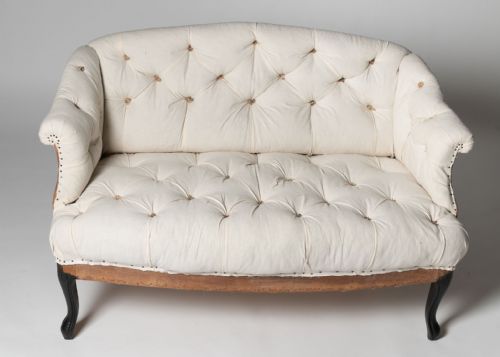


French Style Small Sofa
These French style small sofa examples bring compact seating into a room with painted finishes, giltwood frames and carved woodwork.
French Style Small Sofa
A french style small sofa provides intimate seating through forms such as two-seat settees, boudoir settees, love seats and small couches. These pieces appear across the nineteenth century, including Victorian periods, alongside specific years like eighteen-eighty, nineteen-hundred and nineteen-ten.
The most common versions on this page are nineteenth-century pieces bearing Louis XV style, Louis XVI style and Edwardian neoclassical revival characteristics. They often arrive as two-seat sofas or part of small suites that include matching armchairs.
Makers and designers drew on French chateau aesthetics, Swedish Empire influences and neoclassical traditions to shape these compact seats for smaller reception spaces and bedrooms.
How they were made
Frames take shape from solid hardwoods including walnut, beech, rosewood and giltwood, often finished with paint or intricate marquetry details. Workshops utilised cane work for panels alongside traditional upholstery covered in silk, blue velvet and patterned fabric.
Decorative elements incorporate brass trim and tassel trim to finish the edges of the upholstery. Artisans shaped the wood into flowing curves characteristic of Louis XV designs and the tighter geometry seen in neoclassical pieces.
French Style Small Sofa Retail Price Guide 2026
Typical asking prices for french style small sofa among the pieces listed under this phrase on Sellingantiques today, from the lower quarter to the upper quarter. They describe what is for sale here now, not the wider market.
Some nineteenth-century small sofas arrived with matching tassel trim to ensure the boudoir coordinated down to the last fringe.
What varies in quality
The distinction between standard examples and finer pieces rests upon the crispness of the wood carving and the depth of the giltwood or painted finish. Superior items display well-preserved hand-carved details on the frames and balanced proportions across the small scale.
Quality also shows in the integration of materials, where original canework remains intact and upholstery choices complement the period style rather than masking the structural woodwork beneath.
The French Style Small Sofa Glossary
- Canework
- Woven cane panels fitted into wooden frames, often seen on the backs or sides of seats. This technique lightened the visual weight of nineteenth-century furniture.
- Giltwood
- Timber coated with a thin layer of gold leaf or gilt paint to create a rich metallic surface. It defines the more ornate decorative pieces from this era.
- Marquetry
- Decorative veneer patterns applied to furniture surfaces using thin pieces of wood. It appears on companion tables within seating suites.
- Louis XV Style
- A decorative aesthetic marked by asymmetrical curves, organic plant motifs and cabriole legs. Pieces from this tradition avoid straight lines in favour of flowing contours.
French Style Small Sofa: Frequently Asked Questions
Where did people put a french style small sofa?
These compact seats served in smaller drawing rooms, boudoirs and bedrooms where full-scale seating would overwhelm the floor plan. They offered comfortable spots for conversation and dressing rooms.
Their scale made them versatile enough to sit against bedroom walls or within intimate seating groups alongside matching armchairs.
How do I identify a louis xv style frame?
Look for characteristic serpentine curves, cabriole legs and carved floral motifs that lack rigid symmetry. The wooden framework flows continuously from the crest rail down to the feet.
Painters and gilders highlighted these organic shapes with paint finishes or gold leaf to emphasise the decorative carving.
Are these sofas suitable for daily sitting?
Nineteenth-century seating handles regular use provided the internal webbing and upholstery support remain in sound condition. Many feature button-backed padding or silk and velvet covers designed for comfort.
Placement in low-traffic rooms or bedrooms helps preserve delicate silk fabrics and painted wooden frames over time.
What is the difference between a settee and a couch?
A settee typically describes a light, upholstered two-seat bench with a backrest and arms, built primarily for formal rooms. A couch often suggests a piece designed for more relaxed reclining.
In nineteenth-century rooms, these terms frequently overlapped when describing compact French-inspired seating furniture.