
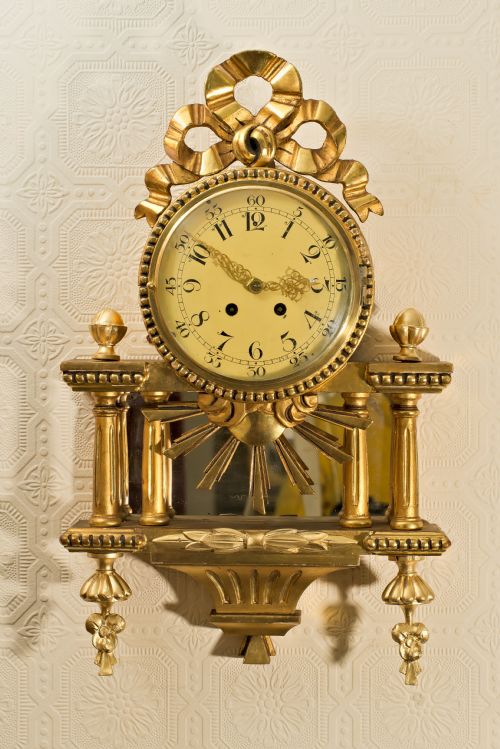


French Style Cartel Clock
A French style cartel clock brings exuberant ornament and precise domestic timekeeping to the wall, combining ornate metal or carved wood with traditional dialwork.
French Style Cartel Clock
A French style cartel clock is a wall-mounted timepiece characterised by ornate casework in gilt bronze, ormolu, or giltwood, designed to serve as a prominent decorative feature in a room. When you search for a French style cartel clock, you encounter pieces primarily from the nineteenth century alongside eighteenth-century originals and early twentieth-century interpretations. The examples most frequently met on this page span the Victorian era and the nineteenth century, reflecting revivals of Rococo and Louis XVI styles.
These wall clocks appear in various forms, ranging from large, substantial bronze models to carved wood and giltwood pieces. The styling draws heavily upon French Rococo and Louis XVI Neoclassical vocabulary, featuring scrolling foliage and asymmetrical or symmetrical cartouche shapes. They function as both mechanical timekeepers and sculptural wall art, historically positioned to command attention in grand interiors.
How they were made
Makers constructed the structural casework of a French style cartel clock using carved wood, giltwood, or cast metals including brass, bronze, and gilt metal. Ormolu and gilt bronze surface treatments provide the characteristic golden metallic lustre seen across many pieces, often paired with enamel components for the dial face.
The decorative schemes rely on intricate casting, chasing, and gilding techniques for the metal mounts, or hand-carving and gilding for the wooden frames. Glass protects the dial face, while mirror glass occasionally appears within the backplates or surrounding decorative elements of specific wall clock variants.
One persistent model repeats the phrase gilt metal cartel wall clock five times in a row, just in case you missed it.
What varies in quality
The quality of a French style cartel clock rests in the crispness of the metal chasing or the depth of the wood carving, which dictates how sharply the decorative motifs of the Rococo or Louis XVI styles are rendered. Heavy, substantial bronze or ormolu castings demonstrate superior substance compared to lighter gilt metal alternatives.
The refinement of the enamel dial, the integration of the movement within the case, and the preservation of the original gilding further distinguish the upper tier of pieces. Clocks produced by established makers or workshops display a greater harmony between the sculptural case and the horological housing.
WETTERSTRANDS·Perivale of England·Japy Freres
The French Style Cartel Clock Glossary
- Cartel clock
- A wall-mounted clock featuring an ornate frame made of metal, carved wood, or giltwood. These pieces were developed in France and designed to be hung directly on interior walls.
- Ormolu
- Finely ground high-carat gold applied to a bronze base using a mercury amalgamation technique, or modern electroplating. It provides a durable golden finish characteristic of high-end French decorative objects.
- Giltwood
- Timber, typically lime or pine, that has been carved and coated with a thin layer of gold leaf or gilt paint. This material offers a lighter alternative to cast bronze for large wall clock cases.
- Louis XVI style
- A neoclassical design aesthetic popular during the late eighteenth century and later revived in the nineteenth century. It is defined by symmetry, straight lines, urns, and classical architectural motifs.
- French Rococo
- A decorative style originating in the eighteenth century and revived in the nineteenth century, marked by asymmetrical scrolls, C-curves, naturalistic foliage, and shell-like motifs.
French Style Cartel Clock: Frequently Asked Questions
How do you hang a cartel clock?
A French style cartel clock requires a secure wall fixing, typically a heavy-duty screw or bracket suited to the weight of the bronze, ormolu, or giltwood case. Because many of these pieces are substantial in size, proper anchorage into wall studs or solid masonry is essential for safe suspension.
Once mounted, the clock must be plumbed correctly on the wall to ensure the pendulum swings evenly and the movement keeps accurate time. Consulting a professional horologist for installation and initial setup helps protect the historical case and delicate internal components.
What is the difference between Louis XV and Louis XVI styles?
Louis XV style clocks, often associated with French Rococo, feature flowing asymmetrical designs, C-scrolls, and naturalistic motifs like leaves and shells. The aesthetic prioritizes movement and curved lines over rigid geometric structures.
In contrast, Louis XVI style clocks embrace neoclassical symmetry, straight lines, urns, and classical architectural details. This later style reflects a return to order and classical restraint following the exuberance of the Rococo period.
Are these clocks mechanical?
Most antique French style cartel clocks operate via traditional mechanical movements driven by springs or weights, requiring periodic manual winding. The dials typically feature enamel chapters with Roman or Arabic numerals indicating the hours.
Because these movements are period mechanisms, they benefit from regular servicing by a qualified clockmaker to clean the gears and maintain proper lubrication. This mechanical nature distinguishes them from modern quartz timepieces.