
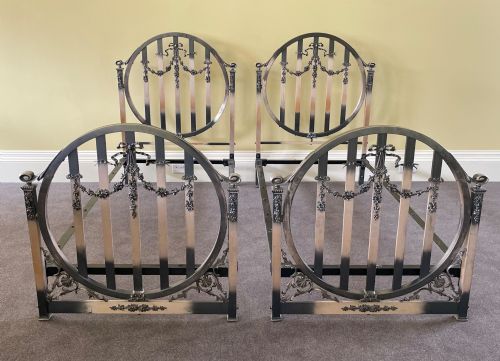


French Single Bed
A french single bed brings continental charm and compact proportions to a bedroom, offering a distinct alternative to standard British dimensions.
French Single Bed
When you search for a french single bed, you encounter a variety of narrower sleeping frames designed for individual use. These pieces often appear singly or as matching pairs, originating from continental Europe during the nineteenth and early twentieth centuries.
The selections available range from simple painted wooden no-end frames to ornate styles featuring carved walnut, gleaming brass, or upholstered headboards. Many examples reflect historical revivals, incorporating Louis XV, Louis XVI, or Empire design motifs.
Buyers frequently find these beds in forms such as standard bed frames, daybeds, and sleigh beds. The offerings span periods from the Victorian era and the late nineteenth century through to the art deco years of the 1930s.
How They Were Made
Cabinetmakers utilised timber such as walnut, mahogany, fruitwood, and pine, often shaping them with hand-carved details or smooth painted finishes. Iron and brass also played a prominent structural role, particularly in metal bedsteads and daybeds.
Surface ornamentation involved techniques like parcel gilt, parquetry, and hand-painted portrait panels, alongside applied bronze or ormolu mounts on finer wooden examples. Caning and upholstered panels provided textural contrast on headboards and footboards.
Some pairs of single beds come with instructions that they can be joined together, offering a flexible sleeping arrangement for antique enthusiasts.
What Varies in Quality
The standard of a french single bed rests on the crispness of its hand-carvings, the weight and finish of its cast metal mounts, and the integrity of its timber. Superior examples display thoughtful proportions and harmonious integration of decorative elements.
Materials dictate much of the character, from solid walnut and figured mahogany down to simpler painted pine. The finesse of original paintwork, hand-painted panels, or intricate brass casting separates standard utilitarian frames from more ambitious pieces.
The French Single Bed Glossary
- Bedstead
- The complete framework of a bed, including the headboard, footboard, and side rails. This term often appears when describing antique frames sold without modern mattresses.
- Daybed
- A couch-like piece of furniture with a back and one or two raised ends, suitable for both lounging and sleeping. These often appear in French period styles.
- Sleigh bed
- A bed style characterised by scrolled headboards and footboards that curve outward like a traditional horse-drawn sleigh. This form gained popularity during the nineteenth century.
- Corbeille
- A French term describing a bed with a rounded, enveloping headboard and footboard that curves inward toward the mattress. This shape provides an enclosed, cocoon-like sleeping area.
- Ormolu
- Gilded bronze used as a decorative mount on furniture. It adds metallic highlights to wood frames.
French Single Bed: Frequently Asked Questions
What size mattress fits a french single bed?
Continental single beds often vary slightly from standard modern British mattress dimensions. It is essential to measure the interior space of the wooden or metal side rails before purchasing a mattress.
Many antique frames accommodate custom or European single sizes rather than standard UK single dimensions, so checking the exact internal length and width is necessary.
Can these beds be used with modern bases?
Most antique bed frames require modern slatted bases or bespoke wooden supports to hold contemporary mattresses securely. Dealers frequently supply or adapt bases to fit within the antique side rails.
Ensuring the internal brackets or ledges can support a modern slatted system allows these older frames to function safely for everyday use.
How do I identify a Louis XVI style bed?
Louis XVI style pieces typically feature straighter lines, geometric symmetry, and neoclassical motifs like fluted columns and ribbon twists. This aesthetic contrasts with the more asymmetrical and curved lines of earlier Rococo designs.
Carved details on these beds often include classical architectural elements, laurel wreaths, and urns executed in painted wood or walnut.
Are painted finishes usually original?
Some pieces retain their original painted surfaces, showing authentic patination and gentle wear from age. Others have received later decorative paint layers in neutral tones like cream or grey.
Examining the surface closely helps reveal whether the paint has accumulated natural craquelure and minor chips consistent with nineteenth-century or early twentieth-century origins.