


French Satinwood Commodes
These French satinwood commodes bring polished veneer and classical lines to a room, offering both display surface and concealed storage.
French Satinwood Commodes
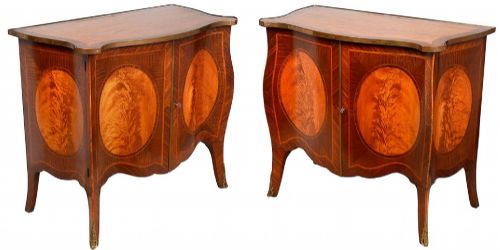
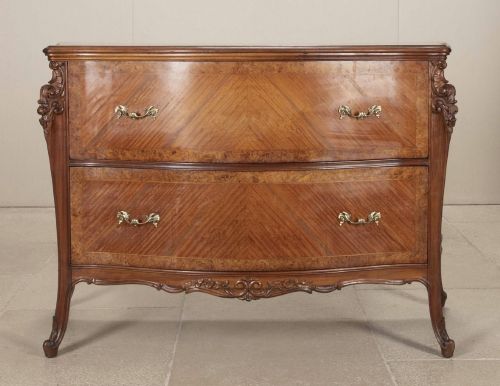
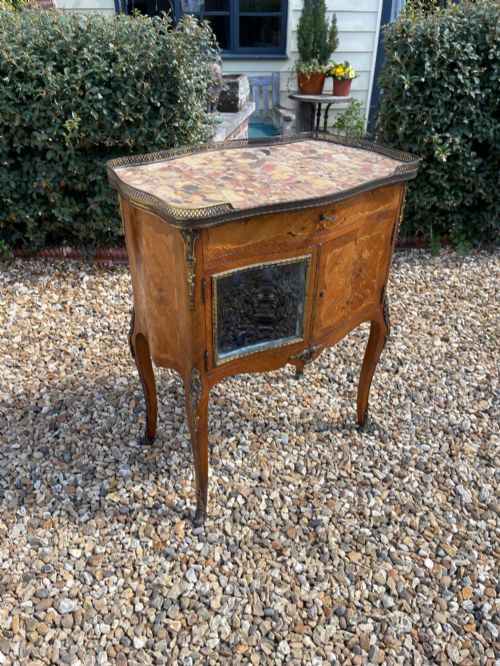
French satinwood commodes span several centuries of cabinet-making, from the eighteenth century to twentieth-century revivals. When you search for french satinwood commodes, you encounter forms that range from serpentine chests of drawers to bedside cabinets and secretaire chests.
The pieces appearing here include items designed in the Louis XVI transitional manner, Sheraton revival styles, and French Provincial taste. These items function as decorative storage furniture in bedrooms and drawing rooms alike.
How they were made
Cabinet-makers constructed these carcasses using hardwoods like walnut, mahogany, and burr walnut as a foundation for delicate satinwood veneers. Artisans applied intricate inlay work, sometimes incorporating rosewood, tulipwood, and kingwood alongside harewood.
Many examples incorporate polished marble tops and cast brass or ormolu mounts to accent the framework. Selected pieces feature painted decoration, while others rely on the natural grain pattern of the timber for visual depth.
Design styles represented in the current selection range from French Rococo Revival and Sheraton Revival to Neoclassical and Louis XVI transitional forms.
What varies in quality
Quality rests upon the precision of the veneer work and the crispness of any inlaid details across the body. Superior examples display seamless integration between the timber panels and the structural mounts.
The choice of secondary woods and the weight of the marble top also distinguish finer output. Well-executed classical proportions elevate an ordinary chest into a notable piece of cabinet-making.
Edmond Poteau·Kaufman
The French Satinwood Commodes Glossary
- Satinwood
- A dense, lustrous timber native to tropical regions, prized for its golden sheen and smooth texture. It takes a high polish and serves as the primary decorative veneer on these cabinets.
- Ormolu
- Gilded bronze used for decorative mounts, feet, and keyhole escutcheons on case furniture. It protects vulnerable corners and adds metallic contrast to the timber surface.
- Serpentine
- A front contour characterised by a gentle double curve, convex in the centre and concave at the sides. This shape requires advanced woodworking skill to veneer successfully.
- Transitional
- A design phase bridging the heavy curves of rococo and the straight geometry of neoclassicism. Pieces from this era blend flowing lines with rectilinear architectural structure.
French Satinwood Commodes: Frequently Asked Questions
Where should I place a commode?
These cabinets suit hallways, drawing rooms, or bedrooms where surface space and enclosed storage are both needed. Their decorative veneers work well against plain walls.
Keep them away from direct sunlight and strong heat sources to protect the polished wood finish from fading or drying out.
How do I care for satinwood?
Dust the surface regularly with a soft, dry cloth and avoid using silicone-based polishes or harsh chemical cleaners. Wax can be applied sparingly to maintain the sheen.
Maintain a stable room humidity to prevent the underlying timber and delicate veneer layers from shifting or cracking.
What is a transitional design?
The transitional style marks the design shift between Louis XV curves and Louis XVI straight lines. Cabinets from this period combine restrained shapes with classic mounts.
This aesthetic offers a balanced look that coordinates easily with both older and contemporary interiors.
Are marble tops original?
Many period commodes feature fitted marble slabs designed to provide a durable, decorative surface for the cabinet top. These stones vary in colour and veining depending on the era.
Inspect the edges and underside to understand how the marble integrates with the wooden frame.