




French Restoration Hall Table
A French restoration hall table brings architectural presence into an entranceway, offering solid timber construction paired with cool stone surfaces.
French Restoration Hall Table
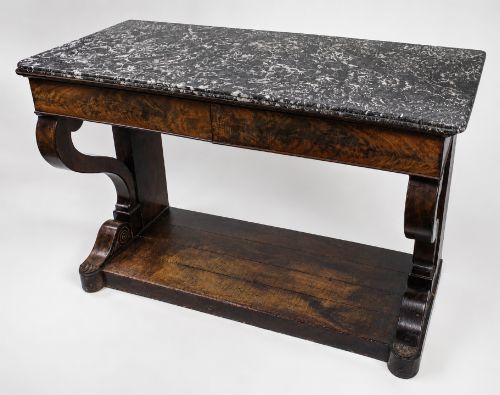
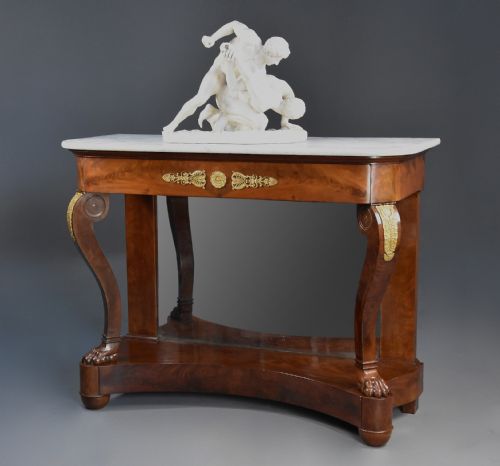
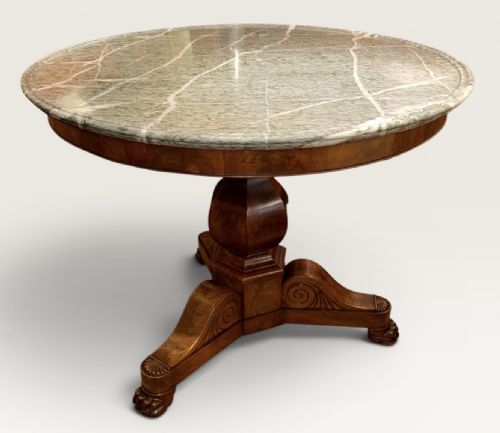
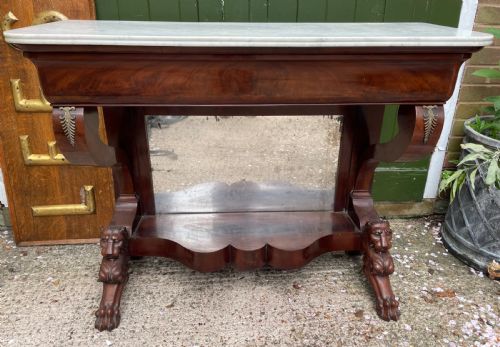
A french restoration hall table encompasses console tables, pier tables, and gueridons originating from the nineteenth century. These forms reflect the design vocabulary of the French Empire, French Restoration, and Charles X periods.
Console tables and pier tables are the most frequent variations encountered on this page, designed to stand flat against a wall in a hallway or drawing room.
Gueridon centre tables also appear, providing a freestanding circular surface suited to the middle of a room. The material palette spans mahogany, flame mahogany veneer, walnut, and satinwood, frequently finished with marble tops.
How they were made
Cabinet makers utilised dense timber foundations of mahogany, walnut, and satinwood, often applying figured veneers such as flame mahogany across broad surfaces. These structural timbers were shaped and joined using traditional nineteenth-century woodworking techniques.
Heavy marble slabs were cut and fitted to form the primary tabletops on console variations, providing a smooth and durable functional surface. Metal elements in ormolu and bronze were cast and applied to punctuate the woodwork.
What varies in quality
The selection of timber grain dictates visual impact, with highly figured flame mahogany and richly patterned satinwood representing superior material choices. Plain timber surfaces offer a simpler aesthetic compared to deeply figured veneers.
The integration of heavy marble tops and cast ormolu mounts determines the refinement of the piece. Clean stone edges and crisp metal ornamentation distinguish the finest examples from simpler utilitarian forms.
The French Restoration Hall Table Glossary
- Console table
- A table designed to stand against a wall, frequently supported by front legs or brackets while securing to the vertical surface.
- Gueridon
- A freestanding circular centre table, originating in seventeenth-century France and remaining popular through the nineteenth century.
- Ormolu
- Gilt bronze ornamentation applied to furniture, created by fusing a gold-mercury amalgam onto a bronze base.
- Flame mahogany
- Mahogany veneer exhibiting a distinctive flickering flame-like grain pattern, prized for its decorative visual movement.
- Carrara marble
- A type of white or blue-grey marble quarried in Italy, frequently utilised for classical tabletop surfaces.
French Restoration Hall Table: Frequently Asked Questions
Where should I place a french restoration hall table?
These tables suit narrow entrance halls, corridors, and reception spaces where a wall-mounted console fits neatly without blocking movement. Freestanding gueridon variants work best positioned in the centre of a room to hold a lamp or floral arrangement.
Ensure the floor is level so the heavy timber frame and stone top settle securely against the wall or floor surface.
How do I care for a marble tabletop?
Wipe the stone surface regularly with a soft, damp cloth and mild soap, avoiding acidic cleaning products that etch marble. Use coasters beneath glasses to prevent moisture rings from forming on the porous stone.
Treat the timber base separately with appropriate furniture wax, keeping it away from direct heat sources to prevent wood splitting.
What is the difference between a console and a gueridon?
A console table is built with a flat back to sit flush against a wall, often supported by two front legs and secured for stability. A gueridon is a round table built to stand freely in the open space of a room.
Both forms belong to the nineteenth-century French aesthetic but serve entirely different spatial functions within an interior.
How do I identify a Charles X table?
Charles X pieces date from the 1820s and 1830s, displaying clean architectural lines that departed from earlier heavier styles. They frequently combine dark mahogany or satinwood with contrasting marble tops and restrained decorative mounts.
Look at the leg construction and veneer selection to determine if the piece fits this specific French period.