

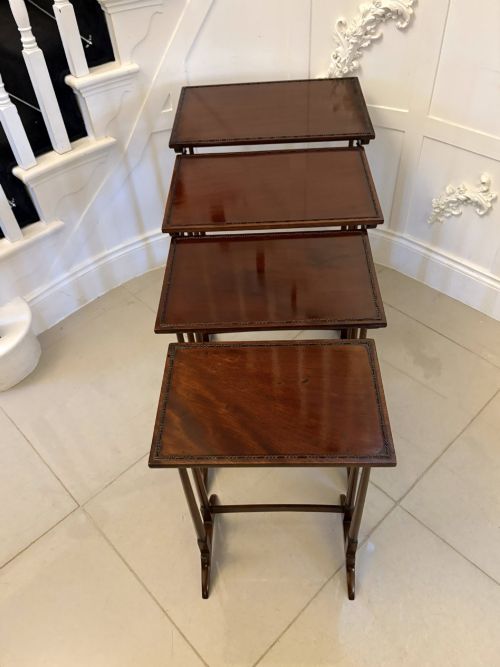


French Nest of Tables
These French nest of tables are ingenious sets of stacking occasional surfaces that solve space problems with grace.
French Nest of Tables
A french nest of tables brings together sets of three or four graduated surfaces designed to slide neatly beneath one another when floor space is at a premium. Buyers searching this phrase encounter varying configurations spanning the nineteenth century through the mid twentieth century, including Edwardian interpretations and pieces from the nineteen twenties and forties.
Origins stretch from nineteenth century workshops to early twentieth century Parisian output, with occasional brass trolley variations and quartetto formats. These tables function together as a unified set yet separate easily to serve guests across a room.
What Varies in Quality
The distinction between standard production and exceptional work rests on the precision of the timber matching and the crispness of the parquetry. Superior examples exhibit seamless jointing that allows each table to slide smoothly into its neighbour without binding.
The quality of surface enrichment, from hand painted floral motifs to cast ormolu mounts and signed maker signatures, separates standard sets from notable pieces of furniture.
French Nest of Tables Retail Price Guide 2026
Typical asking prices for french nest of tables among the pieces listed under this phrase on Sellingantiques today, from the lower quarter to the upper quarter. They describe what is for sale here now, not the wider market.
The documented periods span from the nineteenth century through the nineteen forties, encompassing Edwardian and Art Deco movements.
Émile Gallé·Maison Baguès·E.Daligny
The French Nest of Tables Glossary
- Kingwood
- A dense, richly figured timber native to Brazil, prized for its dark purple and brown contrasting stripes in fine French cabinetry. It frequently forms the top veneer on decorative tables.
- Ormolu
- Gilded bronze mounted to furniture as decorative enrichment, cast and chased by hand to add metallic contrast to wood surfaces. It characterises revival and luxury pieces.
- Parquetry
- Geometric wood mosaic work formed by small veneer tiles arranged in repeating patterns such as cubes or chevrons. It creates a textured decorative surface on table tops.
- Quartetto
- A traditional term for a set of four stacking tables designed to nest together. These sets graduate in size so the smaller tables slide underneath the largest.
- Art Nouveau
- A decorative style from the late nineteenth and early twentieth centuries defined by flowing, organic lines and plant motifs. It appears on carved wooden tables from this era.
French Nest of Tables: Frequently Asked Questions
How were French nest of tables used?
These tables served primarily as occasional furniture in drawing rooms and salons, where multiple surfaces were needed for tea, writing, or lamps.
Servants or hosts would separate the nesting pieces to place drinks or books beside guests before sliding them back into a single compact footprint.
How do I live with them?
Place the master table against a wall or beside a sofa, keeping the smaller tables tucked underneath until extra surface area is required for entertaining.
Protect the polished wood or glass tops from excessive moisture and direct sunlight to preserve the delicate veneers and parquetry.
How do I tell periods apart?
Look to the decorative vocabulary and construction methods, as nineteenth century examples often feature heavier floral painting while Edwardian and nineteen twenties pieces lean towards lighter marquetry or Art Nouveau curves.
Art Deco sets from the nineteen forties adopt cleaner geometric lines distinct from ornate Louis revival styles.
Are all nesting tables French?
While the search phrase specifies French origin, design influences crossed borders during the Edwardian era and early twentieth century, resulting in British quartetto sets sharing similar proportions.
Authentic French examples typically display specific timber choices like kingwood and distinct parquetry or ormolu mounts associated with Parisian workshops.