






French Modern Art Painting
A French modern art painting brings twenty-century avant-garde energy and colour directly to a wall.
French Modern Art Painting
A french modern art painting encompasses canvas and panel works created across the early decades of the twentieth century. These pieces capture the transition toward abstraction, cubism, and surrealism through the lens of continental artists.
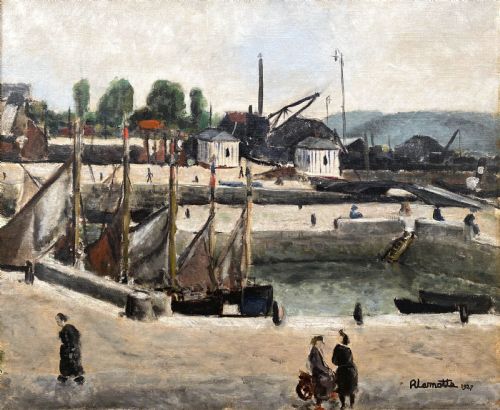
The selections on this page draw heavily from the nineteen-twenties through the nineteen-sixties. Buyers encounter Parisian street scenes, abstracted landscapes, and figurative compositions executed with distinct modernist vigour.
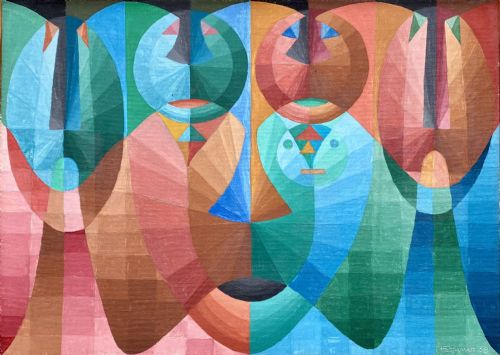
Oil on canvas remains the dominant format, supported by gouache and watercolour on paper or board. Smaller panel works sit alongside large-scale panoramic cityscapes and dynamic geometric abstractions.
Materials and methods
Artists relied primarily on oil paint applied to woven canvas stretched over wooden frames, or directly onto prepared wooden panels. This combination allowed for rich impasto textures and layered colour mixing that endure across the decades.
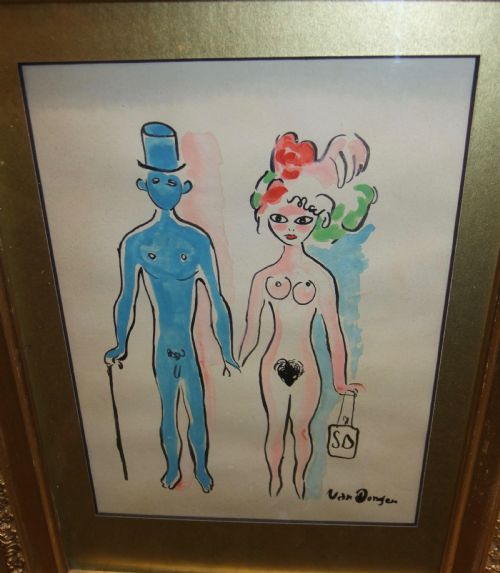
Works on paper utilise gouache and watercolour media, often combined with ink or pencil underdrawings to define sharp edges. Board supports provide a rigid flat ground suited to swift, opaque applications of pigment in surrealist still lifes.
Materials documented across the inventory include oil paint, gouache, watercolour, wood panels, and woven canvas supports.
Assessing quality
Quality rests in the sureness of the brushwork and the ambition of the composition. Stronger examples display confident handling of light and form, whether depicting a bustling Parisian quay or a stark geometric interior.
The distinction between standard decorative work and a superior piece lies in the cohesion of the palette and the distinctiveness of the modernist vision. Well-preserved surfaces retain their original vibrancy without excessive intervention or restoration.
Ron Folland·Jean Hippolyte Marchand·Jeffrey Pratt·Yo Mayer·Kees van Dongen·Hermoine Hammond·Yves Brayer
The French Modern Art Painting Glossary
- Cubism
- An early twentieth-century avant-garde art movement that revolutionised European painting by breaking subjects down into faceted geometric planes.
- Gouache
- An opaque water-based paint that dries to a matte finish, frequently used on paper or board for works requiring flat areas of vibrant colour.
- Impasto
- Paint applied thickly to a canvas or panel, leaving distinct brush or palette knife marks that stand out in relief from the surface.
- Mid-Century Modern
- A style spanning roughly from the nineteen-thirties to the nineteen-sixties characterised by clean lines and abstracted forms.
- Surrealism
- A cultural movement that sought to release the creative potential of the unconscious mind, producing dreamlike scenes and symbolic still lifes.
French Modern Art Painting: Frequently Asked Questions
How do I date a modern French painting?
Dating relies on stylistic shifts, exhibition labels, and artist signatures recorded alongside the canvas. Works from the nineteen-twenties often lean toward cubist fragmentation, whereas nineteen-sixties pieces embrace op art and bold abstraction.
Material analysis of the stretcher frames and canvas weaves also helps confirm the period of creation. Signatures should be compared against known exemplars from the specific decade.
Where should I hang a large cityscape?
Large Parisian street scenes and industrial harbour views require substantial wall space with balanced ambient lighting. Placing them in a principal reception room allows the scale and palette to anchor the surrounding interior.
Avoid direct, harsh sunlight to protect oil pigments and paper supports from fading over time. Picture lights mounted above the frame enhance the texture of the brushwork.
Are gouache works on paper fragile?
Works executed in gouache on paper or board require careful framing behind protective glazing to prevent surface abrasion. They are sensitive to moisture and light fluctuations, demanding stable indoor environments.
Professional mounting using acid-free materials ensures the paper does not buckle or discolour. With correct framing, these vibrant pieces remain stable for generations.
What defines the French School style?
The French School encompasses diverse modernist approaches developed in Paris studios by international and local artists alike. It bridges traditional representation with experimental colour theories and abstracted forms.
Works within this category reflect the lively exchange of ideas among avant-garde painters working in shared urban quarters.