



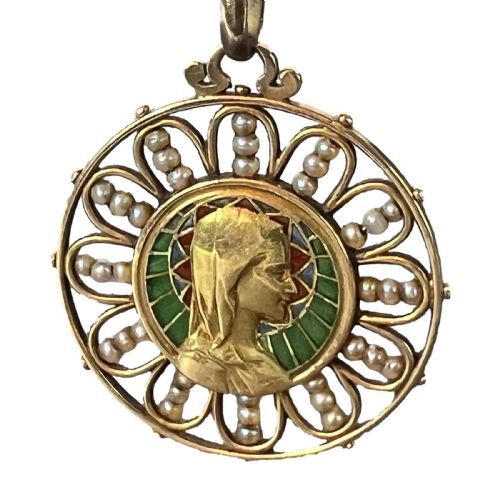
French Mary Pendant
A french mary pendant carries centuries of devotional devotion, combining delicate metalwork with sacred imagery.
French Mary Pendant
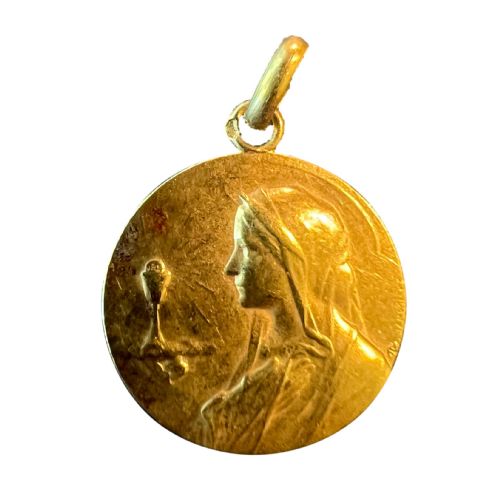
A french mary pendant represents a devotional jewel centred on the Virgin Mary or the Madonna and Child, originating primarily from workshops across France between the late nineteenth and mid twentieth centuries. These pieces take the form of round or oval medals and charms intended for personal wear, often associated with specific sanctuaries or miraculous traditions.
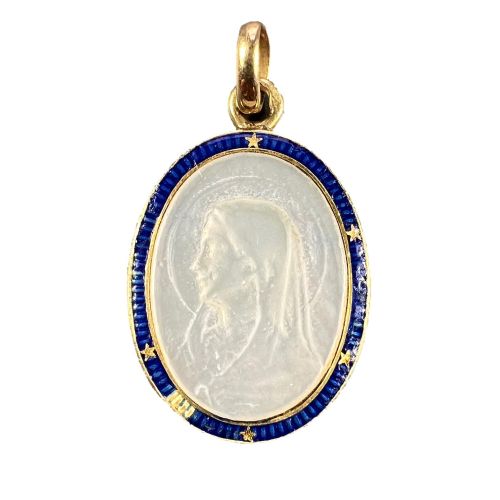
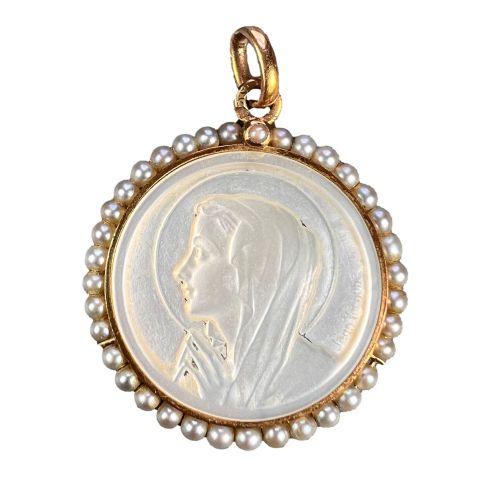
The version most commonly encountered on this page is an eighteenth karat yellow gold medal bearing a detailed relief of the Virgin Mary, frequently accompanied by subsidiary motifs such as seed pearls, enamel, or mother of pearl backing. Such items span various stylistic movements including Art Nouveau and French religious revivalism, reflecting the aesthetic preferences of their period.
Collectors encounter these objects as pendants, charms, or medal necklaces designed to be suspended from fine chains. Their construction ranges from simple engraved discs to elaborate framed compositions incorporating transparent enamelling techniques.
How they were made
Goldsmiths utilised eighteen karat yellow, rose, and white gold to cast or stamp the primary medal bodies, often finishing the surfaces with hand engraving or pierced openwork. Mother of pearl was frequently carved into thin backing plaques to catch the light behind translucent enamel or pierced gold motifs.
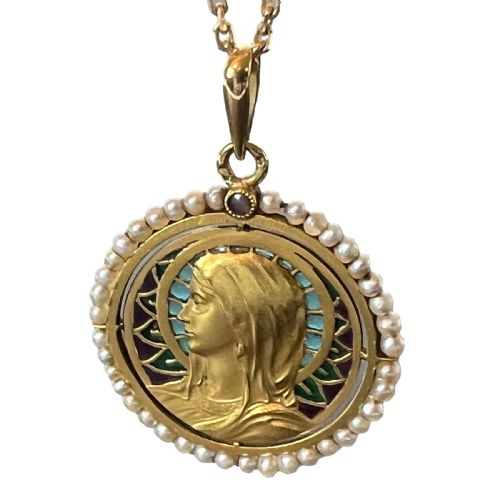
Enamelling techniques played a central role in surface decoration, particularly plique a jour, which creates a stained glass effect without a solid backing metal. Seed pearls were meticulously drilled and pinned or sewn onto the gold mounts to accent borders and halos surrounding the sacred figures.
French Mary Pendant Retail Price Guide 2026
Typical asking prices for french mary pendant among the pieces listed under this phrase on Sellingantiques today, from the lower quarter to the upper quarter. They describe what is for sale here now, not the wider market.
Listings span periods from eighteen ninety through to nineteen fifty, dominated by eighteen karat yellow gold and plique a jour enamel.
What varies in quality
Material combination also distinguishes tiers of workmanship, particularly the complexity of the enamel work and the uniformity of the seed pearls. Pendants featuring intact plique a jour enamel or carefully matched mother of pearl indicate higher levels of artisanal skill.
Emile Monier·Pageli Perriat·Emile Dropsy·Sellier·Mazzoni·Becker·Pageri Perroud·Arnault·Monet·Ruffony·Augis
The French Mary Pendant Glossary
- Plique-a-jour
- An enamelling technique where enamel is applied in cells without a backing, allowing light to shine through transparent colours. This method resembles miniature stained glass.
- Medal
- A flat piece of metal struck or cast with a commemorative or religious design, often fitted with a suspension loop to serve as a pendant.
- Seed pearl
- A very small, naturally formed pearl, often used in clusters or borders around central gemstones and metalwork in antique jewellery.
- Mother of pearl
- The iridescent inner layer of mollusc shells, carved and polished for use as a decorative background or inlay material.
- Art Nouveau
- A stylistic movement characterised by organic, flowing lines and natural motifs, influential in European decorative arts around the turn of the twentieth century.
French Mary Pendant: Frequently Asked Questions
What is a french mary pendant?
A french mary pendant is a devotional gold medal or charm depicting the Virgin Mary, produced by French jewellers and medallists.
These pieces served as personal expressions of faith and remembrance, often carrying specific religious titles or imagery.
How were these pendants worn?
They were suspended from fine gold chains around the neck as protective amulets or devotional tokens.
Many examples include integrated loops or suspension rings designed specifically for daily wear.
How do I identify the period?
Dating relies on stylistic clues such as Art Nouveau curves or the specific treatment of the gold and enamel.
Maker marks and French assay hallmarks stamped on the metal also provide clear chronological markers.
What materials are common?
Eighteen karat yellow gold forms the primary structural foundation for almost all examples.
Secondary materials frequently include seed pearls, mother of pearl panels, and vitreous enamel.