


French Mantle Candlesticks
These French mantle candlesticks bring classical weight and bright metal to a mantelpiece, offering heavy ormolu, bronze, and glass to anchor a room.
French Mantle Candlesticks
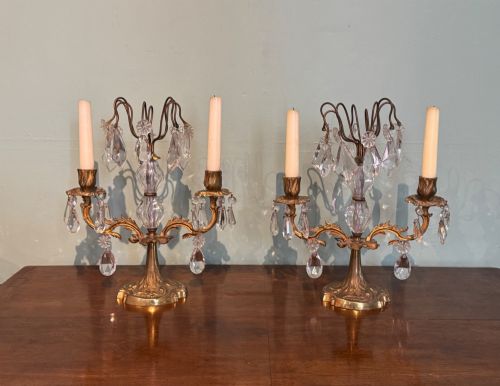
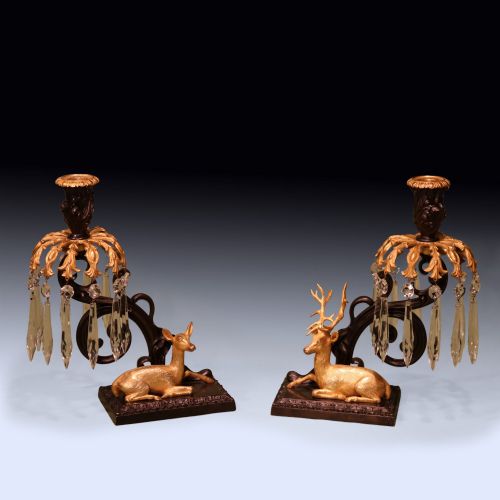
French mantle candlesticks comprise pairs of decorative candle holders and multi-branch candelabra designed for display on a mantelpiece. When searching for french mantle candlesticks, buyers encounter items dating from the nineteenth century, including Regency, Victorian, and later periods around nineteen thirty. These pieces frequently incorporate figural elements such as stags, does, cherubs, and caryatid shafts.
The forms range from single candlesticks to three-branch candelabra and clock garniture sets. Materials include gilt bronze, ormolu, patinated bronze, brass, marble, cut glass, and cut crystal. Many examples feature lustre drops that catch and refract candlelight.
How they were made
Makers utilised cast bronze, brass, and ormolu, employing patination and fire-gilding techniques to achieve contrasting metallic surfaces. Gilt bronze and ormolu provide bright, reflective highlights, while patinated bronze offers dark, matte contrast on figural shafts.
Many items combine metalwork with carved marble bases and precision-cut glass or crystal components, including hanging lustre drops. Cloisonné enamel and biscuit porcelain occasionally appear as decorative insets within the metal framework.
Listings feature items from the nineteenth century, including Regency, Victorian, and nineteen-thirties periods, executed in gilt bronze, ormolu, and cut glass.
What varies in quality
The weight of the casting and the clarity of the cut glass or crystal lustre drops separate standard production from more ambitious workshop output. Complete sets with matching components and intact fire-gilding sit at the higher end of the range.
Finnigan Manchester
The French Mantle Candlesticks Glossary
- Ormolu
- Gilded bronze produced by applying a mercury and gold amalgam to a bronze base and heating it. This technique creates a durable, luminous golden surface characteristic of fine nineteenth-century metalwork.
- Lustre
- A glass or crystal pendant hung from the nozzle or drip pan of a candlestick to refract light. Lustre drops add sparkle and movement to Regency and Victorian lighting.
- Candelabra
- A branched candlestick holding multiple candles on separate arms. These pieces often feature a central shaft flanked by symmetrical candle cups.
- Garniture set
- A matched group of decorative objects, typically a mantel clock flanked by a pair of candlesticks or candelabra. They were designed to sit together on a fireplace mantel.
- Caryatid
- A sculpted female figure serving as an architectural support in place of a column. In these pieces, they form the central shaft of the candlestick.
French Mantle Candlesticks: Frequently Asked Questions
What is a clock garniture?
A clock garniture is a matched set consisting of a mantel clock and a pair of matching candlesticks or candelabra. These sets were designed to sit together as a decorative unit on a fireplace mantel.
The pieces share matching materials, styles, and decorative motifs, creating a unified display across the chimney breast.
How do I spot Regency pieces?
Regency pieces often display clean neoclassical lines, frequent use of bronze and ormolu, and glass lustre drops. They date from the early nineteenth century and lean toward restrained classical forms.
Look for crisp casting, patinated bronze contrasting with bright gilt highlights, and symmetrical arrangements that reflect the period's interest in antiquity.
Where did lustre candlesticks go?
Lustre candlesticks were placed on mantelpieces, side tables, and chests of drawers where candle flames could illuminate the room. The hanging glass drops caught and multiplied the flickering light.
They served both as practical lighting devices and as decorative status objects in formal nineteenth-century interiors.
What is patinated bronze?
Patinated bronze is metal that has been chemically treated to produce a dark, matte surface finish. This treatment protects the bronze and provides a deep, non-reflective background.
In these pieces, dark patinated bronze frequently contrasts with bright gilt ormolu mounts to highlight figural details and architectural elements.