






French Mantel Piece Clock
A French mantel piece clock brings the weight of nineteenth-century reception rooms onto a shelf, offering sculptural metal and stone alongside audible time.
French Mantel Piece Clock
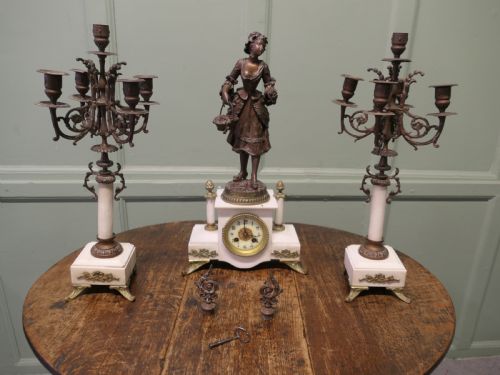
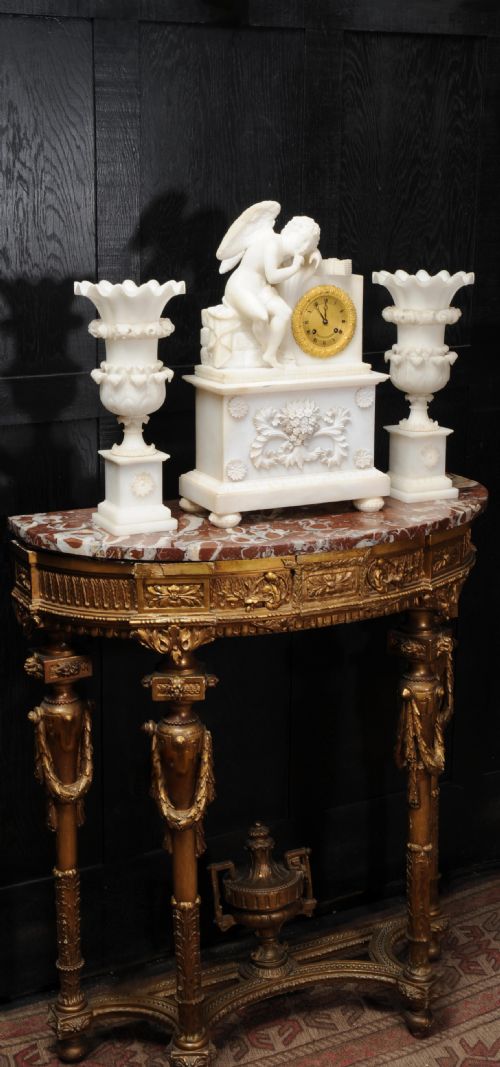
A French mantel piece clock search opens up heavy architectural timepieces alongside matched three-piece garniture sets featuring flanking candelabras or urns. You will encounter nineteenth-century interpretations spanning neoclassical Louis XVI lines up to geometric Art Deco creations.
The material palette runs heavily to marble, slate, and onyx, often mounted with cast bronze, gilt brass, or ormolu. Porcelain components from Paris factories and KPM Berlin appear frequently within multi-piece sets.
Solitary mantel clocks sit alongside complex garniture arrangements designed to anchor the centre of a fireplace surround. The eras represented stretch from mid-nineteenth-century Victorian production into the twentieth century.
Materials and construction methods
Foundry cast bronze and gilt metal provide the structural mounts and figures that adorn stone cases, utilising intricate chasing and gilding techniques. Enamel dials carry delicate numerical markings beneath protective glass bezels.
Heavy natural stones such as rouge marble, black slate, and white marble are sawn, turned, and polished to form the architectural bodies of the clocks. Porcelains are painted and glazed before being fitted into brass and ormolu mounts.
French Mantel Piece Clock Retail Price Guide 2026
Typical asking prices for french mantel piece clock among the pieces listed under this phrase on Sellingantiques today, from the lower quarter to the upper quarter. They describe what is for sale here now, not the wider market.
Materials recorded across the inventory include black slate, white marble, cloisonné, enamel, and gilt bronze.
Distinctions in craftsmanship and execution
The crispness of the bronze chasing and the weight of the marble body separate ordinary production from finer examples. Hand-painted porcelain panels and detailed figural bronzes indicate higher ambition in the workshop.
Movement complexity marks another tier, distinguishing standard striking mechanisms from quarter-repeating carriages or multi-train garniture movements signed by notable makers.
Henry Marc·Finnigan Manchester·Le Roy et Fils à Paris·Ferdinand Berthoud·Japy Freres
The French Mantel Piece Clock Glossary
- Garniture
- A matched set consisting of a central clock flanked by decorative objects such as candelabras or urns. These arrangements were designed to balance mantelpieces and sideboards.
- Ormolu
- Finely ground high-carat gold mercury-gilded onto a bronze base. This technique produces a deep, durable metallic lustre found on superior nineteenth-century mounts.
- Rouge marble
- A rich red decorative limestone with white and grey calcite veins. It provides a striking, colourful base for bronze and gilt metal clock cases.
- Cloisonné
- An enamelwork technique where thin metal strips are soldered to a base to create cells filled with coloured paste and fired. It appears on dials and decorative case elements.
French Mantel Piece Clock: Frequently Asked Questions
How do I wind a French mantel piece clock?
Use the correct winding key gently on the dial arbor holes until you feel resistance. Turn slowly to avoid over-tensioning the internal springs.
Ensure you do not force the mechanism past its natural stop point to protect the escapement.
What is a clock garniture set?
A garniture set includes a central timepiece accompanied by matching side ornaments like candelabras or vases. They create a unified display across a mantelpiece.
These sets gained immense popularity during the Victorian and Napoleon III periods for formal reception rooms.
How do I tell different periods apart?
Look to the overall silhouette and decorative motifs for chronological clues. Neoclassical pieces feature urns and strict symmetry, while Art Deco examples display clean geometric lines.
Materials also shift over decades, moving from heavy carved marbles to sleeker onyx and silvered bronzes.
Where should I place a heavy marble clock?
Position the clock on a stable, level surface capable of supporting considerable stone and bronze weight. A secure mantelpiece or sturdy sideboard prevents accidental tipping.
Keep the piece away from direct heat sources and damp walls to protect the internal brass movement.