




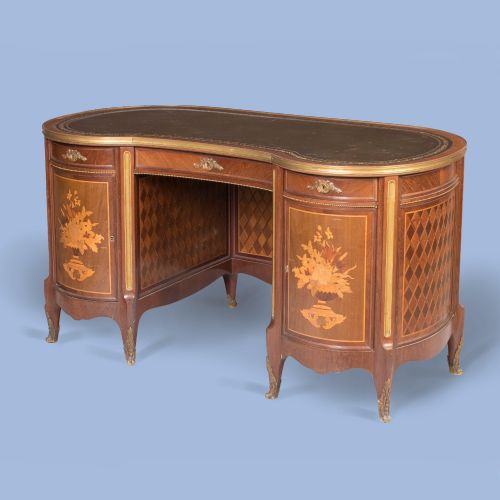

French Kidney Desk
A french kidney desk offers a sweeping curve designed to sit comfortably against the body while you write.
French Kidney Desk
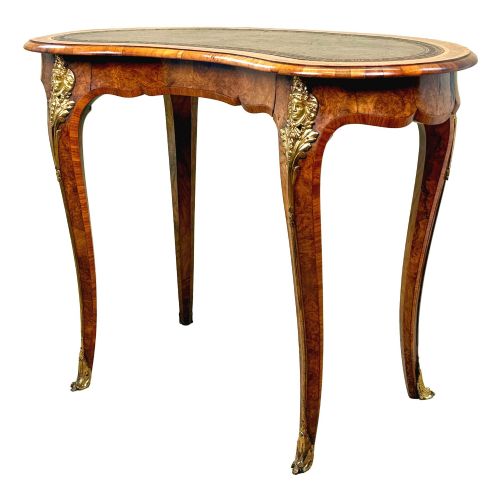
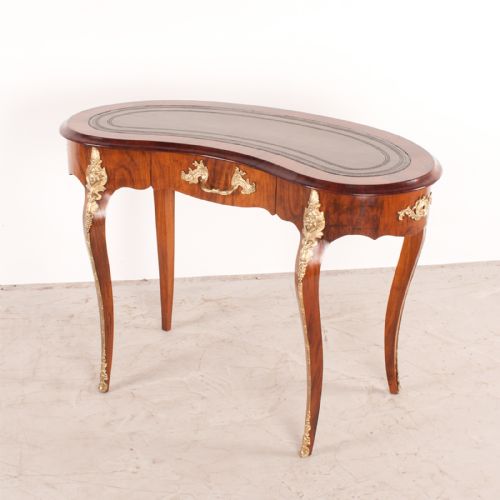
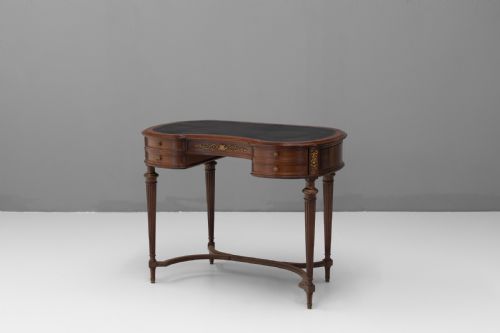
A french kidney desk is a distinctive writing surface defined by its curved, bean-shaped silhouette that accommodates the seated user. You will encounter these pieces executed in nineteenth-century revivals, including Louis XV and Louis XVI styles, alongside Victorian interpretations.
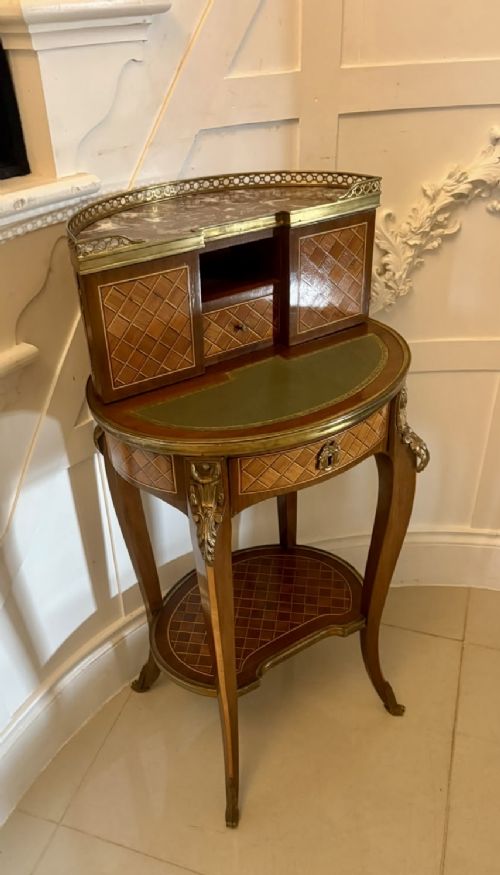
The form appears as freestanding writing tables, occasional pieces, or fitted writing desks equipped with leather inserts. Many examples integrate marquetry or parquetry patterns across the top and sides, reflecting French chateau aesthetics.
Makers utilised characteristic serpentine outlines that allow the furniture to sit centrally in a room rather than flat against a wall. The scale ranges from compact lady's writing desks to larger library tables designed for formal reception rooms.
Materials and construction methods
Cabinetmakers constructed these frames using rich timbers such as kingwood, burr walnut, rosewood, and mahogany as veneers over sturdy carcass woods. Artisans applied intricate marquetry inlay and geometric parquetry to the curved surfaces, requiring precise hand-cutting of diverse wood species.
Gilt bronze ormolu mounts typically accent the edges, feet, and drawer friezes, providing structural reinforcement and ornamental contrast to the dark polished timbers. Inset writing surfaces utilise worked leather panels, bordered by blind tooling, while select variations incorporate marble tops.
French Kidney Desk Retail Price Guide 2026
Typical asking prices for french kidney desk among the pieces listed under this phrase on Sellingantiques today, from the lower quarter to the upper quarter. They describe what is for sale here now, not the wider market.
The curved silhouette was originally engineered so eighteenth-century writers could avoid twisting their spines while reaching for ink.
Assessing quality and craftsmanship
The distinction between standard and exceptional pieces rests upon the crispness of the cast ormolu mounts and the intricacy of the wood veneers. Superior examples display seamless parquetry alignment across the difficult curves of the kidney shape.
Finer desks maintain finished backs, indicating they were built to stand free in the middle of a room, whereas simpler versions rely on plain secondary woods for hidden areas. The depth of figuring in the burr walnut or kingwood also dictates the visual weight and desirability of the construction.
The French Kidney Desk Glossary
- Kidney desk
- A writing table shaped with an inward curve on the operational side, mirroring the bean shape of a human kidney. This silhouette first gained popularity in eighteenth-century France before revival periods.
- Ormolu
- Gilt bronze mounts cast and chased by hand to ornament the corners, legs, and aprons of fine furniture. The technique involves applying a gold-mercury amalgam to bronze before firing.
- Parquetry
- Geometric wood inlay composed of small, precisely cut veneer tiles forming patterns like cubes or chevrons. Craftsmen used this technique to decorate tabletops and drawer fronts.
- Kingwood
- A dense, richly grained tropical timber featuring dark violet-brown tones with lighter streaks. It was frequently employed by cabinetmakers for high-status French veneer work.
- Marquetry
- Pictorial or abstract designs formed by assembling various fine wood veneers onto a ground surface. This method creates floral or scrollwork motifs across the writing surface.
French Kidney Desk: Frequently Asked Questions
How do I use a french kidney desk?
The curved indentation allows you to sit close to the centre of the board while keeping your writing materials within easy reach. They function effectively as freestanding centrepieces in a study or drawing room.
Because finished veneers often cover all sides, you can position the furniture away from walls to display the ormolu mounts and inlay from any angle.
What periods do these desks date from?
Most examples originate from the nineteenth century, spanning Victorian interpretations and continental revivals of Louis XV and Louis XVI styles. Cabinetmakers during this era drew heavily on eighteenth-century aesthetics.
Production continued into the early twentieth century, producing decorative dressing tables and occasional desks that mirrored earlier chateau designs.
Are all kidney desks freestanding?
Many examples are finished on the reverse side with matching veneer or inlay, indicating they were intended to be viewed in the middle of a room. This freestanding capability defined much of the nineteenth-century production.
Simpler variations may feature plain secondary timbers on the back, suggesting they were originally placed against a wall or within a specific alcove.
What is a bonheur du jour?
A bonheur du jour is a small lady's writing desk featuring a superstructure of small drawers and pigeonholes on top of the main writing surface. This elevated compartment was designed for holding stationery and letters.
When combined with the kidney shape, this form creates a compact workstation that prioritises decorative elegance alongside writing utility.