

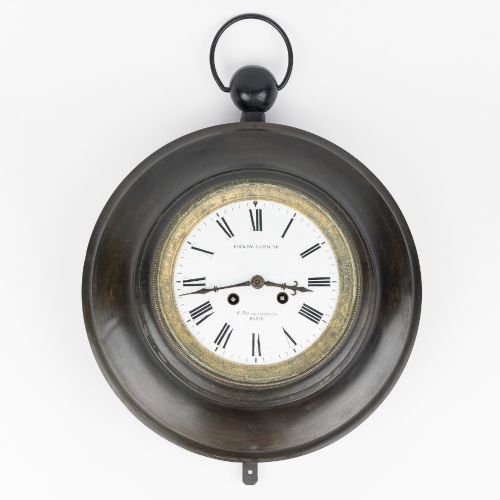


French Industrial Clock
These french industrial clock examples combine mechanical ingenuity with striking engineering aesthetics, bringing robust metalwork and precise movement into the home.
French Industrial Clock
When you search for a french industrial clock, you encounter mechanical timepieces and related dials originating from the nineteenth and early twentieth centuries. These pieces reflect an era fascinated by engineering, incorporating architectural salvage, railway themes, and heavy machinery motifs into domestic and public timekeeping.
The selections available here span diverse utilitarian forms, including large tower clock faces, enamel turret dials, wall clocks, and intricate desk compendiums. Many of these objects adopt novel shapes such as lighthouses, miners lamps, and beam engines, demonstrating the period's taste for mechanical demonstration.
Victorian novelty designs and later Art Deco electric models dominate the aesthetic landscape of these listings. Buyers find both monumental station dials and smaller desk-sized mechanical marvels constructed from heavy industrial materials.
Construction and materials
Makers built these pieces using robust combinations of brass, iron, steel, and copper, often mounted on slate or marble bases for stability. Glass protects delicate dials and exposed mechanisms, while silvered metal and enamel provide high-contrast surfaces for legible numerals.
The construction relies heavily on architectural salvage techniques and specialised metalworking, producing heavy housings designed to endure industrial or railway environments. Movement plates and gears utilise precision brass cutting, contrasting with the heavier structural iron and copper elements.
French Industrial Clock Retail Price Guide 2026
Typical asking prices for french industrial clock among the pieces listed under this phrase on Sellingantiques today, from the lower quarter to the upper quarter. They describe what is for sale here now, not the wider market.
Listings feature items spanning the Victorian era through the 1930s, utilising brass, iron, marble, and glass.
Assessing quality in french industrial clock items
Quality separates through the complexity of the movement and the integrity of the original industrial housing rather than mere decorative flourish. Finer examples display sophisticated automation, such as working beam engines or lighthouse mechanisms, integrated smoothly into the overall design.
The grade of materials also dictates the standing of a piece, with heavy cast bronze, thick bevelled glass, and pristine enamel dials holding greater mechanical authenticity. The presence of identifiable maker signatures elevates a piece from standard utility to documented horological art.
Guilmet·Charvet·Lepaute Paris·ATO
The French Industrial Clock Glossary
- Compendium
- A multi-functional desk object combining a clock with instruments such as barometers or thermometers. These were popular in nineteenth-century offices and studies.
- Turret Clock
- A large clock designed to be mounted on a tower, featuring an oversized dial visible from a distance. They often utilised heavy exterior weatherproofing.
- Automaton
- A mechanical figure or moving part that performs an action in time with the clockwork. Beam engine clocks often incorporate these moving pistons.
- Dials
- The face of the clock showing hours and minutes. Enamel and silvered metal versions offer distinct aesthetic finishes.
- Industrial Series
- A category of novelty desk pieces produced by makers like Guilmet mimicking machinery. They translate heavy factory equipment into domestic scale.
French Industrial Clock: Frequently Asked Questions
What is a french industrial clock?
A french industrial clock is a timepiece or large dial from the nineteenth or early twentieth century styled after heavy machinery, architecture, or transport infrastructure. These objects range from massive railway wall clocks to intricate desk automata.
They reflect an era when engineering and mechanical progress were celebrated through decorative arts. Collectors prize them for their combination of robust utility and intricate internal mechanics.
How were beam engine clocks used?
Beam engine clocks served as decorative desk pieces that mimicked the reciprocating motion of industrial steam engines. They sat on desks and mantelpieces to display mechanical ingenuity.
While they told time, their primary purpose was to entertain and impress viewers with visible moving pistons and rods driven by the clockwork.
How do I identify Art Deco models?
Art Deco models from the 1920s and 1930s feature cleaner geometric lines and often incorporate early electric movements rather than traditional weights or springs. They transition from Victorian mechanical novelty to streamlined modernity.
Look for simplified typography on enamel or metal dials and pared-down industrial housings designed for modern factories or offices.
Where were turret clock faces displayed?
Turret clock faces originally mounted high on the exterior walls of factories, railway stations, or municipal towers to broadcast time to the public. Their large scale ensured visibility from across yards and streets.
Today, these salvaged dials function as architectural wall art in domestic or commercial interiors, retaining their weathered patinas.