
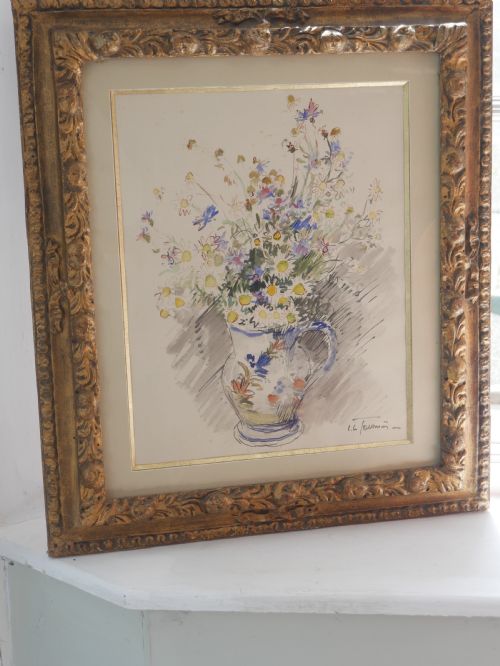


French Impressionist Floral Art
French impressionist floral art brings vibrant colour and expressive brushwork into a room, capturing light and nature through oil paintings.
French Impressionist Floral Art
French impressionist floral art focuses on capturing fleeting moments of natural light upon garden blooms, wildflowers and arranged bouquets. These works showcase the deliberate play of sunlight and shadow, transforming simple botanical subjects into studies of pure colour and atmosphere.
Most pieces encountered on this page take the form of oil paintings on canvas, panel or metal, spanning periods from the late nineteenth century through to the mid twentieth century. Buyers will frequently find still life compositions featuring roses, anemones and water lilies, alongside vibrant cottage garden scenes.
The tradition encompasses varied approaches within the French School, moving from classical realism toward expressive French Modernism and Pointillist techniques. Each work reflects the maker's specific engagement with texture, tone and the immediate visual impact of natural floral forms.
How they were made
Artists typically applied oil paint directly to stretched canvas, prepared wooden panels or metal supports using visible, confident brushstrokes. This technique allowed painters to build texture and capture the vibrant interplay of light across petals and leaves.
Frames often complement the paintings through carved giltwood or gesso finishes, which enhance the visual depth of the artwork. The combination of traditional oil paint and supportive wooden frameworks ensured the lasting stability of these colourful compositions.
Listings feature oil paint applied to canvas, wood panels, paper and metal supports.
What varies in quality
Quality rests upon the artist's ability to manipulate light and shadow to create a convincing sense of atmosphere and depth within a still life or garden scene. Stronger works demonstrate a confident handling of pigment that brings vitality to the blooms without relying on rigid detail.
The cohesion of the palette and the expressive weight of the brushwork distinguish the finest pieces from more conventional decorative paintings. Harmony between the subject matter and the surrounding frame also contributes to the overall integrity of the piece.
Jules Felix Ragot
The French Impressionist Floral Art Glossary
- Impressionism
- A nineteenth century painting style focused on capturing the visual impression of a moment, especially regarding shifting light and spontaneous brushwork. This approach prioritises overall atmosphere over precise botanical accuracy.
- Still Life Painting
- An artwork depicting inanimate subject matter, typically featuring natural objects such as cut flowers in vases, baskets or pots. These compositions allow artists to experiment closely with form, colour and light.
- Oil on Canvas
- A traditional painting medium where oil based pigments are applied to a woven fabric support stretched across a wooden frame. This combination allows for rich texture and flexible layering of colour.
- Pointillism
- A technique involving small, distinct dots of pure colour applied in patterns to form an image. When viewed from a distance, these dots blend together to create vibrant luminous effects.
- Gesso
- A plaster mixture used as a smooth base applied to wood or canvas before painting, or moulded onto frames to create decorative relief details. It provides a durable surface that holds gilt and pigment securely.
French Impressionist Floral Art: Frequently Asked Questions
What subjects do these paintings feature?
These artworks predominantly depict floral subjects, including garden flowers, potted plants, and arranged bouquets in vases or baskets. Water lilies and cottage blooms also appear frequently in the compositions.
Artists focused on natural settings and interior scenes, often incorporating everyday objects alongside the flowers to create balanced, atmospheric still life arrangements.
How should I hang and light these paintings?
Display these works away from direct, harsh sunlight to protect the oil pigments and canvas over time. Gentle ambient lighting helps to reveal the subtle textures and brushwork characteristic of impressionist techniques.
Pairing the painting with a compatible room interior allows the vibrant colours of the florals to complement surrounding furnishings without overwhelming the space.
What periods do these artworks cover?
The pieces span from the late nineteenth century through the mid twentieth century, capturing decades of evolving French artistic styles. Works range from early impressionist and realist approaches to later modernist interpretations.
This timeline reflects a continuous tradition of floral painting in France, where artists continually reinvented how light and colour interact on canvas or panel.
What supports were used for these paintings?
Artists utilised traditional materials such as canvas stretched over wooden frames, mahogany panels, and metal supports. Each type of surface influenced how the oil paint was applied and how the final texture appeared.
Wooden panels and metal sheets provided rigid surfaces for detailed or experimental brushwork, while stretched canvas offered flexibility and traditional texture.