




French Horology Timekeeper
These pieces of french horology timekeeper encompass the brass carriage clocks and mantel clocks of the nineteenth and early twentieth centuries.
French Horology Timekeeper
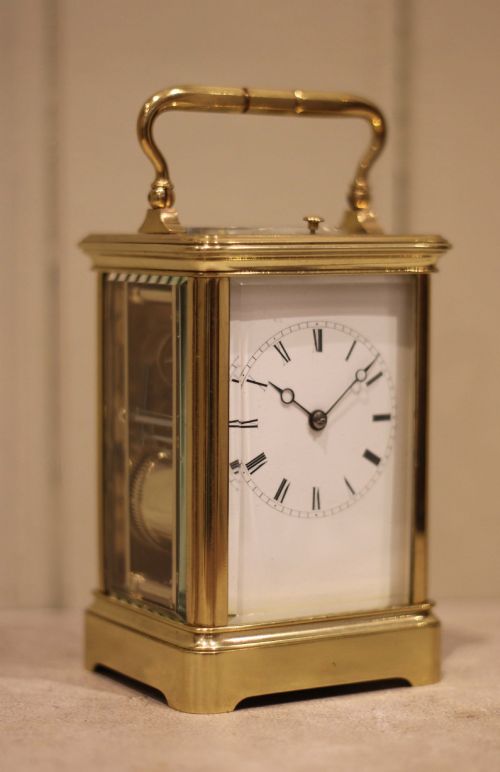
When you search for french horology timekeeper, you encounter portable and domestic timepieces originating from France during the nineteenth century and the Edwardian period. The most common form on this page is the brass carriage clock, housed in cases such as the gorge or corniche style.
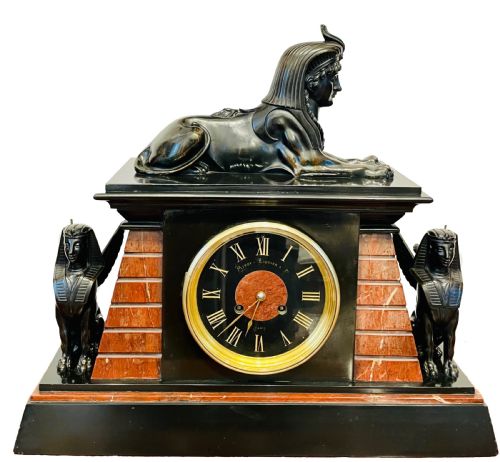
The selection also includes mantel clocks featuring styles like Egyptian Revival and Victorian maritime designs, alongside specialised striking and repeating movements. These objects reflect the sophisticated mechanical output of French and Parisian workshops during the eighteen-fifties through to nineteen hundred.
Materials and construction
Makers utilised heavy brass and gilt brass frameworks to house intricate steel gear trains, often framing the dials and movements with bevelled glass panels. Heavier architectural examples incorporate contrasting black slate and marble.
Details are further enhanced through applied bronze elements and enamelled chapter rings or dials. The resulting construction balances structural rigidity with the visibility required for portable mechanical timekeepers.
Several of these small travelling clocks retain their original carrying cases, ready for nineteenth-century journeys.
Evaluating quality and execution
Quality in these timekeepers rests on the precision of the movement and the weight of the metal case. Heavier gilt bronze and solid brass corniche or gorge housings indicate superior production standards compared to lighter counterparts.
The integration of complicated striking and repeating mechanisms, alongside signed dials from established makers, elevates the status of an individual piece within the range of nineteenth-century horology.
Drocourt Paris·Bishop Bournemouth·Dwerrihouse And Bell·Bourdin Paris
The French Horology Timekeeper Glossary
- Carriage clock
- A small, spring-driven portable clock designed for travel during the nineteenth century. These items typically feature a glass-panelled brass case and a swinging platform escapement.
- Gorge case
- A distinct stepped rectangular brass housing style frequently seen on nineteenth-century carriage clocks. This form frames the glass panels securely within heavy moulded pillars.
- Corniche case
- A traditional rectangular carriage clock case design featuring simple rounded or cavetto mouldings at the top and bottom. It remains one of the standard enclosures for French brass timepieces.
- Striking and repeating
- A movement mechanism that sounds the hours and quarters automatically, and repeats the last struck time when a lever or button is pressed. This complication adds mechanical depth to the clock.
French Horology Timekeeper: Frequently Asked Questions
What is a french horology timekeeper?
It is a mechanical clock originating from France, predominantly taking the form of a portable brass carriage clock or a decorative mantel clock.
These objects utilise spring-driven movements and date primarily from the nineteenth century up to the Edwardian era.
How do carriage clocks work?
Carriage clocks rely on a mainspring and a platform escapement rather than a traditional pendulum, which allows them to keep time while being transported.
Many examples include additional gear trains to strike the hours or repeat the time on demand.
Where were these clocks made?
The majority of these pieces were produced in France, with many specific workshops and retailers operating out of Paris.
Some English retailers also retailed these French movements, adding their own signatures to the dials.
How do I identify the period?
Periods are identified through case styles, such as the heavy corniche or gorge brass frames of the mid to late nineteenth century, and specific decorative motifs.
References to Egyptian Revival or Edwardian design elements also help narrow down the date of manufacture.