


French Gold Virgin Mary
A french gold virgin mary piece combines devotional artistry with warm metalwork, offering wearers a tangible link to continental religious heritage.
French Gold Virgin Mary
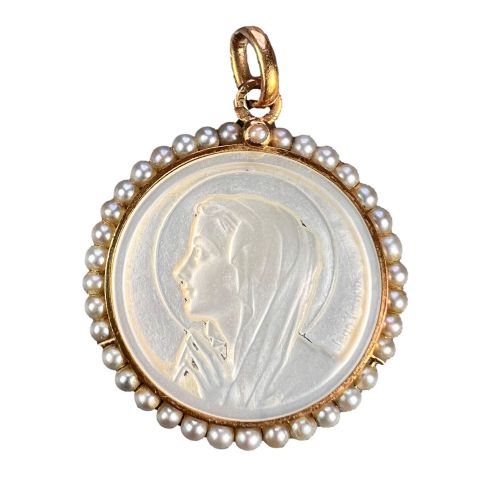
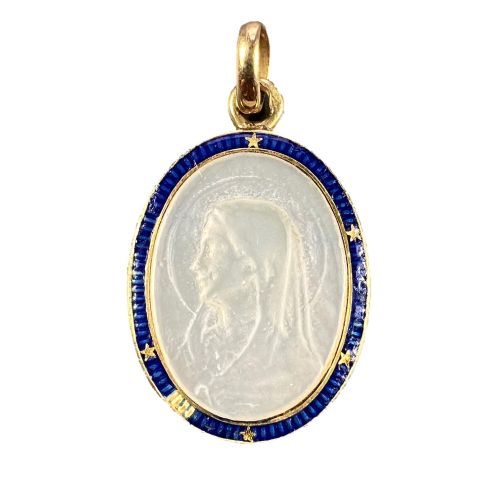
When searching for a french gold virgin mary, buyers encounter a distinct category of devotional jewellery spanning the nineteenth and twentieth centuries. The selection centres primarily upon pendants, charms, and religious medals designed to be worn close to the heart.
Most examples originate from French workshops operating between eighteen-ninety and nineteen-fifty, reflecting styles from Art Nouveau to mid-century devotional design. Forms range from simple oval medals to intricate framed charms depicting the Madonna and Child.
The category also encompasses occasional fine art pieces such as oil paintings housed within traditional display domes. Yet the wearable pendant remains the dominant form found across these listings.
How they were made
Goldsmiths utilised eighteen-carat yellow, rose, and white gold as the primary structural medium for these devotional objects. This high purity metal provided a rich, warm foundation capable of holding fine engraving and secure stone settings.
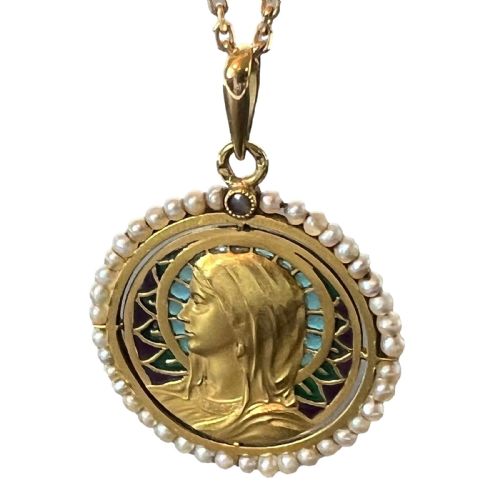
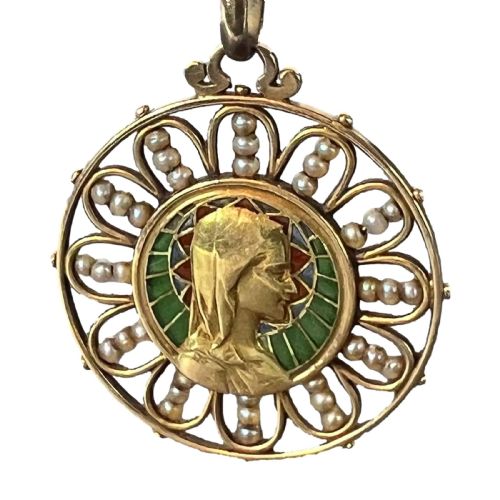
Artisans incorporated delicate decorative techniques such as plique-à-jour enamel, which creates a translucent stained-glass effect without a solid backing. Mother of pearl inserts and seed pearls frequently accented the gold work, adding texture and luminous contrast to the religious iconography.
Several makers clearly kept spare halo stamps handy, applying divine geometry with steadfast continental precision.
What varies in quality
The complexity of the surrounding ornamentation marks the upper tiers of the craft. Pieces featuring intact plique-à-jour enamel work or handset seed pearls demand higher levels of technical mastery than plain polished gold discs.
Emile Monier·Pageli Perriat·Emile Dropsy·Sellier·Mazzoni·Becker·Pageri Perroud·Arnault·Augis
The French Gold Virgin Mary Glossary
- Plique-a-Jour
- An enamelling technique where pigment is fired in open cellular wire frames without a backing metal, allowing light to pass directly through the colour. This method resembles miniature stained glass and requires exceptional skill from the enameller.
- Miraculous Medal
- A specific devotional oval medal design originating from nineteenth-century apparitions, featuring standardised imagery of the Virgin Mary standing upon a globe. Collectors prize these for their precise traditional iconography and widespread historical significance.
- Seed Pearl
- Tiny natural or cultured pearls utilised in jewellery design for delicate borders and floral motifs. Their uniform small scale creates subtle, shimmering textures against polished gold surfaces.
- Globe de Marie
- A nineteenth-century French decorative dome used to house religious statues, oil paintings, or devotional mementos. These glass enclosures protected sacred artwork while displaying it prominently within domestic interiors.
- Madonna and Child
- An artistic representation depicting the Virgin Mary holding the infant Jesus. This central motif appears frequently in devotional medals across various twentieth-century artistic movements.
French Gold Virgin Mary: Frequently Asked Questions
How do I identify the period of a medal?
Dating relies heavily on stylistic markers present in the metalwork and surrounding ornamentation. Pieces exhibiting flowing, organic lines typically align with Art Nouveau aesthetics from around nineteen-ten.
Simpler geometric framing or different gold hues often point towards later decades such as the nineteen-twenties and thirties. Maker marks and assay stamps on the gold bail also assist in establishing a precise timeframe.
Were these medals worn daily?
Historical evidence suggests these pendants served as deeply personal items worn regularly by their original owners. The durable nature of eighteen-carat gold made them suitable for everyday wear as protective amulets or necklaces.
Many examples show gentle softening of the raised relief, indicating decades of tactile interaction and consistent daily use.
What does plique-a-jour enamel look like?
Plique-à-jour resembles miniature stained glass where the enamel spans open spaces within a gold wire framework. When light strikes the pendant, the translucent colour glows brightly without any opaque backing metal.
This technique creates a vibrant, luminous backdrop behind the gold figure of the Virgin Mary, adding remarkable depth to the small composition.