
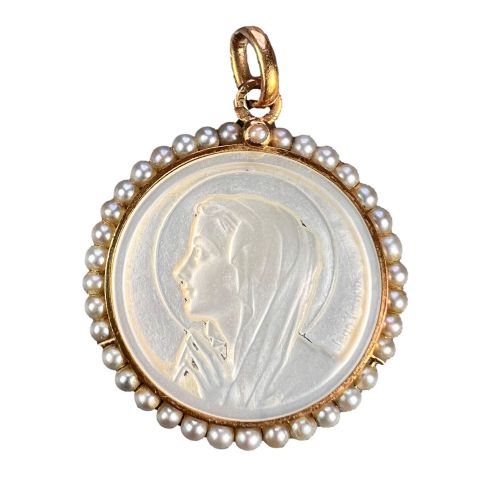
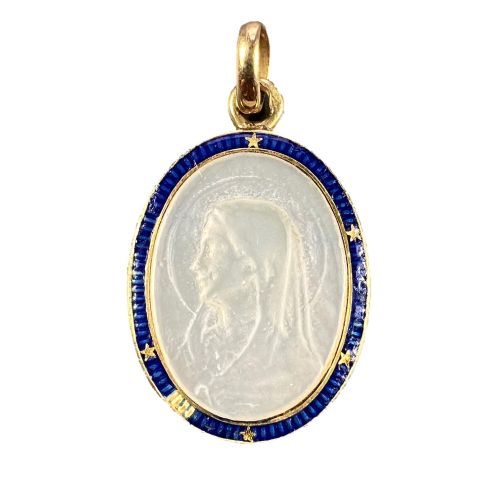
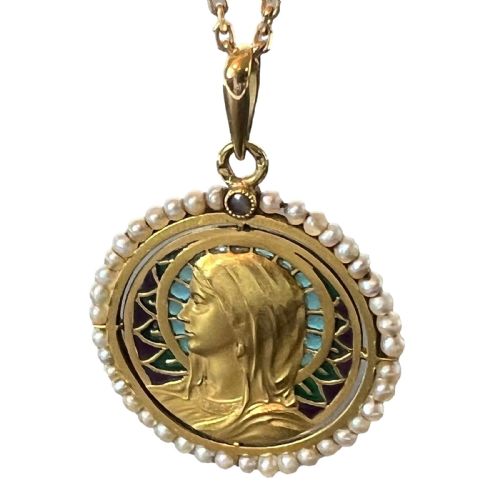


Vintage French Gold Medal
These vintage french gold medal pieces are wearable miniature works of art that combine devotional imagery with precious metalwork.
Vintage French Gold Medal
When you search for a vintage french gold medal, you uncover small devotional and decorative pendants worn as charms or necklaces. These pieces originate primarily from the late nineteenth century and span through the art deco and mid-century periods.
The selections you meet on this page lean heavily towards religious subjects, including the Virgin Mary, Madonna and Child, and various saints. Alongside these sacred figures, you also discover zodiac signs, floral motifs, and geometric crosses.
Materials and construction
Maker workshops utilised 18ct yellow gold, rose gold, and occasionally white gold as the primary metal base for these pieces. This high purity metal provides a rich warm tone that characterises the surviving examples.
Artisans applied decorative techniques such as enamel work, plique-a-jour, and mother of pearl inlay to add colour and texture to the metallic surfaces. Details were often hand-engraved or stamped with specific iconography before being finished with seed pearls or small diamonds.
Among the sacred figures and zodiac signs, a solitary hunting horn and a whimsical dog house charm wait to be discovered.
Factors that define quality
Quality in a vintage french gold medal depends heavily upon the crispness of the relief work and the skill involved in the engraving. Finer examples display intricate facial expressions on figures and deep, well-defined floral or architectural motifs.
The presence of specialised decorative techniques elevates a piece, particularly when transparent enamel or delicate plique-a-jour lets light pass through the colour. Signed work from recognised medallists also marks a distinct tier of craftsmanship above unsigned production.
Emile Monier·Paul Brandt·Mazzoni·Pageli Perriat·Guilbert·Vernon·Emile Dropsy·Sellier·Rasumny·Tairac·Perroud
The Vintage French Gold Medal Glossary
- Plique-a-jour
- An enamelling technique where the enamel is fired without a backing, creating a translucent, stained-glass effect. This delicate method allows light to pass directly through the coloured sections.
- Medallion
- A large metal disc struck or cast with a commemorative design or portrait. These pieces are often pierced with a suspension loop to function as a pendant.
- Mother of pearl
- The iridescent internal layer of mollusc shells utilised as a smooth background material. Artisans carved and polished this substance to contrast against surrounding gold elements.
- Seed pearl
- A very small, naturally occurring or cultured pearl used in clusters or borders. They are traditionally drilled and threaded or pegged onto the jewellery mount.
Vintage French Gold Medal: Frequently Asked Questions
What periods do these gold medals come from?
The evidence shows items originating from the late nineteenth century through the decades of the twentieth century. You will find pieces dated from the 1890s, the 1900s, and the 1910s up to the 1950s.
Design influences span French Art Nouveau, Belle Epoque, Art Deco, and mid-century aesthetics. Each period brings distinct artistic touches to the iconography.
What materials were used to make them?
Makers constructed these charms primarily from 18-carat yellow gold, alongside variations in rose gold and white gold. The metal provides a durable and warm foundation for the detailed work.
Enamel, mother of pearl, seed pearls, and small diamonds frequently appear as supplementary materials. These additions provide contrast and texture to the central metallic figures.
How were these religious medals worn originally?
People wore these pieces suspended from chains around the neck as protective pendants or devotional tokens. They served as personal expressions of faith and remembrance.
Many examples also functioned as charms attached to bracelets or kept close as pocket items. Their loop attachments made them versatile for various forms of personal adornment.
How do I identify a signed piece?
Look along the lower edge or reverse side of the metal for an engraved signature left by the original medallist. Names such as Emile Dropsy or Paul Brandt appear in the archive records as maker marks.
These signatures indicate the hand of a specific artist rather than an anonymous workshop production. They provide a direct link to the designer responsible for the relief sculpture.