



French Gold Madonna Medallion
A French gold madonna medallion is a small devotional jewel worn close to the heart, combining fine metalwork with sacred imagery.
French Gold Madonna Medallion
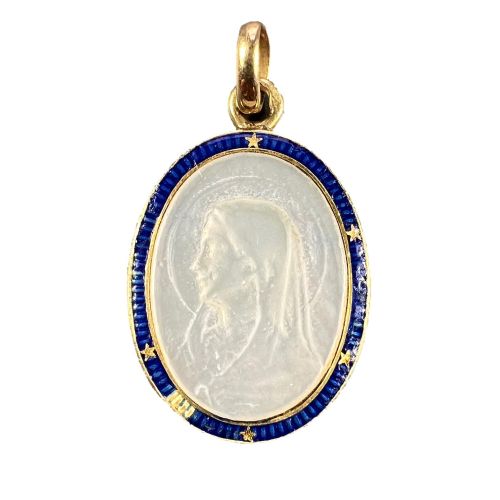
A french gold madonna medallion is a pendant or charm depicting the Virgin Mary, often with the infant Jesus or the Sacred Heart, intended for personal devotion. The examples found here date primarily from the late nineteenth century through to the mid-twentieth century, spanning Art Nouveau and mid-century aesthetics.
Most pieces take the form of circular or oval medals made in France, frequently signed by notable medallists on the rim or field. Buyers encounter these as wearable pendants that integrate religious iconography with decorative metalcraft from specific periods like 1910 and 1900.
Materials and construction methods
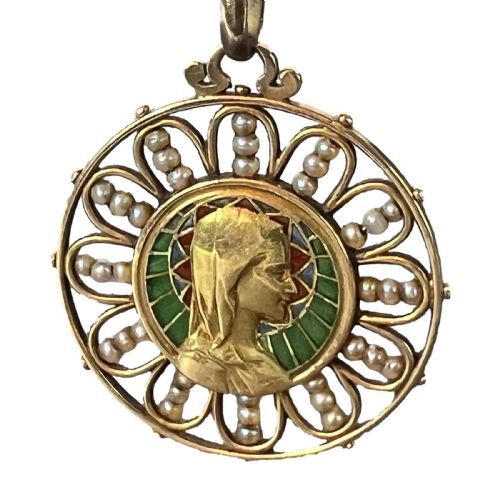
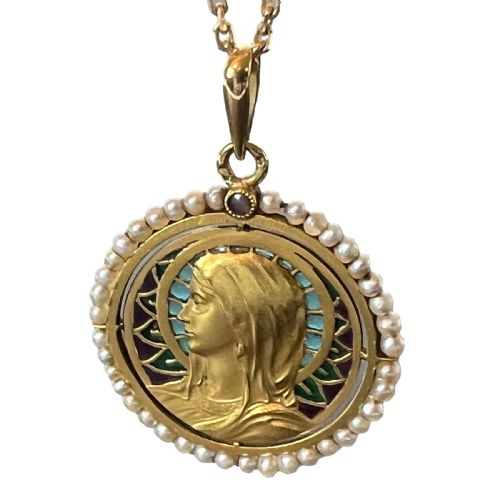
Goldsmiths worked predominantly in 18K yellow gold, sometimes incorporating white or rose gold variations, shaping the metal into framed religious pendants and charms. The surfaces frequently combine polished gold with intricate bas-relief figures of the Madonna and child.
Selected pieces integrate decorative elements such as enamel, translucent plique-a-jour enamel, mother of pearl, seed pearls and pearls to highlight floral motifs or halos around the sacred figures.
French Gold Madonna Medallion Retail Price Guide 2026
Typical asking prices for french gold madonna medallion among the pieces listed under this phrase on Sellingantiques today, from the lower quarter to the upper quarter. They describe what is for sale here now, not the wider market.
Materials recorded across the selection include 18K yellow gold, white gold, rose gold, enamel, plique-a-jour, mother of pearl and seed pearls.
Judging quality in devotional medals
Quality rests upon the crispness of the medallist's strike and the fineness of the hand-chased details on the figures. Sculptural depth in the depiction of the Madonna distinguishes finer studio output from simpler commercial stampings.
The integration of enamelling techniques, particularly translucent plique-a-jour work that allows light to pass through the colour, separates standard devotional items from exceptional pieces produced by named French artists.
Emile Monier·Mazzoni·Pageli Perriat·Emile Dropsy·Sellier·Pageri Perroud·Perriat·Arnault·Ruffony·Augis Grun·Serraz·Augis and Mazzoni
The French Gold Madonna Medallion Glossary
- Plique-a-jour
- An enamelling technique where enamel is applied in cells without a backing, resembling miniature stained glass. This method allows light to shine directly through the coloured glass elements on the pendant.
- Medallion
- A large medal made to be worn as jewellery rather than awarded. These pieces often feature suspension loops for chains.
- Bas-relief
- A sculptural technique where the figures project only slightly from the background plane. French medallists used this to create dimensional portraits of the Virgin Mary.
- Sacred Heart
- A Catholic devotion depicting the physical heart of Jesus Christ as a symbol of divine love. It frequently appears alongside the Madonna on these French pendants.
French Gold Madonna Medallion: Frequently Asked Questions
How do I wear a pendant medal?
Pendant medals are typically suspended from a fine gold chain to be worn around the neck as a necklace. They also function successfully when added to a charm bracelet alongside other small gold elements.
Because these pieces often feature detailed relief work on both sides or delicate enamel, they suit daily wear provided they are paired with a secure chain.
What materials are used in these medals?
The pieces on this page are constructed mainly from 18K yellow gold, with occasional examples incorporating rose gold or white gold accents. Makers frequently enhanced the gold frame and figures using enamel, mother of pearl and seed pearls.
These materials reflect the standard palette of French jewellers working during the Art Nouveau and subsequent periods.
How can I tell the period of a medal?
Dating relies heavily on stylistic markers such as the flowing organic lines characteristic of Art Nouveau designs from around 1900 to 1910, or the cleaner geometries of later mid-century pieces.
Many medals also bear maker signatures or French poinçon assay marks stamped directly onto the gold loop or rim, which help identify the exact era of production.