


French 18ct Gold Medal
These french 18ct gold medal pieces bring together devotional subjects and secular symbols in solid yellow gold, white gold, and enamel.
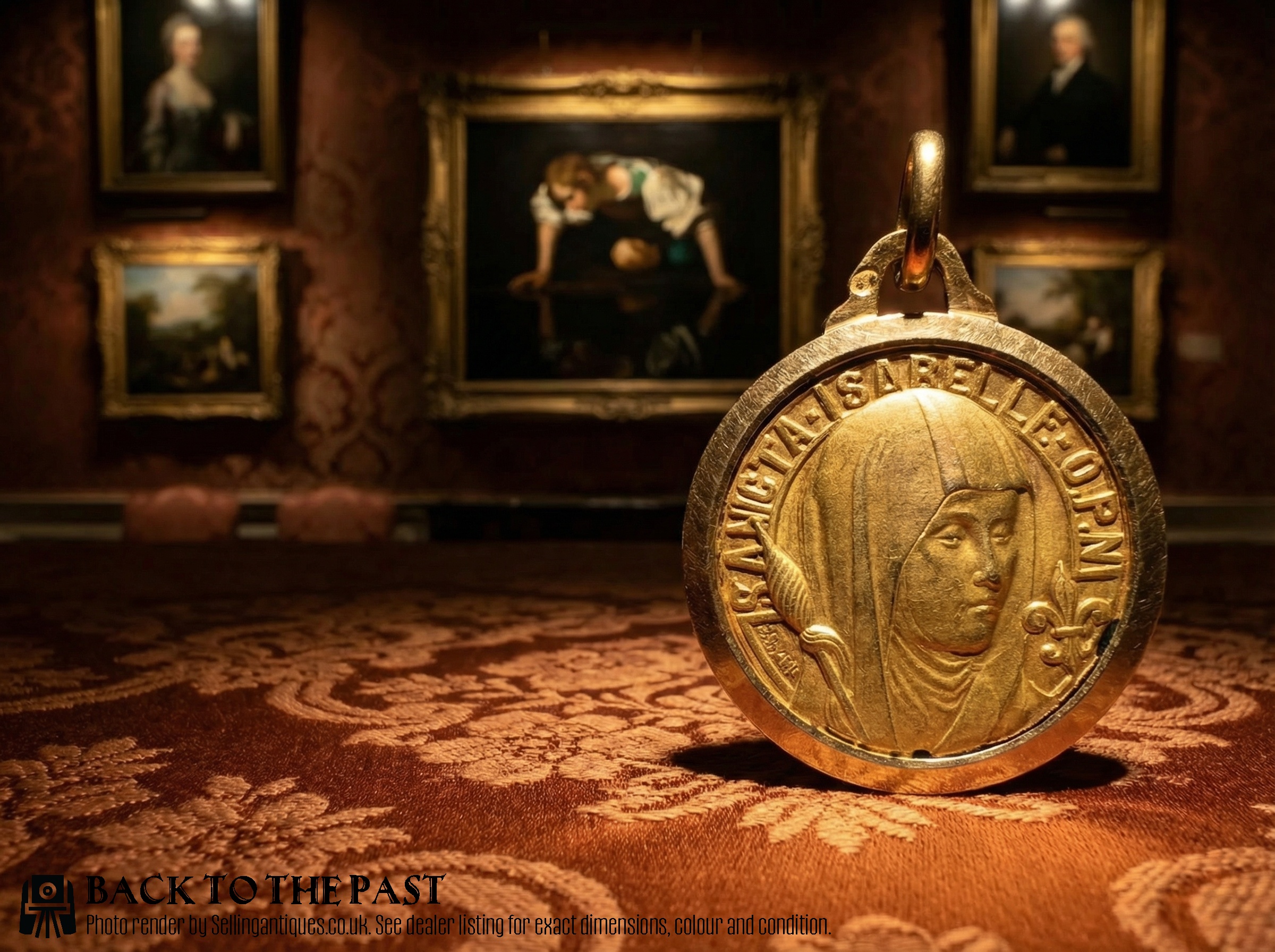
French 18ct Gold Medal
A french 18ct gold medal serves primarily as a pendant, charm, or medallion, often depicting the Virgin Mary, the Madonna and Child, or saints such as Saint John the Baptist. These items emerge across decades spanning the late nineteenth century through to the mid-twentieth century, capturing periods from Art Nouveau to mid-century modern design.
Religious motifs dominate the selection, including the Miraculous Medal, the Sacred Heart, and first communion pieces, alongside secular designs like zodiac signs, Maltese crosses, and medical blood group charms. Collectors encounter both shield-shaped and oval formats, frequently cast in yellow gold with occasional white gold accents.
The objects function as wearable jewellery intended to be suspended from chains, recording personal milestones, faith, and artistic movements of their time. Pieces from the early twentieth century often display detailed relief work, while later examples show shifts towards simpler geometric or figural interpretations.
Materials and Techniques
Makers utilised 18ct yellow gold and 18K gold as the primary body material, sometimes combining white gold or rose gold elements to create contrast within the relief design. This high gold purity yields a warm hue that retains its finish over decades of wear.
Enamel work, including translucent plique-à-jour techniques and opaque red applications, appears alongside seed pearls and mother of pearl to highlight specific details like halos, floral wreaths, and religious garments. Artisans cast and chased the metal to achieve deep relief portraits and intricate borders.
Even blood group medical tokens received the full golden treatment in mid-century French workshops.
Quality Variations
The definition and depth of the chased relief sculpture separate standard production from finer work, particularly in facial expressions and drapery folds on figural medallions. Signed pieces by known medallists display sharper execution in the background punchwork and lettering.
The application of enamel and the security of seed pearl settings dictate the refinement of decorative examples. Pieces featuring translucent window enamel require advanced technical skill compared to standard cast medals, shifting the visual depth and complexity of the object.
Monier·Pageli Perriat·Emile Dropsy·Sellier·Ovide Yencesse·Mazzoni·Perroud·Becker·Charl·Grun·Arnault·Augis·Serraz
The French 18ct Gold Medal Glossary
- Medallion
- A large medal worn as a pendant or charm. These pieces often feature religious iconography or commemorative designs on both sides.
- Plique-à-jour
- A vitreous enamelling technique where the enamel is applied without a backing, creating a stained-glass effect that lets light pass through.
- Chasing
- A metalworking technique where the artisan pushes metal from the front using hammers and punches to form raised surface details.
- Seed Pearl
- Very small natural or cultured pearls, often used in historic jewellery to trace borders or accent floral motifs.
- Miraculous Medal
- A devotional medal whose design was based on apparitions of the Blessed Virgin Mary reported by Catherine Labouré.
French 18ct Gold Medal: Frequently Asked Questions
How do I wear a medal?
These pieces function as pendants or charms, suspending easily from standard gold chains or charm bracelets.
Their lightweight construction allows for daily wear, though care should be taken with enamelled or pearl-set variations.
What periods do these date from?
The items span from the late nineteenth century through the Art Nouveau and Art Deco eras up to the nineteen-fifties.
Most examples originate from the early decades of the twentieth century, reflecting traditional French devotional styles.
Are all medals religious?
While the majority depict figures like the Virgin Mary or saints, secular designs do exist within the selection.
Collectors can find zodiac signs, blood group medical charms, floral wreaths, and Maltese cross motifs alongside devotional pieces.
What gold purity is used?
The pieces are struck in 18-carat yellow gold, occasionally incorporating white gold or rose gold highlights.
This high gold content ensures durability alongside a rich, warm tone characteristic of French workshop standards.