


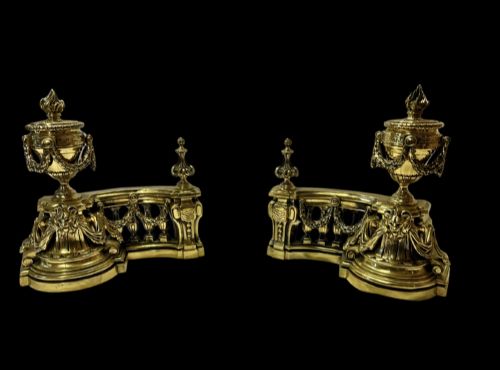


French Fireplace Urns
French fireplace urns and their accompanying garnitures bring nineteenth-century neoclassical symmetry to a mantelpiece.
French Fireplace Urns
French fireplace urns and related garniture pieces encompass mantel clocks, incense burners, and matching side vases that anchor a hearth arrangement. These decorative objects emerge predominantly from nineteenth-century workshops, spanning periods from the Second Empire to Art Deco.
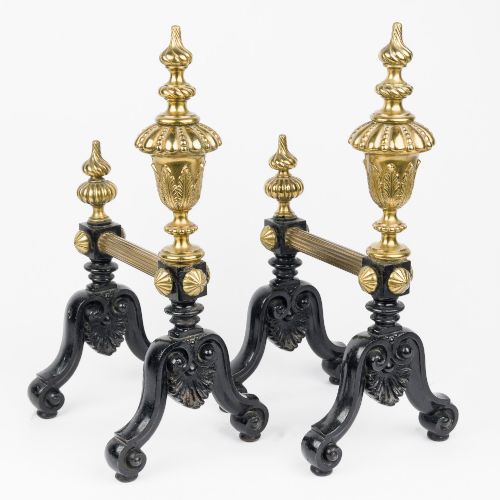
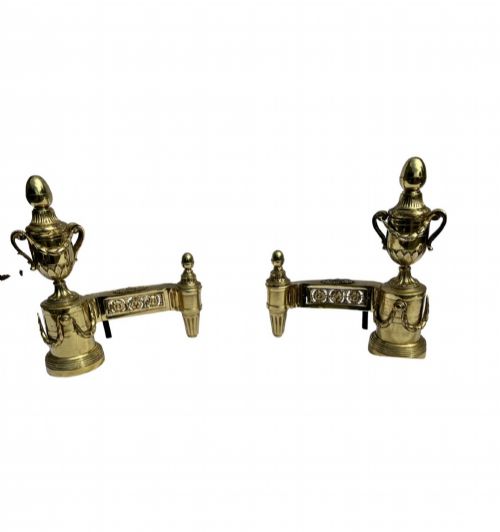
The pieces on this page lean heavily towards nineteenth-century classical revivals, including Louis XVI and Napoleon III styles. Alongside actual urns within garniture sets, buyers will encounter fire dogs, fenders, overmantel mirrors, and log bins.
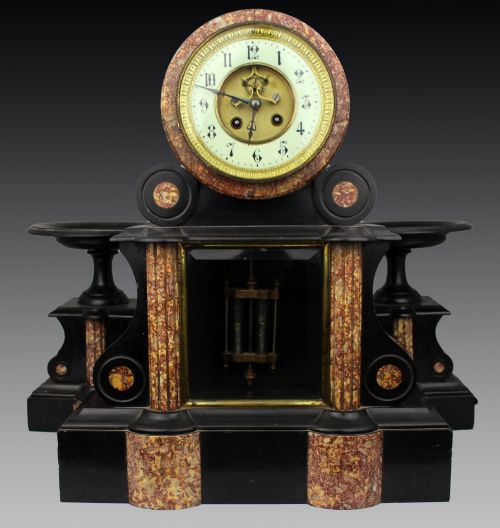
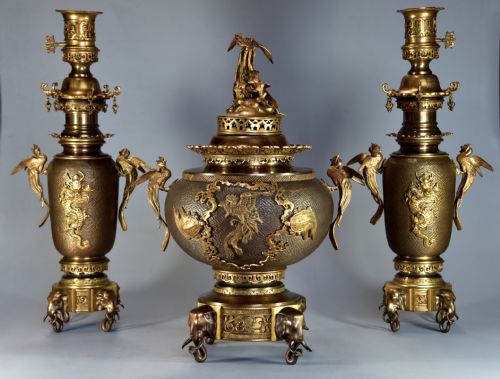
Many of these items function as part of a garniture set, where a central mantel clock is flanked by a matching pair of urns or vases. Materials range from striking black and white marble to gilded brass and cast bronze.
Materials and construction
Foundry work relied on the casting of brass, bronze, and ormolu, often paired with hand-chased surface details that defined the neoclassical aesthetic. Ormolu involves applying finely ground gold to a bronze base, creating a lasting golden lustre.
Stonework required precision cutting and polishing of black slate and white marble for clock bodies and urn bases. Artisans combined these mineral elements with glass domes, porcelain inserts, and patinated metal surfaces.
Several sets come protected beneath their original glass domes, preserving the delicate gilt components from nineteenth-century hearth dust.
Judging quality and execution
Quality rests in the crispness of the cast metal ornamentation and the depth of the gilding or patination. Finer examples display sharp architectural details and well-proportioned figural mounts rather than softened edges.
The choice of materials dictates the standing of the piece, with solid marble, heavy ormolu, and integrated porcelain panels marking out superior workshop output. Complete garniture sets that retain their matching components demonstrate greater integrity.
Japy Freres·James Ritchie and Son
The French Fireplace Urns Glossary
- Garniture set
- A matching group of three or more decorative mantel objects, usually a central clock flanked by two urns or vases.
- Ormolu
- Finely ground gold applied to a bronze base through a mercury amalgamation process, characteristic of French decorative arts.
- Chenets
- Decorative metal supports placed on either side of a hearth, also known as fire dogs.
- Neoclassical
- A revival style drawing on classical Greek and Roman motifs, prominent in nineteenth-century French design.
- Dinanderie
- The craft of beaten and worked brass, copper, or bronze decorative objects.
French Fireplace Urns: Frequently Asked Questions
What is a clock garniture?
A clock garniture is a matched set designed to sit together on a mantelpiece. It typically consists of a central clock accompanied by two matching side pieces such as urns or vases.
These sets were manufactured in large numbers during the nineteenth century in France to provide balanced ornamentation for formal rooms.
How do I style a mantelpiece?
Mantelpiece styling around these items generally relies on symmetry, placing the central clock directly in the centre with matching urns flanking it. Overmantel mirrors often hang immediately above to reflect the metal and marble surfaces.
Keeping the hearth accessories in a complementary metal or marble finish ties the entire fireplace zone together.
What materials were used?
Nineteenth-century workshops utilised a mix of cast metals including brass, bronze, and ormolu, alongside black slate and white marble. Porcelain panels and glass domes also appear frequently in clock sets.
Surface finishes range from high-gloss gilding to darkened patinated bronze and copper dinanderie.
How do I identify periods?
Periods are identified through stylistic cues, such as the strict symmetry of Louis XVI neoclassical designs versus the ornate elaboration of Napoleon III or the later geometric lines of Art Deco. Materials like black marble and specific cast motifs offer further clues to the decade of manufacture.
Inscriptions on clock movements or foundry stamps can also pinpoint the date and origin of the piece.