




French Empire Bouillotte Lamp
A French Empire bouillotte lamp brings focused task lighting and classic Neoclassical style to a desk or table.
French Empire Bouillotte Lamp
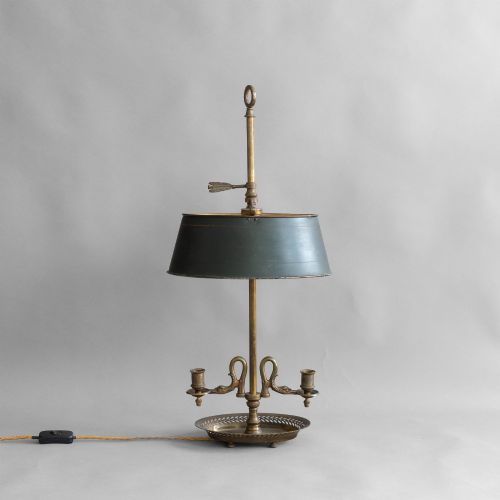
When you search for a French Empire bouillotte lamp, you are looking at adjustable task lights designed originally for card games, combining a central shaft with candle arms and a characteristic shade. These pieces typically take the form of desk lamps and table lamps, with occasional wall lights appearing in the selection.
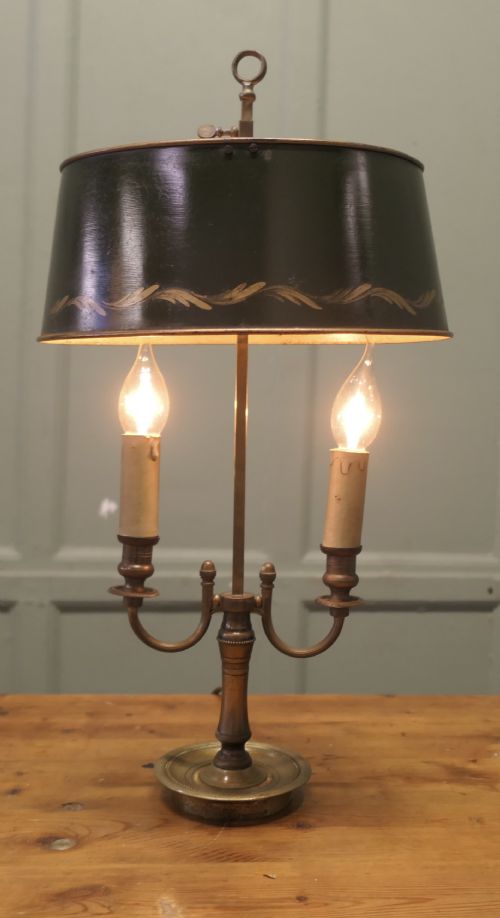
The version you are most likely to meet on this page pairs a brass or bronze structure with a painted toleware shade, often finished in green and gold. The selection spans the nineteenth century through to mid twentieth century decades like nineteen twenty and nineteen thirty, alongside Victorian examples.
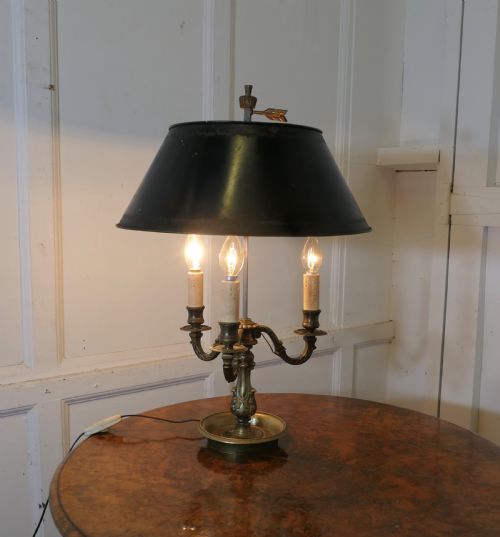
Forms vary from twin and triple light configurations to four branch models, generally featuring adjustable height mechanisms. The stylistic vocabulary draws heavily on French Neoclassical and Empire traditions, creating a formal silhouette suited to traditional interiors.
Materials and construction methods
These lamps rely primarily on metalworking traditions, utilising cast and turned brass, bronze, and gilt metal for the structural body and candle arms. Silver plate also appears among the metal finishes, alongside occasional mahogany elements.
Shades are constructed from toleware, which involves painted and varnished sheet metal, most frequently seen in green with gilt accents. Makers combined these durable metal components to create adjustable mechanisms that allowed the shade to slide along a central stem.
Listings for this phrase feature materials such as brass, bronze, and painted toleware, spanning the nineteenth century through to the nineteen forties.
Distinctions in quality and execution
Quality in these pieces rests upon the crispness of the metal casting and the weight of the base materials used. Heavier bronze and solid brass constructions demonstrate a superior build compared to lighter metal alloys.
The fineness of the painted finish on the toleware shade, including hand applied gilt decoration, marks the difference between standard production and finer workshop output. Original adjustable mechanisms that hold their position securely also distinguish better examples.
The French Empire Bouillotte Lamp Glossary
- Bouillotte
- A traditional French card game played with three players, which gave its name to these specific lamps designed to light the table. The form persists as a classic desk and table light.
- Toleware
- Painted or lacquered sheet metal utensils and decorative objects, widely used for lamp shades in green and other colours. The surface is often finished with gilt painted details.
- Gilt Metal
- Metal that has been given a thin coating of gold or a gold coloured finish to resemble solid or fire gilt bronze. It provides a bright decorative surface across the lamp body.
- Neoclassical
- A style originating in the eighteenth century that draws inspiration from the classical art and culture of ancient Greece and Rome. It informs the formal proportions and decorative motifs of these lamps.
- Bronze
- An alloy consisting primarily of copper, traditionally used for high quality casting of lamp bases and decorative mounts. It offers durability and a heavy, stable foundation.
French Empire Bouillotte Lamp: Frequently Asked Questions
What is a bouillotte lamp?
A bouillotte lamp is a traditional lighting fixture featuring a central stem, multiple candle arms, and an adjustable painted metal shade. It was originally designed to illuminate card games.
Today, these pieces function as elegant desk or table lamps, providing focused downward light while adding a formal decorative element to a room.
How do you adjust the shade?
The shade on a bouillotte lamp slides vertically along a central upright rod and is held in place by a key or screw mechanism. This allows the user to lower or raise the shade to direct the light.
When adjusting an antique lamp, loosen the central fastener gently rather than forcing the metal to avoid stressing the vintage brass or bronze components.
Where should I place this lamp?
These lamps suit studies, libraries, and living spaces where focused surface lighting is required. They sit well on writing desks, side tables, or chests of drawers.
The combination of polished brass and green toleware allows them to blend easily with traditional wood furniture and classic interior schemes.
How do I care for toleware shades?
Toleware requires gentle cleaning with a soft, dry cloth to remove dust. Moisture should be avoided to protect the painted and varnished surface from damage.
Preserving the original painted finish and gilt accents maintains the historical character and visual appeal of the lamp over time.