

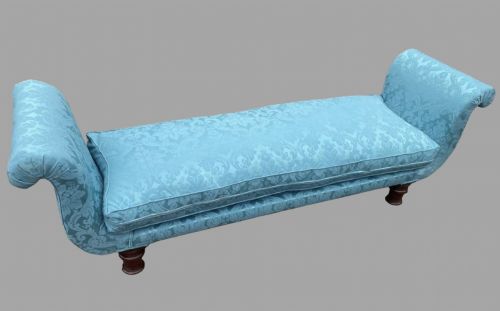


French Empire Bench
These french empire bench pieces bring classical neoclassical elegance and bold Regency lines into a room, offering both seating and striking architectural presence.
French Empire Bench
A french empire bench encompasses settees, daybeds, and gilt X-frame stools derived from early nineteenth-century French taste and later revival periods. Buyers seeking this aesthetic encounter forms ranging from miniature chaises and window seats to full parlour suites and settees.
The material record points heavily toward nineteenth-century production, with specific examples spanning from around eighteen hundred through the Regency era and into later nineteenth-century revivals. Regional variations such as Swedish Empire interpretations also appear alongside continental sofas and gilt curule stools.
Seating forms vary widely in scale, from intimate footstools and window seats to substantial seven-piece carved walnut suites. The core vocabulary of the style remains rooted in neoclassical proportions, whether executed in primary nineteenth-century workshops or subsequent revival iterations.
How they were made
Construction relies heavily on timbers such as mahogany and walnut, frequently enriched with giltwood surfaces and distinct brass mounts. Ormolu mounts provide the characteristic metallic contrast against dark wood bodies in classical empire and revival pieces.
Upholstery forms a vital component of these seats, utilising textiles including silk, velvet, and damask. Frame structures incorporate architectural X-shapes and curule designs alongside traditional wood-carving techniques.
French Empire Bench Retail Price Guide 2026
Typical asking prices for french empire bench among the pieces listed under this phrase on Sellingantiques today, from the lower quarter to the upper quarter. They describe what is for sale here now, not the wider market.
Listings feature mahogany, walnut, and giltwood construction paired with brass and ormolu mounts.
What varies in quality
Quality reveals itself in the crispness of the wood carving and the precision of the brass or ormolu mounts fitted to the frame. Finer examples display meticulous joinery and harmonious proportions that reflect the rigorous standards of neoclassical design.
The choice and execution of upholstery textiles also set tiers of quality, where genuine silk and damask distinctively elevate a piece above standard fabric treatments. Structural integrity in weight-bearing X-frames and giltwood surfaces further distinguishes superior examples.
The French Empire Bench Glossary
- Empire
- A dominant early nineteenth-century design style characterised by neoclassical motifs, heavy classical influence, and military-inspired ornamentation. It draws directly from the aesthetic of the Napoleonic era.
- Giltwood
- Timber treated with a thin layer of gold leaf or gilt finish, commonly utilised on decorative frames and decorative seating mounts. This technique provides a luminous metallic sheen.
- Ormolu
- Finely chased and gilt bronze applied as decorative mounts to furniture frames. It defines the rich decorative highlights found on premier empire pieces.
- Curule stool
- An ancient Roman magistrate chair design featuring intersecting curved legs forming an X-shape. Revival variants often adopt this classical ancient form for compact seating.
- Lit Bateau
- A French bed or daybed style featuring scrolled ends of equal or near-equal height resembling a boat hull. These pieces function as dramatic daybeds or settees in formal interiors.
French Empire Bench: Frequently Asked Questions
How do I place an empire settee in a modern room?
An empire settee or window seat works effectively as a focal point in a hallway, bedroom, or formal drawing room. Their strong architectural lines anchor open spaces and complement both traditional and eclectic interiors.
Pairing them with simple surrounding decor allows the carved wood and ormolu mounts to stand out properly without visual clutter.
How do I tell original empire pieces from later revivals?
Original pieces generally date from the early nineteenth century and reflect the primary neoclassical movement under Napoleon. Revival pieces emerged later, notably during the nineteenth-century revival periods and into the early twentieth century.
Examining the construction methods, timber ageing, and the style of the brass mounts helps clarify whether a piece is an early original or a later revival.
What textiles are authentic to these seats?
Upholstery on these seats traditionally includes luxury fabrics such as silk, velvet, and damask upholstery. These materials reflect the opulent interior schemes associated with classical French decoration.
Many surviving pieces feature later replacement textiles chosen to match these historic fabric traditions.