


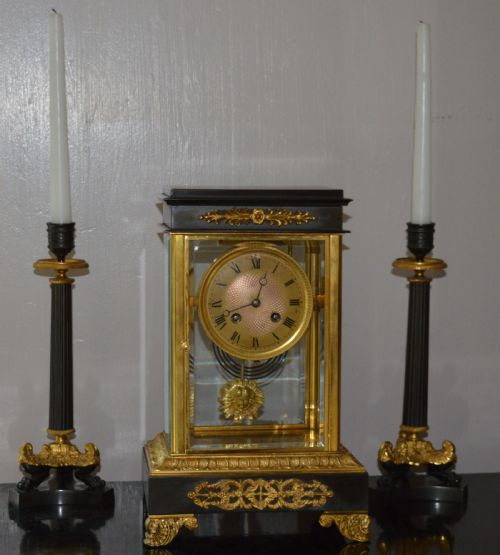


French Crystal Clock
A french crystal clock brings together heavy bevelled glass and polished brass, offering a bright centrepiece for a mantelpiece.
French Crystal Clock
A french crystal clock unites transparent glass panes with polished metal frames to create an open view of the mechanical movement inside. These pieces span the nineteenth and twentieth centuries, taking the form of architectural portico clocks and tall four-glass regulators designed for prominent placement on a mantelpiece.
The selection here ranges from early nineteenth century Charles X portico models supported by columns to later crystal regulators featuring enamelled dials and painted glass panels. Makers such as Samuel Marti et Cie and L Epee produced these timepieces during periods including the Belle Epoque and Victorian eras.
Buyers seeking a french crystal clock will find variations in shape, from oval and bow fronted cases to rectangular four-glass housings. Each iteration displays the interior escapement and pendulum through clear panels while maintaining a sturdy brass or ormolu framework.
How They Were Made
Cases combine heavy cut crystal or bevelled glass panes fitted securely into cast brass, gilt brass, and ormolu frames. Metal components are shaped and polished to support the delicate glass walls without obscuring the interior mechanism.
Dials frequently incorporate white enamel with painted numerals, sometimes accompanied by decorative floral panels in pink, green, or blue tones. Precision brass gearing and escapements are housed centrally within the transparent structure, often featuring visible mercury or temperature-compensated pendulums.
French Crystal Clock Retail Price Guide 2026
Typical asking prices for french crystal clock among the pieces listed under this phrase on Sellingantiques today, from the lower quarter to the upper quarter. They describe what is for sale here now, not the wider market.
Listings span the nineteenth and twentieth centuries, featuring materials such as ormolu, bevelled glass, paste stones, and enamel across Second Empire and Belle Epoque styles.
What Varies in Quality
The weight and thickness of the glass panes set finer examples apart from simpler models, alongside the precision of the bevels and the clarity of the cut crystal. Heavier cast ormolu and gilt brass frames with crisp chasing demonstrate superior manufacturing standards compared to lighter stamped metal mounts.
Intricacy in the dial work also defines the grade of the piece, particularly where hand-painted enamel panels and polychrome decorations are applied. The inclusion of signed movements by established makers adds historical substance to the construction.
Samuel Marti et Cie·L Epee France
The French Crystal Clock Glossary
- Portico clock
- A monumental clock design featuring architectural columns supporting a central movement, popular during the Charles X period. These pieces often employ cut crystal pillars alongside ormolu mounts.
- Crystal regulator
- A mantel clock enclosed entirely by glass panels on four sides, allowing light to pass through to the central pendulum and movement. They emerged strongly during the later nineteenth century.
- Ormolu
- Gilt bronze produced by applying a mercury and gold amalgam to a bronze base, creating a rich golden surface finish. It appears frequently on nineteenth-century French clock mounts.
- Bevelled glass
- Glass panes with angled edges cut and polished to create a prismatic border effect. This technique adds depth and catches light around the perimeter of the clock case.
- Paste stones
- Faceted lead glass gems cut and polished to resemble precious stones, sometimes set into clock bezels or pendulum bobs for added ornament.
French Crystal Clock: Frequently Asked Questions
How do four glass clocks work?
Four glass clocks rely on a spring-driven or weight-driven brass movement suspended between transparent panels, letting light illuminate the gears and pendulum from every angle.
Most examples use a visible escapement visible on the dial face, transferring energy steadily to keep accurate time while the heavy glass case protects the delicate mechanism from dust.
What is a crystal regulator?
A crystal regulator is a mantel clock housed in a tall brass and bevelled glass case designed to display the movement and a mercury or gridiron pendulum. The style gained popularity in France during the late nineteenth century.
These clocks earned their name because the heavy glass panels regulate the visual transparency of the piece while enclosing the precision brass machinery.
How do I identify a Charles X portico clock?
Charles X portico clocks feature distinct architectural frames with vertical pillars supporting a central clock housing, often constructed from ormolu and cut crystal. The design reflects early nineteenth-century neoclassical tastes.
They stand out from later regulators through their monumental column structures and prominent use of heavy gilded bronze mounts alongside glass elements.
Where should I place a heavy glass clock?
These clocks require a stable, level surface such as a mantelpiece or sturdy sideboard where vibrations are minimal. A secure foundation ensures the pendulum swings evenly without striking the interior glass panels.
Because light passes directly through the transparent sides, positioning them near a window or in a well-lit room highlights the intricate brass gears and enamelled dials.