
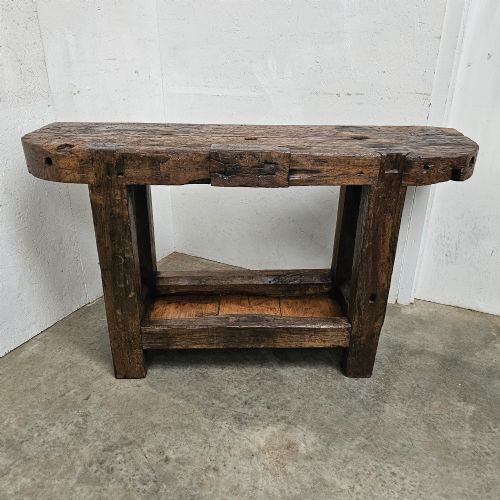


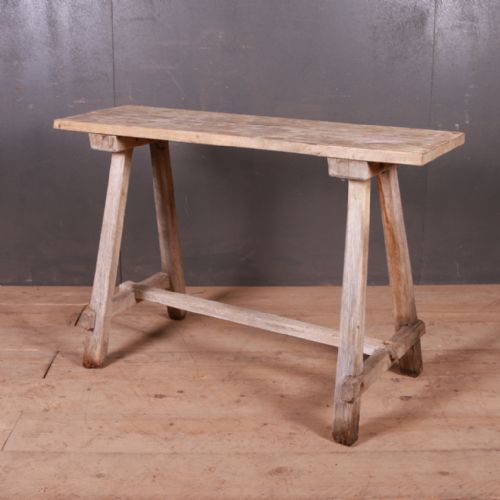
French Country Workbench Console
A french country workbench console brings honest utility and warmth to a room, offering robust timber surfaces shaped by generations of practical use.
French Country Workbench Console
When you search for a french country workbench console, you find sturdy work tables and long boards originating from rural France during the nineteenth century. These items bridge the gap between heavy industrial utility and domestic rustic charm, often taking the form of low-profile tables or narrow console units.
The versions most commonly met on this page span the 1860s through to 1900, drawing on French provincial and primitive traditions. They include authentic artisans' workbenches fitted with vises alongside scrubbed timber trestle tables suited for modern hallways and kitchens.
How they were made
Construction relies on solid timbers selected for hard wear, predominantly oak, elm, pine, and poplar, joined with traditional carpentry methods. Many surfaces show the honest marks of daily labour, shaped by hand tools rather than modern factory machinery.
Metal elements appear in functional components such as cast iron vises and brackets, adding structural integrity to the wooden frames. Bleached and scrubbed finishes reveal the natural grain of the wood, achieved through decades of washing and weathering.
What varies in quality
The distinction between standard examples and superior ones lies in the depth of patination and the integrity of the original timber. Pieces that retain their functional vices and bear genuine working scars command greater interest from collectors.
Proportions also dictate distinction, particularly where narrow console depths meet exceptional length, such as substantial country house formats. The harmony between scrubbed surfaces and intact structural framing separates ordinary utility boards from finer decorative specimens.
The French Country Workbench Console Glossary
- Trestle table
- A table consisting of two or more supports connected by a horizontal beam. This form provides sturdy legroom and stable placement for heavy top boards.
- Workbench
- A heavy wooden table used by artisans for manual work. These items often incorporate integrated wooden or iron vices.
- Bleached oak
- Oak timber treated to lighten its natural tone, exposing the grain. This finish results from historical scrubbing and cleaning processes.
- Primitive
- A style characterised by simple construction and minimal ornamentation. These items prioritize pure function over decorative refinement.
French Country Workbench Console: Frequently Asked Questions
How do I use a workbench console at home?
These narrow timber tables fit comfortably in hallways, behind sofas, or as preparation surfaces in rustic kitchens.
Their substantial depth and sturdy construction provide both display space and reliable utility for daily life.
What woods were used in these pieces?
Cabinet makers and rural carpenters utilised local hardwoods and softwoods including oak, elm, pine, sycamore, and poplar.
Each timber brings a distinct grain pattern and durability suited to heavy manual work.
How do I date a nineteenth century table?
Dating relies on construction marks, tool traces, and the natural wear accumulated across the timber surface over decades.
Nineteenth century pieces typically display hand-cut joinery and authentic patination rather than modern mechanical finishing.
What is a scrubbed finish?
A scrubbed finish is the result of historical cleaning and daily washing that strips away old wax and dark polishes.
This process leaves the bare wood smooth, pale, and pleasant to the touch.