







French Clock with Handle
A French clock with handle is a portable timepiece designed for travel or domestic placement, prized for brass cases and mechanical movement.
French Clock with Handle
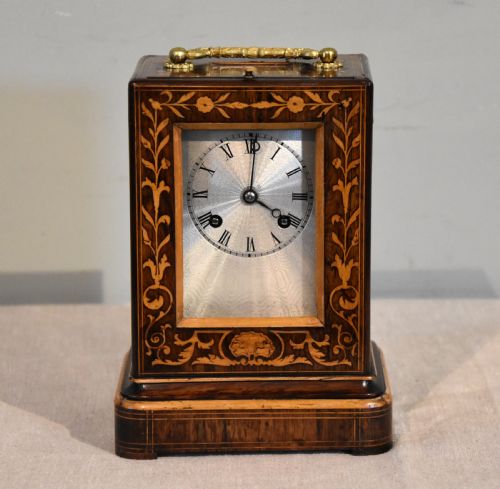
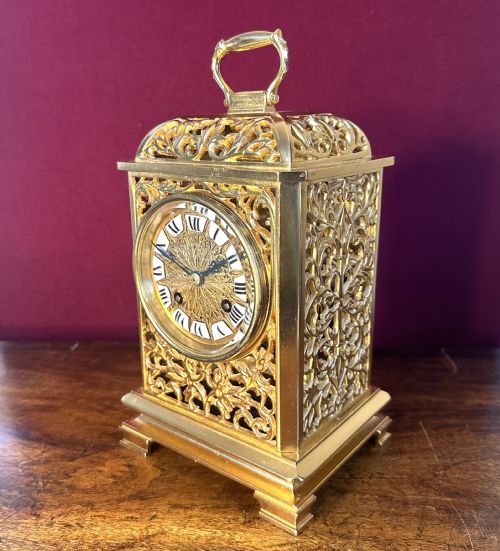
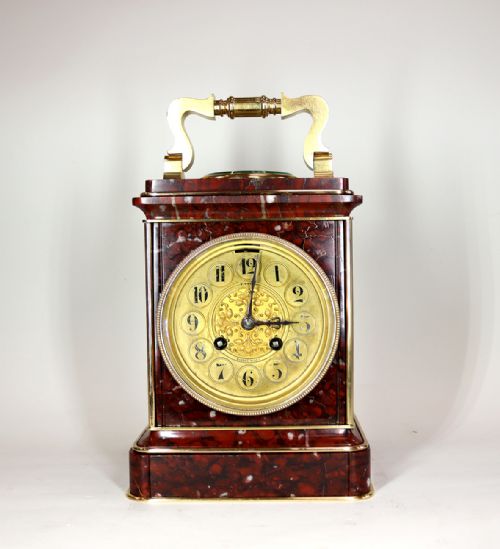
A French clock with handle typically takes the form of a brass or bronze carriage clock, built with a sturdy top mount for carrying. These timepieces originate from periods spanning the mid nineteenth century up to the mid twentieth century, including Victorian and Edwardian eras.
The most common examples on this page are brass carriage clocks featuring glass panels that reveal the internal escapement and gear train. Collectors frequently encounter variations incorporating striking mechanisms, enamel dials, and decorative architectural details like frets and columns.
How they were made
Makers constructed these clocks using heavy brass, gilt brass, and bronze for the structural frames and cases, often integrating bevelled glass panels to enclose the movement. Metalwork techniques involved casting, plating, and fine finishing to achieve polished or gilded surfaces.
French Clock with Handle Retail Price Guide 2026
Typical asking prices for french clock with handle among the pieces listed under this phrase on Sellingantiques today, from the lower quarter to the upper quarter. They describe what is for sale here now, not the wider market.
Some clocks feature a chaff-cutter escapement, proving that even tiny Victorian gears deserve agricultural ambition.
What varies in quality
Quality in a French clock with handle rests upon the sophistication of the movement and the crispness of the cast brass case. Finer examples display complex repeat striking mechanisms and fully integrated decorative panels rather than plain housings.
Pickford of London·Paul Garnier
The French Clock with Handle Glossary
- Carriage clock
- A small, spring driven clock designed for travelling during the nineteenth century. These clocks are fitted with a handle on top and glass sides to view the movement.
- Repeat striking
- A mechanism that allows the clock to chime the last hour or quarter hour on demand by pressing a button or pulling a cord. This complication required advanced watchmaking skill.
- Fret
- An ornamental pattern cut out of metalwork, commonly seen on the panels or above the dial of carriage clocks. It allowed sound to escape from the bell or gong inside.
- Escapement
- The internal mechanism that controls the release of power to regulate the movement. It is often visible through the upper glass panel of a carriage clock.
French Clock with Handle: Frequently Asked Questions
How do I wind a carriage clock?
Wind the mainspring using a dedicated key inserted into the arbours found on the underside or backplate of the movement. Turn gently until resistance is felt.
Take care not to overwind the mechanism, as this can damage the internal springs and affect the timekeeping accuracy.
What is a repeat striking clock?
A repeat striking clock contains extra complication gearing that chimes the most recent hour when activated manually. This function was useful for telling time in the dark.
Operators press a button on the top case near the handle to trigger the acoustic signal on demand.
Why do these clocks have glass panels?
Glass panels protected the delicate internal gear train from dust while allowing light to reach the escapement. This design enabled owners to inspect the mechanical action during operation.
Bevelled glass was standard on higher grade models to add structural rigidity and visual depth.
How do I date a brass carriage clock?
Dating relies on stylistic clues such as case proportions, dial typography, and the complexity of the escapement platform. Victorian and Edwardian examples often feature registration marks or maker signatures.
Comparing the escapement type from cylinder platforms to lever escapements helps narrow down the decade of production.