
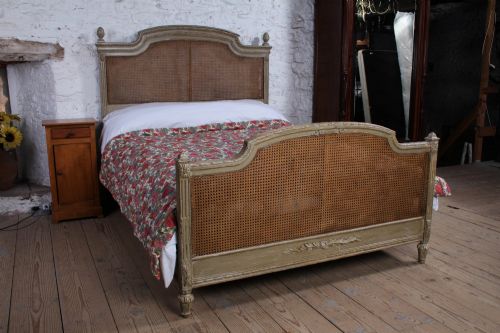


French Caned Bedstead
A french caned bedstead brings lightness to a bedroom through woven panels set within carved wood frames.
French Caned Bedstead
A french caned bedstead provides a sleeping frame constructed from timber and woven plant fibres, originating mainly from the early twentieth century and the Victorian era. These pieces frequently adopt Louis XVI style, French chateau, or Art Deco designs, taking forms such as single beds, double frames, and king size suites.
The version most commonly met on this page combines painted or gilded wooden frameworks with natural cane or rattan panels. Such beds range in scale from standard single platforms to super king sizes, occasionally accompanied by matching bedside tables and chairs.
How they were made
Makers constructed the structural frames from beech and other hardwoods, shaping them through hand carving and applying paint, polychrome decoration, or gold leaf. Artisans then wove natural cane and rattan by hand to form resilient, breathable headboards and footboards.
Joinery techniques relied on traditional wood framing to support the tension of the woven panels while accommodating various mattress sizes from single to super king dimensions.
Several beds arrive with unexpected company, including matching chairs and bedside drawers for those who enjoy a coordinated slumber.
What varies in quality
The standard of a french caned bedstead rests on the depth and precision of the carved wooden ornament, from simple mouldings to elaborate polychrome portrait panels. Refinement shows in the tightness and evenness of the hand-woven cane work across larger surfaces.
Finishes separate standard examples from finer ones, distinguishing between straightforward painted wood and sophisticated applications of gold leaf or detailed hand-painted decorative schemes.
The French Caned Bedstead Glossary
- Cane
- Material woven from the outer skin of rattan palms to create flexible, open panels in furniture backs and headboards. It provides a durable and breathable surface.
- Polychrome
- Decoration executed in multiple colours, often found on painted wooden panels. This technique adds pictorial interest to the bed frame.
- Louis XVI Style
- A neoclassical design vocabulary characterised by straight lines, classical symmetry, and restrained carving. It strongly influences many early twentieth century French beds.
- Rattan
- A climbing palm used both in its solid form for framing and stripped into strands for weaving. Its flexibility suits curved bedhead designs.
- Gold Leaf
- Gold beaten into extremely thin sheets and applied to wooden surfaces with size. It creates a gilded finish on carved mouldings.
French Caned Bedstead: Frequently Asked Questions
How do I clean a caned headboard?
Dust the woven cane regularly with a soft brush or a dry cloth to prevent dirt from settling between the strands. Avoid using excess water or harsh chemical cleaners, which can make the natural fibres brittle over time.
Occasionally dampen a cloth slightly with warm water to wipe down the wooden frame, taking care not to soak the cane panels. Conditioning the wood with appropriate polish keeps the surrounding structure nourished.
Will a standard mattress fit these beds?
Many older French bed frames do not conform to modern standard UK or international mattress dimensions. It is essential to check the exact internal measurements of the rails before purchasing a mattress.
Some platforms accommodate standard modern sizes, while others require custom-made mattresses to ensure a correct fit within the wooden side rails.
How do I identify a Louis XVI style bed?
Look for straight tapered legs, fluted columns, and geometric or classical carved motifs rather than the curving lines of earlier periods. These frames often feature symmetrical proportions and restrained ornamentation.
Hardware and painted finishes on these pieces typically reflect neoclassical restraint, drawing inspiration from late eighteenth-century French design.
Are painted finishes original?
Many surviving pieces retain their historic painted or polychrome surfaces, which show natural ageing through light craquelure or softening of the pigment. Examining the layers can reveal whether a finish dates from the early construction period.
Some pieces feature later decorative paintwork applied to enhance the carved details or to match specific interior colour schemes.