



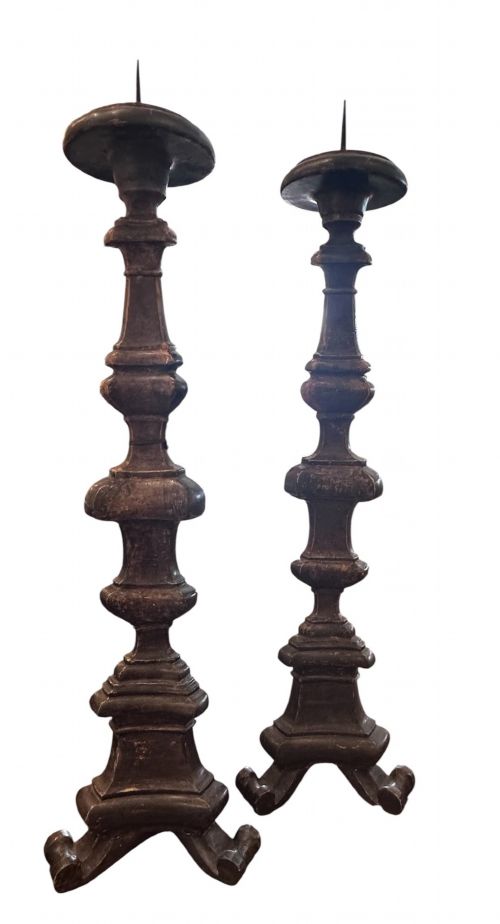


French Candle Sticks
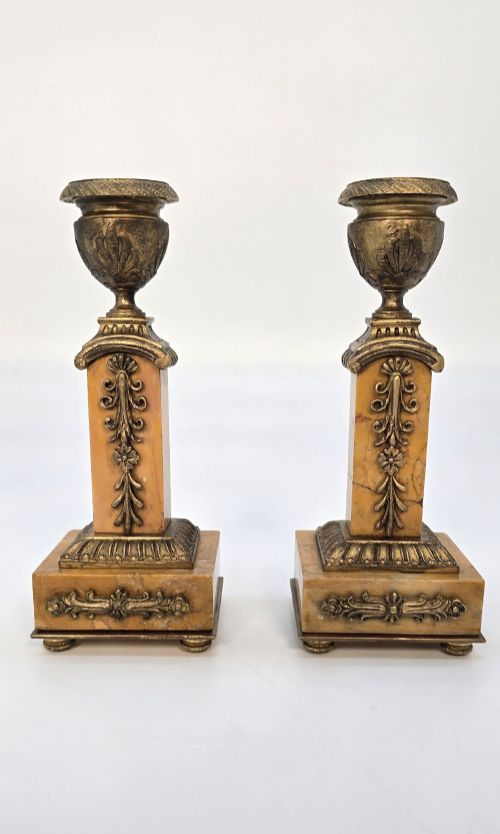
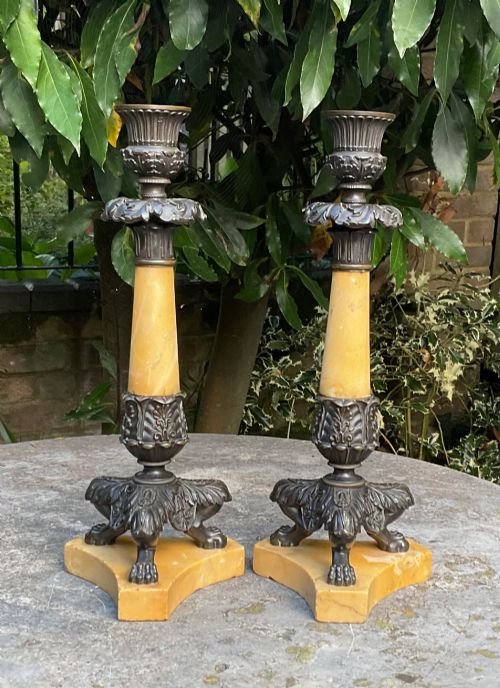
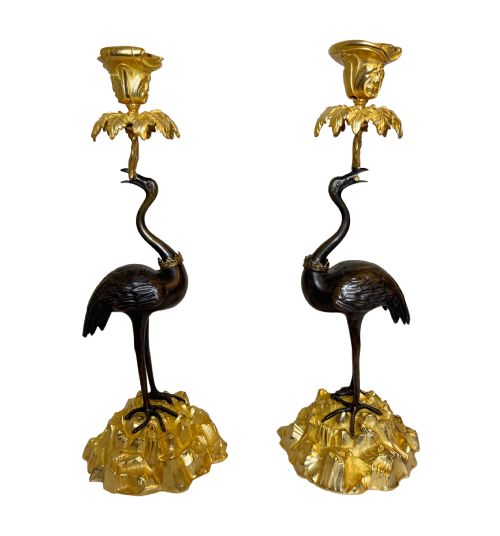
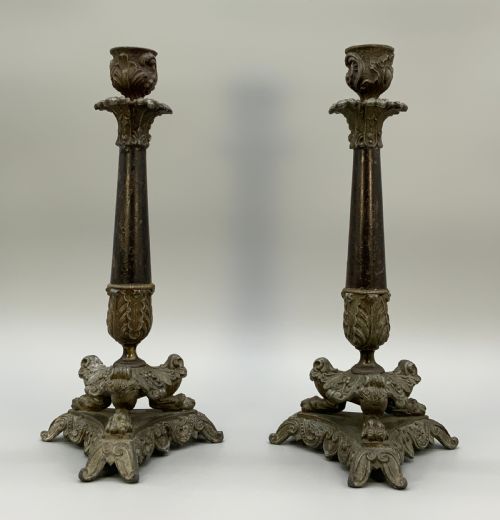
These French candle sticks bring weight and presence to a table, cast in bronze and carved in wood across the nineteenth century.
French Candle Sticks
When you search for french candle sticks, you encounter objects shaped by nineteenth-century tastes, spanning the Regency period through to the late eighteen-eighties. The most common forms on this page are pairs, created to stand balanced on a mantelpiece or sideboard.
Makers utilised diverse materials, pairing gilt bronze and carrara marble with carved wood, brass, and ormolu. Certain examples take the form of twin-light candelabra or incorporate figural motifs such as dancing cherubs and flamingos.
The styles range from French Empire and Louis XVI Revival to Regency and Victorian Aesthetic Movement. These candle sticks and candelabras often double as table lamps or retain their original pricket formations.
Materials and methods
Foundry work relied on casting metal, producing gilt bronze, brass, bronze, and spelter components that were often finished with fire-gilding or ormolu. These metal parts were combined with turned or carved marble bases to add structural heft.
Woodworking traditions involved carved timber finished with silver leaf or gesso, providing a lighter alternative to cast metal while retaining decorative depth. Glass lustre drops were occasionally suspended from rings to catch the flickering light.
Enamel details and patinated finishes were applied to surface areas to introduce colour and contrast against the polished metallic elements. Assembly typically involved threaded bolts or pins to secure the heavy sockets to their respective bases.
French Candle Sticks Retail Price Guide 2026
Typical asking prices for french candle sticks among the pieces listed under this phrase on Sellingantiques today, from the lower quarter to the upper quarter. They describe what is for sale here now, not the wider market.
Listings span the nineteenth century, featuring materials such as gilt bronze, carrara marble, and carved wood alongside styles like French Empire and Regency.
Distinctions in manufacture
The integration of mixed media reveals the ambition of the maker, particularly when heavy carrara marble is properly turned and pinned without excess adhesive. Inferior examples rely on simpler turned wood or lightweight plated metals that lack tactile gravity.
Surface patination maintains the visual integrity of the object, showing uniform wear where hands touched the metal over generations. Unsympathetic cleaning or modern replating flattens this dimension, removing the subtle tonal variations accumulated across the nineteenth century.
Ferdinand Barbedienne
The French Candle Sticks Glossary
- Ormolu
- A technique of applying finely ground high-carat gold to a bronze object using a mercury amalgam, then fired to leave a rich golden coating. This finish appears frequently on high-status nineteenth-century lighting.
- Pricket
- A sharp metal spike set in the centre of a drip pan to support a candle, distinct from a socket that holds the base of the candle. They often feature on ecclesiastical or altar-style pieces.
- Candelabra
- A multi-branched lighting fixture designed to hold two or more candles simultaneously. They provide greater illumination and visual weight than a single candlestick.
- Spelter
- An alloy of zinc and lead cast into decorative shapes, often given a bronzed or painted finish to imitate heavier metals. It served as a more economical alternative to bronze during the Victorian era.
- Gesso
- A plaster-like mixture applied to a wooden substrate to provide a smooth surface for gilding or painting. It allows intricate relief moulding on carved wooden holders.
French Candle Sticks: Frequently Asked Questions
How do I clean antique brass and bronze?
Dust gently with a soft dry cloth to remove surface particles without disturbing the underlying patination. Avoid harsh chemical polishes that strip away age and diminish the subtle tones of the metal.
Allow the natural surface to remain undisturbed as much as possible. A light application of microcrystalline wax can protect exposed metal surfaces from moisture in the air.
Were these originally wired for electricity?
Nineteenth-century lighting was designed exclusively for wax or tallow candles, long before domestic electricity existed. Many surviving examples have been carefully adapted into table lamps in modern times.
Conversion is typically executed with minimal impact on the antique structure, often running the cord through the central core. Check the wiring method to ensure it respects the integrity of the original metal or wood.
How do I tell Empire style from Louis XVI Revival?
Empire style draws upon classical Roman and Greek motifs, displaying military trophies, sphinxes, and bold geometrical lines. It reflects the neoclassical taste of the early nineteenth century under Napoleon.
Louis XVI Revival looks back to an earlier eighteenth-century French court aesthetic, featuring lighter ribbons, cascading florals, and delicate scrolls. This lighter decorative vocabulary reappeared strongly in the late nineteenth century.
Can I use real candles in these holders?
Most antique sockets and drip pans accommodate standard taper candles, provided the base matches the interior diameter. Take care not to force an oversized candle into a fragile bronze or marble socket.
Use fitted beeswax or paraffin candles and extinguish them before the flame reaches the metal or wood. Drip trays and glass lustres help catch melted wax and protect the decorative surfaces below.