


French Brass Crystal Regulator
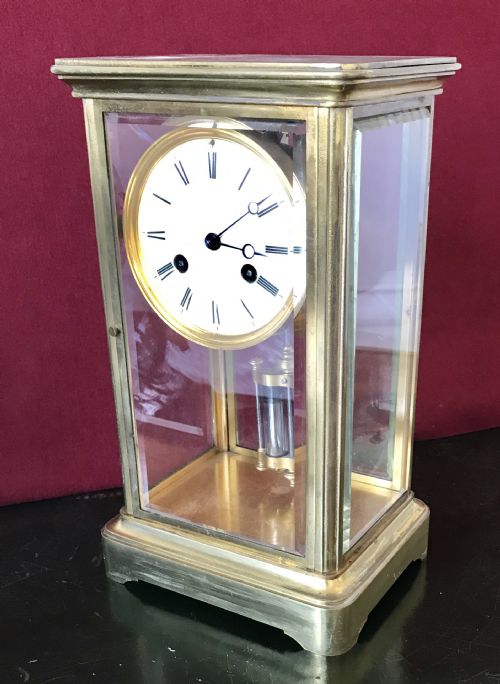
These French brass crystal regulator clocks are precision timepieces housed in transparent cases that let you watch the intricate movement from every angle.
French Brass Crystal Regulator
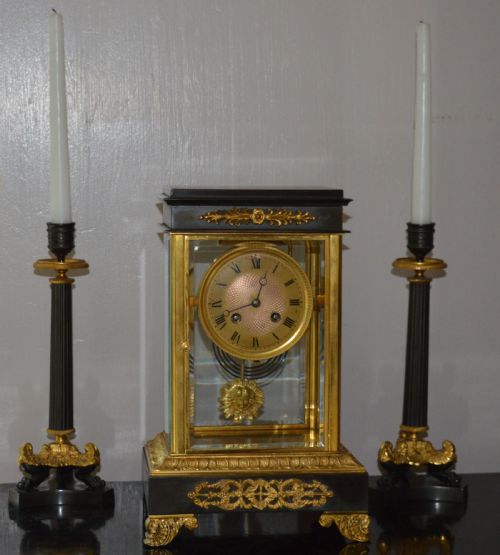
A French brass crystal regulator is a mantel clock designed with bevelled glass panes on four sides, allowing an uninterrupted view of the interior mechanism and swinging pendulum.
You will regularly encounter these timepieces attributed to late nineteenth century periods, including Victorian eras and the Belle Epoque, often taking the form of mantel clocks or four glass clock sets.
The casing typically utilises brass, gilt brass, or ormolu frames, frequently accented with painted enamel dials or coloured side panels in shades of blue, pink, and green.
Materials and construction methods
Makers constructed the structural framework using heavy cast brass or gilt bronze, sometimes referred to as ormolu, which provided the necessary rigidity to support thick bevelled glass panels without flexing.
Clockmakers fitted delicate white enamel dials with fine numerals, occasionally pairing them with matching painted enamel panels on the body or pendulum bob for decorative effect.
Materials recorded across the inventory include gilt brass, bevelled glass, ormolu, paste stones, and hand-painted enamel.
Distinctions in quality and execution
Quality separates simple production models from superior examples through the crispness of the brass casting, the depth of the fire gilding, and the precision of the bevelled edges on the glass panes.
The complexity and refinement of the movement itself, particularly when bearing the mark of an established maker like Samuel Marti or L Epee, elevate the standing of a piece.
Samuel Marti et Cie·L Epee France
The French Brass Crystal Regulator Glossary
- Crystal regulator
- A mantel clock featuring glass panels on all four sides enclosing a visible pendulum and movement. The term denotes transparency rather than lead crystal glass.
- Bevelled glass
- Glass panes with angled, polished edges fitted tightly into the brass framework. This technique adds depth and catches the light distinctively.
- Ormolu
- Finely ground high-carat gold applied to a bronze or brass base using mercury amalgamation. It yields a rich, durable metallic finish.
- Enamel
- Fused powdered glass applied to a metal substrate and fired at high temperatures. It creates smooth, glossy dial faces resistant to fading.
- Pendulum
- The suspended weight that swings back and forth to regulate the clock mechanism. In these pieces, the bob is frequently decorative or temperature-compensated.
French Brass Crystal Regulator: Frequently Asked Questions
How do I wind a crystal regulator clock?
Most models require a dedicated winding key inserted into the dial face to tension the mainsprings for both timekeeping and striking trains. Take care not to overwind the springs.
Ensure you turn the key smoothly and stop the moment you feel firm resistance to protect the antique mechanism from internal strain.
Where should I place a crystal regulator in my home?
Position the clock on a stable mantelpiece, shelf, or cabinet away from direct sunlight, heavy foot traffic, and sudden temperature fluctuations. A sturdy surface prevents vibrations that can disrupt the pendulum swing.
Because the four glass sides offer a complete view of the interior, placement where light can pass through the case enhances the visual appeal.
How do I tell different periods apart?
Look to the decorative styles and casing materials, as pieces from the 1870s and 1880s often display robust Second Empire or early Victorian proportions. Items from the 1890s through 1900 frequently incorporate Belle Epoque or Louis XVI style motifs.
Later mid-century examples reflect updated manufacturing techniques while maintaining the traditional four-glass architectural layout.
Why does my clock gain or lose time?
Changes in room temperature and humidity cause the metal pendulum rod to expand or contract slightly, altering the timing rate. You can adjust this by turning the small regulation nut on the pendulum.
Ensure the clock sits completely level on its surface using a spirit level, as an uneven stance causes the beat of the escapement to become erratic.