
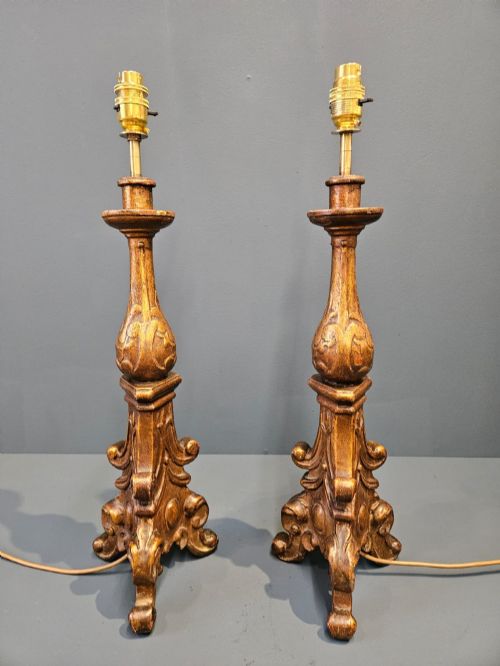


French Altar Candlestick Lamps
French altar candlestick lamps bring sacred grandeur into domestic spaces, offering a striking blend of ecclesiastical history and warm interior lighting.
French Altar Candlestick Lamps
When you search for french altar candlestick lamps, you encounter ecclesiastical metalwork and carved timber adapted into practical table lighting. These pieces originate predominantly from the nineteenth century, reflecting periods such as the Victorian era, Gothic Revival, and Baroque Revival.
The selections on this page span from tall carved oak and giltwood examples to heavy brass and silver-plated church pieces. You will find single table lamps alongside matching pairs and occasional multi-armed candelabras.
The forms draw directly from continental church furnishings, carrying the imposing height and architectural detailing intended for altars. Adaptation into lamps generally involves running wiring through the central shaft while preserving the original pricket or socket top.
How they were made
Maker workshops utilised heavy casting for brass and bronze components, producing robust structural bases that could support tall tapers during church services. Gilding, silver leaf, and silver plating were applied to timber and metal surfaces to create rich reflective finishes.
Carved timber examples relied on traditional hand woodworking techniques, shaping solid oak, giltwood, and general wood blocks into elaborate columnar or fluted forms. Artisans finished these wooden bodies with layers of gesso and gold leaf to mimic solid precious metals.
Many of these holy helpers spent decades holding wax before trading holy water for table duty and a modern plug.
What varies in quality
The distinction between standard and superior pieces rests in the crispness of the hand-carving and the thickness of the metal casting. Finely chased brass work and deep, confident chisel marks on carved timber indicate a higher standard of workshop production.
The integrity of the original surface finish, whether aged giltwood, patinated brass, or worn silver leaf, dictates the visual presence of the lamp. Pieces retaining their unpolished historical patination command greater aesthetic weight in a room.
The French Altar Candlestick Lamps Glossary
- Pricket stick
- A candlestick featuring an upward-pointing metal spike designed to secure a wax taper. This form sits at the heart of traditional altar lighting.
- Giltwood
- Timber that has been coated with a thin layer of gold leaf or gold paint. It provides a luminous, decorative surface on carved lamp bases.
- Gothic Revival
- An architectural and decorative style popular during the nineteenth century. It draws inspiration from medieval ecclesiastical design.
- Baroque Revival
- A theatrical design movement reviving seventeenth-century ornamentation. It brings exuberant curves and heavy scrolling to altar pieces.
- Ecclesiastical
- Relating to the Christian Church or its clergy. Pieces described thus were originally made for liturgical use in chapels or cathedrals.
French Altar Candlestick Lamps: Frequently Asked Questions
How do I choose the right lampshade?
Select a shade that complements the substantial height and heavy base of these ecclesiastical fixtures without overwhelming the carved or cast details. Neutral linen or silk shades allow the historic metalwork or giltwood to remain the visual focus.
Ensure the proportions balance the vertical stretch of the shaft. A wider drum or empire shade typically grounds the towering silhouette effectively.
Were these originally used in churches?
The majority of these pieces began their lives on church altars or in chapel sanctuaries holding large ceremonial candles. Their imposing scale was designed to project light and majesty across vast sacred spaces.
Later conversions adapted these liturgical objects for domestic illumination by discreetly integrating electrical wiring through the original structure.
How do I tell nineteenth century pieces apart?
Examine the construction methods, weight of the materials, and surface wear to distinguish nineteenth-century examples. Brass castings from this era tend to feel heavier and show deeper patination than later reproductions.
Stylistic cues such as strict Gothic Revival arches or exuberant French Rococo scrolls help anchor pieces within specific decades of the eighteen-hundreds.
Can I place these on a sideboard?
Their significant height makes them well-suited for placement on sideboards, side tables, or deep mantelpieces where they can command vertical space. Ensure the surface is stable enough to support the substantial weight of cast metal or dense carved timber.
Position them away from high-traffic walkways to protect the delicate wiring adaptations and aged surface finishes.