
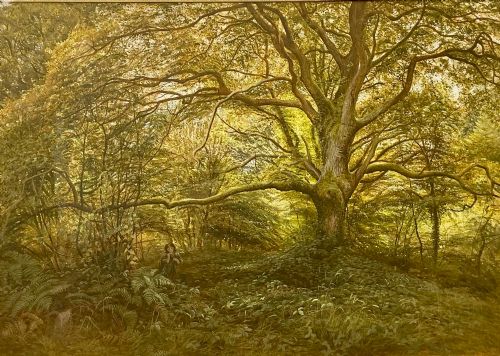


Framed Woodland Watercolour Painting
These framed woodland watercolour painting examples capture shaded paths and bluebell woods on paper beneath glass.
Framed Woodland Watercolour Painting
A framed woodland watercolour painting brings nineteenth-century and early twentieth-century tree-lined paths, riverscapes and country thickets directly into domestic rooms. These works depict rural British and Irish scenery through gentle pigment washes on paper.
The selections span Victorian landscapes, Edwardian botanical floors, and early twentieth-century fine art interpretations. Buyers encounter miniature paintings alongside larger signed watercolours housed in period wooden and gilt frames.
How They Were Made
Artists applied watercolour pigment directly onto paper surfaces, utilising the white of the sheet to create luminosity within forest clearings and undercanopies. The resulting brushwork records quick atmospheric shifts in light across leaves and bark.
Framing typically involves wood and glass enclosures that protect the delicate water-soluble pigments from moisture and handling over the decades. Gilt accents on frames complement the warmer tones found within autumn river scenes and spring bluebell glades.
The listings span from nineteenth-century Victorian works to nineteen sixty compositions, utilising paper, watercolour, glass, wood, and gilt.
What Varies In Quality
Quality rests upon the artist's ability to render light through translucent washes without muddying the shadows beneath forest branches. Stronger examples demonstrate confident brushwork that defines tree structure and foliage with distinct clarity.
The integrity of the paper support and the preservation of the pigment beneath the glass influence desirability. Surviving frames contemporaneous to the painting also contribute to the overall coherence of the piece.
Bonomi Edward Warren·William Hoggatt·Alfred Grey RHA·Henri Joseph Harpignies·Walter Follen Bishop·Rowland Henry Hill·Edmund George Warren·William Lucas·Charles James Adams·George Graham·Charles Edward Holloway·Beatrice Parsons·Charles Edward Wilson·Donald Watson
The Framed Woodland Watercolour Painting Glossary
- Watercolour pigment
- Finely ground colour particles suspended in a water-soluble binder applied to paper. This medium allows for luminous layering and delicate washes.
- Gilt
- A thin layer of gold leaf or metallic gilding applied to wooden frames. It enhances the visual weight and period character of the presentation.
- Barbizon School
- A nineteenth-century art movement focused on tonal realism and direct observation of nature. It heavily influenced subsequent landscape painters.
- Miniature painting
- A highly detailed small-scale artwork requiring fine brushwork. These pieces often depict intimate woodland scenes or figural studies.
Framed Woodland Watercolour Painting: Frequently Asked Questions
How should I hang a watercolour painting?
Keep watercolours away from direct sunlight to prevent the pigments from fading permanently over time. Stable indoor humidity protects both the paper support and the wooden frame.
Ensure the hanging wall remains free from dampness to safeguard the interior glass and backing boards.
What periods do these paintings cover?
The selections span from the nineteenth century through the Victorian and Edwardian eras into the mid twentieth century. Dates range from the late Victorian period up to nineteen sixty.
Earlier nineteenth-century pieces often display traditional naturalist techniques while later works incorporate impressionist tendencies.
Are original frames important?
Period frames matching the creation date of the watercolour enhance historical context and visual harmony. Wood and gilt mouldings reflect the aesthetic preferences of their specific decade.
Replacing a damaged period frame requires careful matching of wood tones and profile styles.