
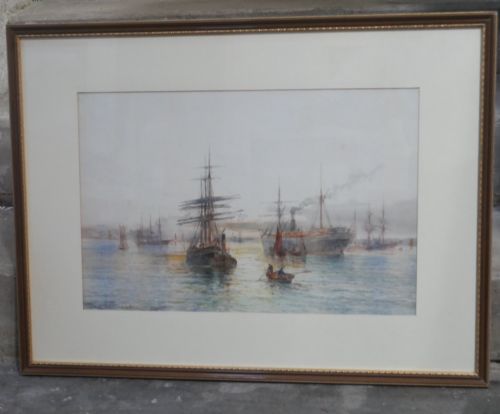


Framed Tall Ship Painting
A framed tall ship painting brings the salt and canvas of maritime history straight onto the wall.
Framed Tall Ship Painting
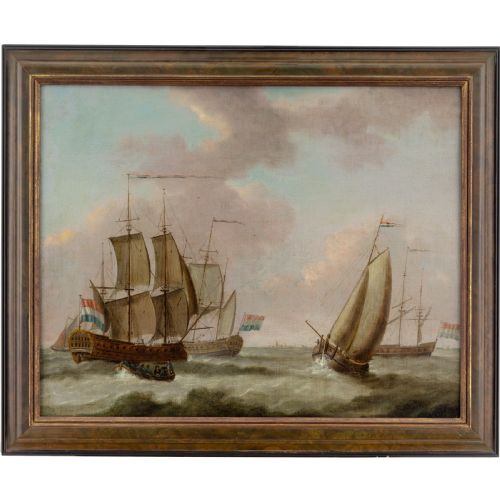
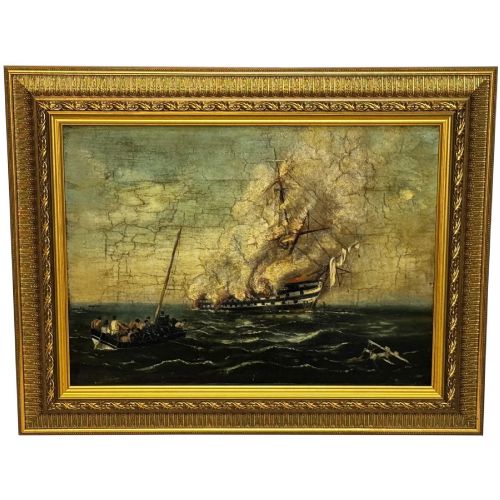
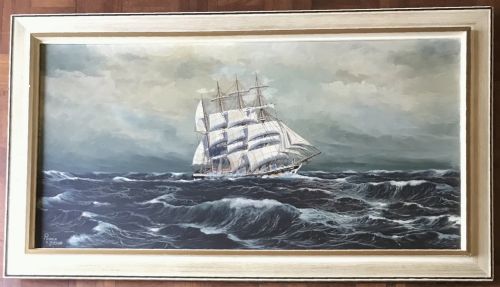
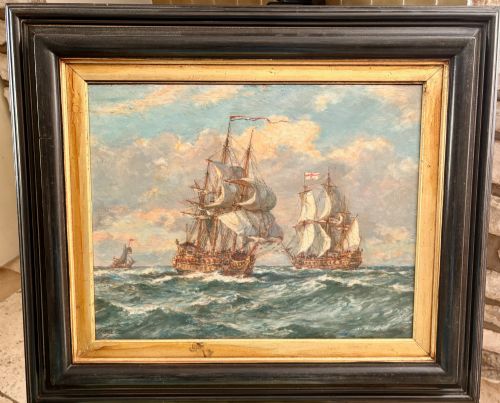
A framed tall ship painting captures large sailing vessels upon the open sea, inside harbour scenes or battling heavy weather. When searching for a framed tall ship painting, a buyer meets works spanning the Regency, Victorian and Edwardian eras up to the nineteen-thirties.
The most common pieces on this page are nineteenth-century oils on canvas and board, framed in period wood or giltwood. These works range from detailed port portraits to stormy seascapes depicting barques, frigates and four-masted vessels.
Subjects often record specific historic locations such as Dublin Bay, Portsmouth Harbour or off Gibraltar. Alongside traditional oils, collectors find occasional watercolours and unique hybrid objects like mirrors inset with maritime scenes.
How they were made
Artists painted primarily with oil paint upon prepared canvas, wooden panel or board, capturing rigging and hull details with fine brushes. Watercolours on paper also appear, preserving lighter washes for skies and coastal light.
Frames form an essential part of these pieces, constructed from solid wood and gilded plaster moulded in styles from Regency sweeps to Queen Anne Revival. Protection comes from traditional glass coverings on works executed on paper.
One unexpected piece combines a Queen Anne Revival yew wood mirror with a framed maritime scene tucked inside.
What varies in quality
Quality rests upon the artist's command of maritime rigging, hull anatomy and the fluid movement of water. Skilled painters render light across billowing canvas and turbulent waves with convincing depth.
The integrity of the original frame and the stability of the canvas or board determine the condition and visual impact of the piece. Works bearing clear attribution to known marine hands command closer attention from collectors.
Bernard Gribble·Dion Pears·John Callow·Frank Wood·Joseph Heard·George Stainton·Stephen Brownlow
The Framed Tall Ship Painting Glossary
- Barque
- A sailing vessel with three or more masts having square sails on the foremast and mainmast and mizzenmast rigged fore and aft. This hull type frequently appears in nineteenth-century maritime art.
- Giltwood
- Wood carved and coated with a thin layer of gold leaf or metallic gilt gesso. Many period frames utilise this finish to complement marine canvases.
- Seascape
- A work of art depicting the sea, ships and coastal views. These subjects form the core of traditional marine painting.
- West Indiaman
- A large merchant ship built for trade between Europe and the West Indies. These armed vessels are often the subject of detailed nineteenth-century ship portraits.
Framed Tall Ship Painting: Frequently Asked Questions
How do I date a ship painting?
Dating relies on the ship rig, clothing styles of any figures ashore, and the construction of the canvas or stretcher frames. Nineteenth-century works often bear specific stylistic traits of maritime realism.
Framing styles also offer clues, as many paintings retain their original giltwood or moulded wooden surrounds from the Victorian or Edwardian periods.
Where should I hang a marine painting?
These works suit dining rooms, studies or hallways where natural light illuminates the dark tones of oil paint and the gleam of gilt frames. Keep them away from direct sunlight and damp walls to protect the canvas and wood.
Pairing a framed tall ship painting with traditional wood furniture highlights the maritime aesthetic established in the nineteenth century.
What is a ship portrait?
A ship portrait is a specialised marine painting commissioned to record a specific vessel with architectural accuracy. Artists paid close attention to hull lines, flag signals and rigging details.
These paintings often show the named ship from a broadside perspective, sometimes entering or leaving a recognised port.
Are watercolours as durable as oils?
Watercolours on paper require glass protection and stable indoor environments to prevent fading from light exposure. They offer a delicate transparency quite distinct from heavy oil paint.
Oils on canvas or board tolerate ambient light better, though both mediums benefit from stable humidity away from heat sources.