
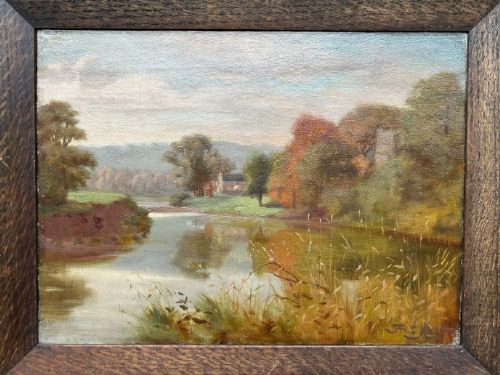
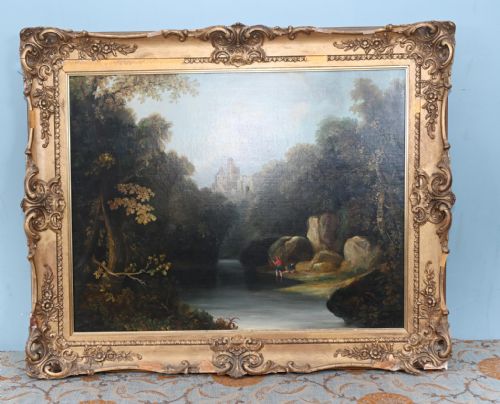


Framed Riverbank Oil Canvas
A framed riverbank oil canvas captures water and pastoral life, bringing nineteenth-century atmosphere and varied Impressionist brushwork directly to a wall.
Framed Riverbank Oil Canvas
A framed riverbank oil canvas depicts rural waterscapes, featuring fishermen, cattle, boats, and figures gathered along banks. These works range from late nineteenth-century Victorian naturalism and French Barbizon scenes to mid-century impressionism.
Buyers encounter subjects spanning English country school landscapes, Scottish views, and French chateau settings. The selections show artists rendering changing light upon rivers, lakes, and becks across several decades.
Materials and construction
Painters applied oil paint directly onto stretched canvas surfaces using traditional brushes to build texture and tone. Canvases are housed within protective surrounds constructed from wood, gesso, and gilt wood frames.
The physical build combines pigmented oil mediums with organic textile supports, secured inside decorative mouldings that define each composition's perimeter.
Several canvases record quiet moments of waiting for a bite, featuring attentive ducks and patient anglers along the river.
Judging quality and execution
Quality rests in the handling of light and atmosphere across the water and foliage, distinguishing fluid impressionist brushwork from stiff academic execution. The precision of figural elements, such as anglers or cattle, elevates certain canvases above standard topographical records.
Frame craftsmanship also plays a role, as original gilt wood and moulded gesso surrounds complement the preservation and period integrity of the underlying canvas.
Frederick Marriott·Archibald Kay·Frank Hyde·William Manners·Phyllis Morgans·Harry Pennell·Constant Ludovic Artz·Henry Cheadle·T.B. Garvie·Robert John Hammond·Augustus William Ennes·Sonia Mervyn·Thomas E. Francis·George Neil
The Framed Riverbank Oil Canvas Glossary
- Oil on canvas
- A painting technique where pigmented oil paint is applied to a woven fabric support stretched over a wooden frame. This method allows for rich blending and textured impasto application.
- Gilt wood
- Wood coated with a thin layer of gold leaf or metallic gilt powder. It is commonly utilised for decorative antique picture frames.
- Gesso
- A paint mixture consisting of a binder mixed with chalk, gypsum, or pigment. It prepares wooden frame surfaces for gilding and ornamentation.
- Barbizon style
- A nineteenth-century French landscape movement focusing on realism, tonal subtlety, and direct observation of nature. Practitioners often depicted rural riverbanks and forest interiors.
- Impressionism
- A style of painting characterised by relatively small, thin, yet visible brush strokes and an emphasis on accurate depiction of light. Mid-century variants continue this focus on atmospheric outdoor settings.
Framed Riverbank Oil Canvas: Frequently Asked Questions
What periods do these riverbank oil paintings date from?
The available canvases primarily span the nineteenth and twentieth centuries, encompassing Victorian naturalism, 1900s impressionism, and mid-century modern interpretations.
Specific dates within listings stretch from the 1860s through the 1960s, reflecting changing regional schools across Britain and France.
How were these framed riverbank oil canvas works originally displayed?
These paintings were designed to hang in domestic interiors, parlours, and drawing rooms within homes of the period. Their heavy wooden and gilt frames protected the canvas edges while projecting the artwork outward from the wall.
Today, they serve a similar decorative function in modern spaces, bringing historical depth and pastoral subject matter into living areas.
How do I identify a Barbizon style landscape?
Barbizon style works focus on moody, naturalistic outdoor scenes with soft lighting and muted earth tones. They frequently picture quiet riverbanks, trees, and rustic figures rather than grand historical narratives.
This French-influenced approach prioritises atmospheric mood over rigid academic precision.
Are all listed canvases signed by the artist?
Many listings attribute works to specific named artists such as William Manners, Frank Hyde, or Henry Cheadle, often bearing signatures on the canvas.
Other examples are attributed to regional schools or remain unsigned, representing the broader output of anonymous nineteenth-century painters.