
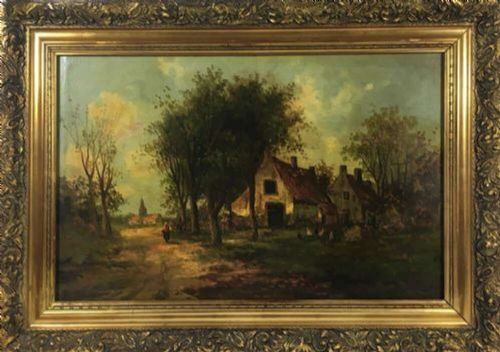


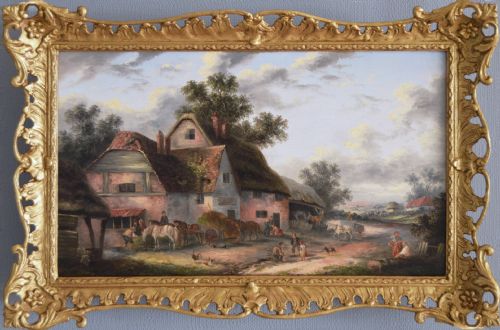

Framed Pastoral Village Oil Painting
A framed pastoral village oil painting brings nineteenth-century rural life into your home with oil paint on canvas.
Framed Pastoral Village Oil Painting
A framed pastoral village oil painting depicts nineteenth-century rural life, farmyards, riverbanks, and country cottages. These works capture English country scenes and French farmyards through the lens of Victorian and Barbizon School aesthetics.
Most examples found here date from the nineteenth century, including specific years like 1860, 1870, 1910, and 1930. Artists render village taverns, windmills, and figures on riverbanks using traditional oil painting techniques on canvas.
The selection ranges from British Impressionism to Victorian Traditional styles, created by named painters such as Charles Vickers, B W Leader, William Greaves, Stephanie Cooper, John Holland Snr, and Georgina Lara.
How they were made
Makers apply oil paint to stretched canvas, building up rich textures and deep colour tones for landscape and figurative elements. Canvases are secured within wooden frames that frequently incorporate gilt, gold leaf, and giltwood finishes.
Artists utilise traditional nineteenth-century studio practices, balancing fine brushwork with broader impressionistic strokes to render village architecture, foliage, and water. The physical support relies on sturdy wooden stretchers housed inside decorative period frames.
Listings span the nineteenth and early twentieth centuries, utilising oil paint, canvas, wood, giltwood, and gold leaf.
What varies in quality
The distinction between standard works and finer examples lies in the precision of the brushwork and the articulation of light across the village landscape. Superior paintings demonstrate a confident handling of figures and architecture that brings depth to the canvas.
Framing also influences the overall presentation, with original giltwood and gold leaf frames offering a more integrated historical object. The reputation of the artist, from listed historical painters to regional practitioners, shapes the standing of each piece.
Charles Vickers·B W Leader·William Greaves·Stephanie Cooper·John Holland Snr·Georgina Lara
The Framed Pastoral Village Oil Painting Glossary
- Oil on Canvas
- Pigment mixed with drying oil applied to a woven fabric support. This technique allows for rich blending of colour and varied surface textures.
- Giltwood
- Wood carved and covered with a thin layer of gold leaf or metallic powder. It provides decorative framing for nineteenth-century artworks.
- Barbizon School
- A mid-nineteenth-century French art movement focused on realism in landscape painting. Painters of this circle emphasised rural life and direct observation of nature.
- Victorian Traditional
- An artistic approach adhering to established academic standards of the nineteenth century. These works prioritize clear narrative subjects and precise draughtsmanship.
Framed Pastoral Village Oil Painting: Frequently Asked Questions
What periods do these paintings cover?
The available selection spans the nineteenth and early twentieth centuries, with specific dates including 1860, 1870, 1910, and 1930.
These dates align with Victorian, Barbizon School, and British Impressionism styles.
Are the frames original?
Frames are constructed from wood and frequently feature gilt, gold leaf, or giltwood finishes appropriate to the period.
Materials vary from simple wooden surrounds to ornate gilded mouldings designed to complement the oil painting.
Who painted these village scenes?
Works are attributed to both known nineteenth-century artists and specific historical painters like Charles Vickers, William Greaves, and Georgina Lara.
Some pieces are associated with the Barbizon School or British Impressionism.
What materials were used?
Artisans employed oil paint on canvas stretched over wooden frames, complemented by giltwood and gold leaf framing.
The combination of canvas and oil paint defines the physical medium across the entire selection.