



Framed Horse Cart Artwork
Framed horse cart artwork brings rural commerce and pastoral rhythm onto the wall through watercolours, oils, and early prints.
Framed Horse Cart Artwork
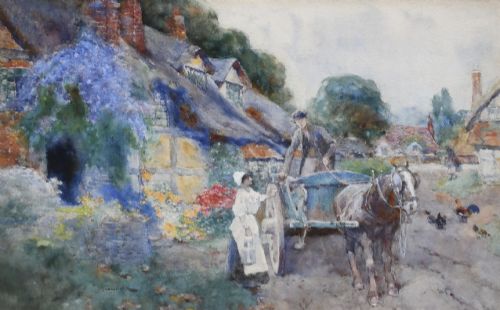
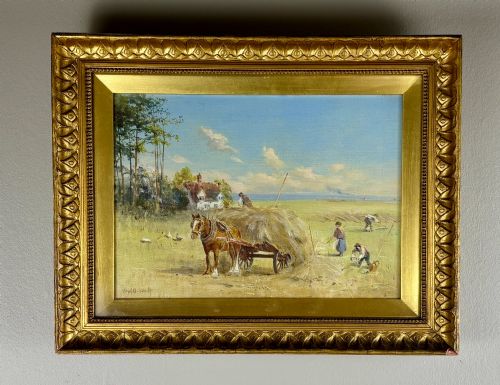
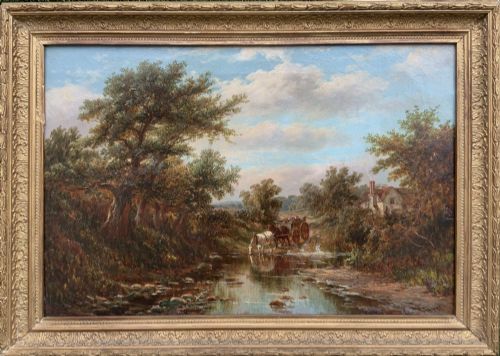
These works capture agrarian labour, roadside transport, and country landscapes through the motif of the horse-drawn vehicle. When searching for framed horse cart artwork, collectors encounter nineteenth-century watercolours, early twentieth-century oil paintings, and original prints depicting hay carts, market carts, and timber wagons.
The selections span Victorian pastoral scenes, British realism, and Edwardian watercolours created by notable painters of the period. Forms range from intimate chalk drawings in walnut frames to substantial oil paintings on canvas.
Rural and coastal settings dominate the subjects, featuring figures and horses engaged in seasonal work such as harvesting, seaweed gathering, and logging.
Materials and construction
Artists utilised watercolour pigment on paper, oil paint on canvas, and gouache or ink, often protected behind glass in wood or giltwood frames. Canvas supports allow for textured oil applications in landscape scenes, whilst paper supports suit delicate washes in watercolours.
Original frames frequently incorporate traditional timber mouldings, matching the period of the painting or drawing they enclose.
Framed Horse Cart Artwork Retail Price Guide 2026
Typical asking prices for framed horse cart artwork among the pieces listed under this phrase on Sellingantiques today, from the lower quarter to the upper quarter. They describe what is for sale here now, not the wider market.
Horses working in watercolour endure damp British weather while fishermen haul seaweed on Guernsey shores.
Assessing quality
Quality rests in the handling of light, atmospheric depth, and the anatomical rendering of horses and figures within the landscape. Works by listed artists display confident brushwork and precise draughtsmanship that elevate simple rural subjects.
The preservation of the pigment, the stability of the paper or canvas, and the integrity of the original framing contribute significantly to the standing of each piece.
Cecil Charles Windsor Aldin·James William Booth·Léon Joseph Voirin·John Augustus Atkinson·Edward Brice Stanley Montefiore·George Hamilton Constantine·Will Anderson·Charles H Poingdestre·Herbert Royle·William Manners·Walter Duncan·George Smith·Henry H Parker·Alfred George Stevens·Fred Lawson·Reginald Mills·Robert Thorne Waite·James Edwin Meadows
The Framed Horse Cart Artwork Glossary
- Watercolour
- A painting method in which the paints are made of pigments suspended in a water-based solution. This technique produces luminous washes often seen in nineteenth-century landscapes.
- Gouache
- An opaque water-based paint that includes a white pigment to create denser, heavier colour fields than traditional watercolour. It appears frequently in twentieth-century works on paper.
- Giltwood
- Wood that has been treated with a thin layer of gold leaf or gilt paint. This finish frequently highlights the decorative moulding of period frames.
- Etching
- A printmaking process where lines are incised into a metal plate with acid before ink is applied. These works show fine linear detail and tonal precision.
Framed Horse Cart Artwork: Frequently Asked Questions
What periods do these artworks come from?
The pieces span from the early nineteenth century through the Edwardian era up to the nineteen-thirties. Most examples date from the Victorian and late nineteenth-century periods.
Watercolours and oil paintings from this span reflect changing British and European approaches to rural realism and pastoral landscape painting.
How are these paintings and prints framed?
Many works retain their period wooden frames, including walnut profiles and giltwood surrounds. These housings complement the traditional nature of the imagery.
Glass often protects works on paper such as watercolours, chalk drawings, and etchings from environmental damage.
What subjects appear besides horse carts?
Compositions frequently incorporate cottages, figures, coastal activities like kelp gathering, and seasonal tasks such as haymaking and logging. The overarching focus remains on nineteenth and early twentieth-century rural life.
Landscapes range from Yorkshire and Lancashire scenes to coastal views and continental settings.
How do I care for framed watercolours?
Keep watercolours and works on paper away from direct sunlight to prevent the fading of pigments. Stable indoor humidity levels protect both the paper support and the wooden frame.
Glazing should remain intact to shield the delicate medium from airborne moisture and dust.