


Framed Farm Landscape Art
Framed farm landscape art brings the rhythm of rural life, heavy working horses and pastoral fields directly onto the wall.
Framed Farm Landscape Art
When searching for framed farm landscape art, a buyer encounters oil paintings and watercolours that record rural scenes, agricultural labour and livestock from the nineteenth and twentieth centuries. These works document traditional country life, showing working horses, cattle, sheep and harvest scenes across British, French and Belgian schools.
The most frequent pieces on this page are oil paintings on canvas or board and watercolours on paper, typically housed within period wooden or gilt frames. Subjects range from detailed depictions of farmyards and heavy shires to broader Impressionist and Realist views of fields and pastures.
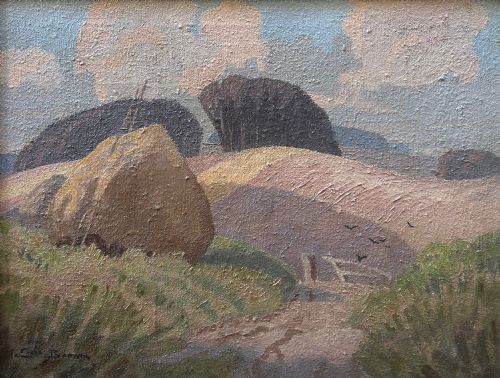
Spanning from the early nineteenth century through to the mid-twentieth century, these artworks capture the changing aesthetics of pastoral painting. Stylistic approaches move from precise Victorian realism toward looser British and Scottish impressionism in later decades.
How they were made
Artists painted primarily with oil on canvas, oil on board, or applied watercolours onto heavy paper, building up rural scenes through layered brushwork and pigment. Mixed media and original etchings also appear among the selections, showing a variety of graphic techniques used to render farm animals and landscapes.
Canvases and panels sit inside wooden frames, frequently finished with gilt or ebonised surfaces that complement the earthy tones of the pastoral subjects. The physical construction relies on traditional stretching and framing methods appropriate to the Victorian, Edwardian and mid-century periods.
Listings feature works across oil paint, canvas, wood, and paper, spanning the nineteenth century through the 1960s.
What varies in quality
Quality in these pastoral scenes rests upon the artist's command of anatomy, light and atmospheric perspective when rendering animals and working environments. Stronger works demonstrate precise observation in the rendering of heavy horses, cattle and human figures within the landscape.
The handling of the medium itself distinguishes the range, where confident brushwork in oil or delicate control in watercolour creates depth and texture. Original frames that suit the period and scale of the painting also influence the overall integrity of the piece.
Herbert Dicksee·Raimond Louis Lecourt·Franz van Severdonck·James William Booth·John Frederick Herring Jnr·Ernest Pile Bucknall·Samuel Joseph Clark·John Atkinson·Charles Vickers·Percival Glenfern·John Frederick Herring·George Soper·Pierre Emmanuel Dielmans·Owen Bowen·John Frederic Greenwood·Robert Russell MacNee·Claude Cardon·Rowland Henry Hill·Thomas Sidney Cooper·John R K Duff·Henry Birtles·Ernest Higgins Rigg
The Framed Farm Landscape Art Glossary
- Oil Paint
- A slow-drying paint made from pigment suspended in oil, typically linseed, allowing for rich colour blending and textured impasto surfaces. This medium dominates nineteenth-century and mid-century farm paintings.
- Watercolour
- A painting method where coloured pigments are suspended in a water-based solution, applied to paper to create translucent washes. It appears frequently in Edwardian and early twentieth-century rural scenes.
- Etching
- A printmaking technique where lines are bitten into a metal plate with acid before ink is applied and pressed onto paper. This process creates fine, detailed linear artwork.
- Impressionism
- An art style focused on capturing the visual impression of a moment, paying attention to shifting light and loose brushstrokes rather than tight detail. Scottish and British variations of this style appear in later farming scenes.
- Gilt
- A thin layer of gold leaf or gold paint applied to wooden frames to give a decorative metallic finish. It enhances the visual weight of traditional oil paintings.
Framed Farm Landscape Art: Frequently Asked Questions
What subjects appear in farm landscape art?
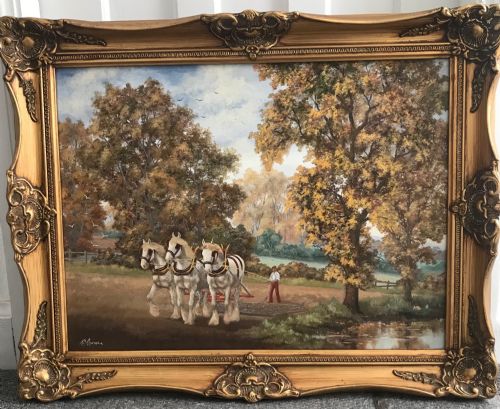
These artworks depict agricultural scenes, including heavy shire horses ploughing fields, cattle resting by rivers, and shepherds tending flocks. Farmyards, hay carts, and daily rural labour also feature prominently.
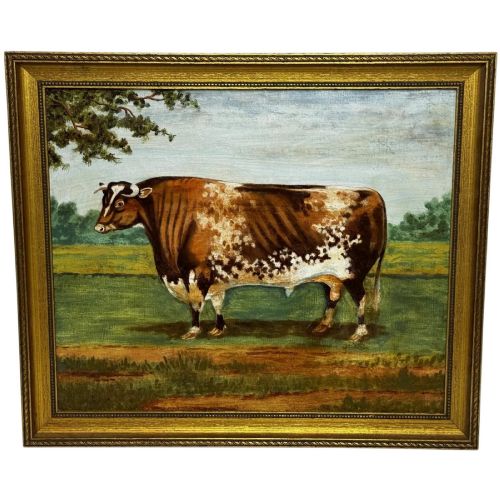
Many pieces highlight specific farm animals such as shorthorn bulls, pigs, chickens, and ducks alongside farm workers and country homesteads.
How do I date a farm painting?
Dating relies on stylistic clues, clothing styles of farm workers, framing materials, and the documented active years of the artist. Victorian pieces often show high realist detail, while mid-century works display looser brushwork.
Signatures, inscriptions on the reverse, and the type of canvas or paper support provide additional chronological markers.
Where should I hang a farm landscape?
These works suit dining rooms, studies, or hallways where traditional wooden furniture and neutral wall colours can complement the earthy palette. Matching the frame to existing interior woodwork helps integrate the painting into the room.
Keeping the artwork away from direct sunlight protects oil pigments and watercolours from fading over time.
Are watercolours as durable as oils?
Watercolours on paper require framing behind glass with acid-free mounts to protect the pigment and paper from moisture and light damage. Oil paintings on canvas are more robust but still benefit from stable indoor humidity.
Both mediums have survived for over a century when given proper care and stable environmental conditions.