


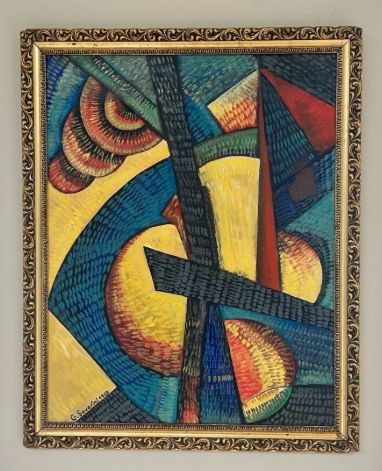


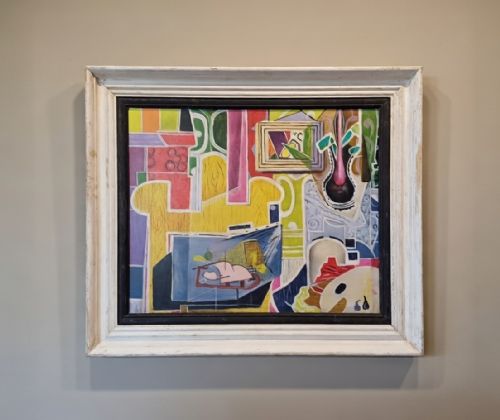


Framed Abstract Canvas
A framed abstract canvas brings mid-century modern character to a room through bold brushwork and distinctive composition.
Framed Abstract Canvas
When you search for a framed abstract canvas, you encounter mid-century paintings spanning the decades from the 1940s to the 1960s. These works incorporate styles such as mid-century modernism, abstract expressionism, and modernist abstraction.
The selections on this page include oil paintings, oil on canvas, and works on board housed in wood frames. Subjects range from abstract cityscapes and still lifes to landscapes and portraits created by English, French, and Spanish artists.
You will find pieces originating from specific artistic circles, including the St Ives school and Groupe De Gravelines. The physical presentations vary from large impasto surfaces to relief paintings and framed canvases dated across the mid-twentieth century.
Materials and Techniques
These works rely on oil paint applied to canvas or board, often utilising thick impasto techniques that build physical texture on the surface. Painters of this era also employed acrylic and mixed media within wood frames designed to complement the composition.
Supports include stretched canvas, loose canvas, and rigid board, with frames constructed from wood to enclose and protect the artwork. The application ranges from flat colourist planes to heavy relief work associated with modernist circles.
The periods represented on this page span the 1940s, 1950s, and 1960s.
Evaluating the Works
Quality rests upon the strength of the composition, the handling of the medium, and the integrity of the canvas and frame. Works by documented artists with established exhibition histories or connections to notable schools demonstrate greater depth than anonymous student pieces.
The interaction between the paint layer and the wood frame contributes to the overall cohesion of the piece. Superior examples display confident brushwork and stable materials that have aged gracefully across the decades.
Tony Giles·Denis Mitchell·Raymond Picque·William Littlejohn·William McCance·Antonio Ferri·William Ernst Burwell
The Framed Abstract Canvas Glossary
- Impasto
- Paint applied thickly to a canvas, leaving visible brush or palette knife marks that stand proud of the surface.
- Mid-Century Modern
- A design and art style spanning roughly the 1940s to the 1960s, characterised by clean lines and abstraction.
- St Ives School
- A group of artists based in Cornwall who developed significant modernist and abstract painting traditions.
- Abstract Expressionism
- A post-second world war art movement focused on spontaneous expression and non-representational forms.
- Canvas
- A heavy woven fabric stretched across a wooden frame to serve as a sturdy support for oil and acrylic painting.
Framed Abstract Canvas: Frequently Asked Questions
How do I date a framed abstract canvas?
Examine the materials, canvas preparation, and framing style alongside any visible signatures, dates, or gallery labels on the reverse.
Mid-century works from the 1940s to the 1960s often display specific modernist palettes and stretcher construction typical of that era.
What is the difference between canvas and board supports?
Canvas provides flexibility and texture through woven fabric stretched over a wooden frame, whilst board offers a rigid and completely flat painting surface.
Both materials were widely utilised by mid-century abstract painters depending on their preferred working method.
How should I hang and light an abstract painting?
Position the centre of the canvas at eye level on a wall with stable humidity and away from direct, harsh sunlight to protect the oil paint.
Use gentle, adjustable picture lighting to illuminate the impasto texture without creating unwanted glare on the surface.
Are these frames original to the paintings?
Many mid-century works retain their original wood frames, which were often selected or constructed by the artist or contemporary galleries to suit the composition.
Some pieces may have been reframed later to ensure structural support and visual harmony within modern interiors.