



Foyer Hanging Lamp
These foyer hanging lamp selections bring historical illumination to entryways, spanning the nineteenth century up to the nineteen-twenties.
Foyer Hanging Lamp
A foyer hanging lamp comprises overhead lighting fixtures designed specifically for hallways, vestibules, and entrance spaces. These pieces emerge in forms such as hall lanterns, pendant lights, and ceiling lights, reflecting periods ranging from the mid-nineteenth century to the early twentieth century.
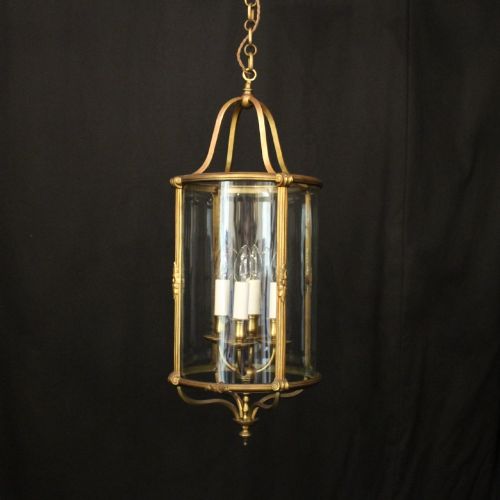
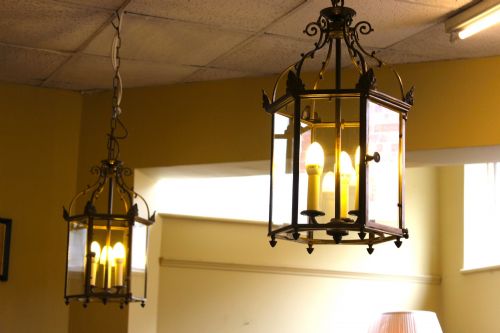
The most common examples on this page take the form of brass or gilded bronze lanterns with glass panels. Hexagonal and convex shapes appear frequently alongside multi-light configurations.
Origin points span English and French workshops, encompassing styles from the Victorian and Edwardian eras as well as French neoclassical and Gothic revival aesthetics.
How they were made
Makers utilised cast and forged metals including brass, bronze, and wrought iron to construct the structural frames of these lanterns. Gilt bronze and gilded brass finishes provide a reflective surface quality across many French and English examples.
Glass elements, including frosted panels and convex panes, fit securely within the metal frameworks to diffuse light from internal burners or bulbs. Wrought iron and heavy brass bars form rigid suspension loops and decorative scrolling.
Foyer Hanging Lamp Retail Price Guide 2026
Typical asking prices for foyer hanging lamp among the pieces listed under this phrase on Sellingantiques today, from the lower quarter to the upper quarter. They describe what is for sale here now, not the wider market.
Current selections span from the mid-nineteenth century to nineteen-twenty, featuring brass, bronze, and glass constructions.
What varies in quality
Quality rests in the crispness of metal casting and the depth of the gilding or patination. Heavier gauge brass and finely detailed bronze work distinguish the more ambitious pieces from simpler utility lighting.
The integrity of the glass panels and the precision of the joinery where the metal meets the glass indicate the standard of production. Original components and period-appropriate wiring accommodations also influence the standing of an individual lantern.
The Foyer Hanging Lamp Glossary
- Convex lantern
- A hanging light featuring outward-curving glass panels that expand the visual volume of the fixture. This shape disperses light widely across a hallway.
- Gilded bronze
- Metal alloy coated with a thin layer of gold or gold-coloured leaf to create a rich surface sheen. It appears often in French neoclassical lighting.
- Hexagonal lantern
- A six-sided hanging fixture with separate glass panes fitted into a rigid metal frame. This geometric form allows for multiple angles of illumination.
- Gothic revival
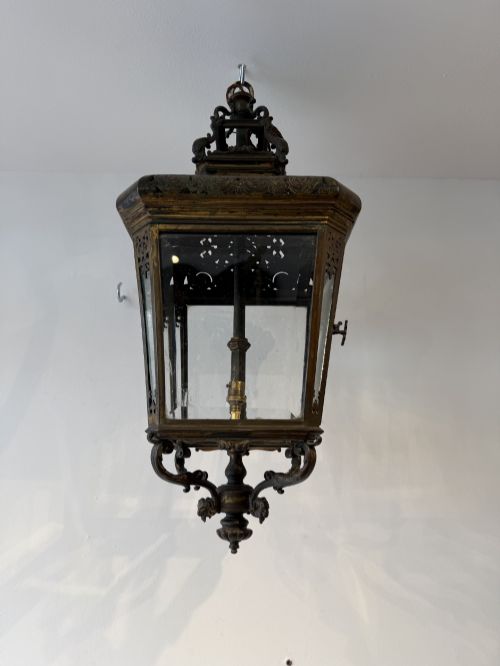
- An architectural and decorative style drawing inspiration from medieval forms, characterised by pointed arches and heavy ecclesiastical detail. Examples sometimes follow the manner of Pugin.
- Hall lantern
- A compact overhead light intended for narrow corridors and entrance vestibules. These fixtures hang close to the ceiling on short chains or rods.
Foyer Hanging Lamp: Frequently Asked Questions
Where should I hang a hall lantern?
These fixtures suit entrance halls, vestibules, and stairwells where overhead illumination serves a practical and welcoming purpose.
Ensure adequate ceiling height allows clearance for the drop of the chain or hanging bracket.
How do I date an antique lantern?
Dating relies on identifying the stylistic markers, metal types, and construction methods characteristic of periods like the Edwardian era or the nineteenth century.
Examine the casting quality and glass characteristics to confirm the production era.
Are these lamps wired for modern use?
Many examples feature updated wiring or rewiring to accommodate contemporary electrical standards while preserving the exterior housing.
Check individual descriptions for confirmation of current electrical readiness.
What is a convex lantern?
A convex lantern utilises curved glass panes that bulge outward from the metal frame.
This design diffuses light more broadly across an entryway than flat glass panels.