

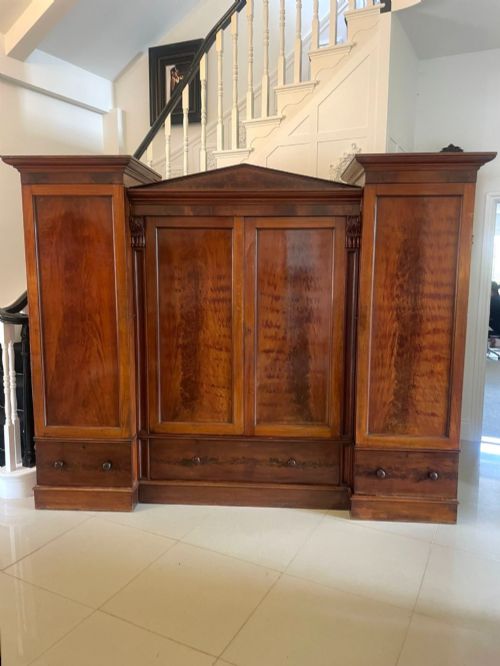
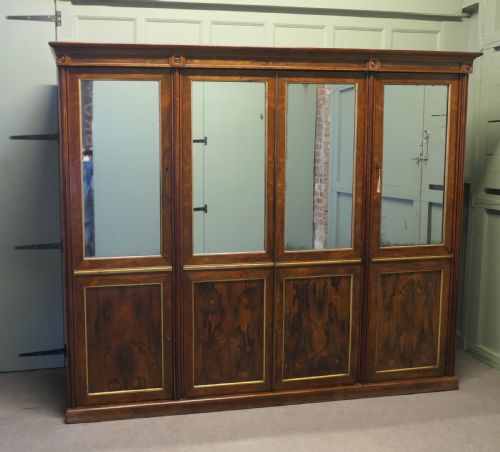


Four Door Clothes Press
These four door clothes press examples provide substantial storage while anchoring a bedroom with period presence.
Four Door Clothes Press
A four door clothes press offers extensive storage capacity through a combination of hanging space and linen slides, typically presenting a breakfront or wardrobe configuration. Buyers seeking a four door clothes press encounter pieces dating from the Regency, George IV, William IV, and Victorian eras, alongside Sheraton Revival interpretations.
Many examples double as linen presses or compactums, reflecting the adaptable storage needs of nineteenth-century households. The surviving pieces demonstrate the enduring utility of large-scale bedroom furniture from the nineteenth century.
Materials and construction methods
Cabinetmakers utilised solid mahogany and rosewood for structural integrity, often applying figured mahogany veneer to large expanses to create striking visual movement. Flame mahogany veneer enhances the primary display surfaces, while contrasting satinwood and boxwood provide linear stringing and delicate inlay.
Brass hardware secures the heavy doors and internal fittings, while glass panels occasionally feature in the upper sections of breakfront wardrobes. Construction relies on traditional joinery techniques capable of supporting the substantial weight of these architectural bedroom pieces.
Four Door Clothes Press Retail Price Guide 2026
Typical asking prices for four door clothes press among the pieces listed under this phrase on Sellingantiques today, from the lower quarter to the upper quarter. They describe what is for sale here now, not the wider market.
Listings span the nineteenth century, featuring Victorian, Regency, George IV, and William IV periods alongside Sheraton Revival styles.
Judging the quality of a four door clothes press
Quality rests primarily on the selection of timber veneers and the crispness of any inlaid decoration, where figured mahogany and satinwood display superior grain patterns. Cabinetmakers who matched veneer figures symmetrically across four doors achieved a balanced aesthetic that distinguishes superior examples from plain construction.
Proportion and architectural detailing also separate standard production from exceptional work, particularly in breakfront formats where cornice mouldings and plinth drawers require precise execution. Original brass fittings and intact internal configurations further elevate a piece above altered or heavily restored alternatives.
Robert Strahan of Dublin
The Four Door Clothes Press Glossary
- Breakfront
- A piece of furniture where the central section projects forward from the flanking wings. This architectural arrangement creates depth and visual interest on large wardrobe facades.
- Compactum
- A multi-functional wardrobe or clothes press designed to hold a variety of garments and linen in one unit. These pieces typically combine hanging space, sliding trays, and drawers.
- Linen Press
- A tall cabinet traditionally used for storing folded linen on internal sliding trays behind upper doors. Lower drawers provide additional space for garments.
- Flame Mahogany
- A veneer cut from the fork of a mahogany tree where the branches meet the trunk. This produces a distinctive flickering flame pattern highly prized in nineteenth-century cabinetmaking.
- Sheraton Revival
- A late nineteenth-century design movement inspired by the neoclassical furniture of George Sheraton. Pieces in this style frequently feature satinwood, delicate inlay, and classical motifs.
Four Door Clothes Press: Frequently Asked Questions
How do I fit a large four door clothes press?
These grand pieces require generous wall space and sufficient ceiling height to accommodate their substantial architectural proportions.
Many nineteenth-century examples are modular or take down into sections to facilitate transport and placement within domestic rooms.
What is the difference between a wardrobe and a clothes press?
A wardrobe traditionally focuses on vertical hanging space for garments inside full-length doors.
A clothes press generally incorporates internal sliding trays for folded textiles behind upper doors, paired with drawers below.
How do I date a nineteenth-century wardrobe?
Stylistic cues such as Regency curves, William IV heft, or Sheraton Revival satinwood inlay help narrow down the period.
Secondary woods, construction methods, and the choice of veneer also provide reliable indicators of age.
Can I use a breakfront wardrobe in a modern bedroom?
Their imposing scale makes them ideal as primary storage units in rooms with high ceilings and adequate floor area.
The internal layout accommodates modern clothing rails and shelving while retaining period character.