
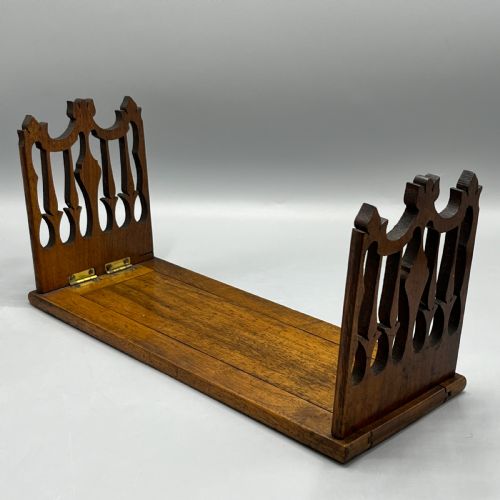

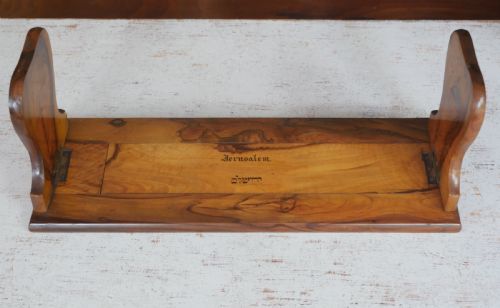


Folding Wooden Book Slide
A folding wooden book slide is a clever desk accessory designed to keep volumes upright, and you want one for its blend of practicality and period character.

Folding Wooden Book Slide
A folding wooden book slide is a clever piece of desk equipment designed to extend and support a row of volumes on a study table or library shelf. Most examples on this page date from the Victorian period and the nineteenth century, reflecting the era's enthusiasm for organised home libraries.
These functional accessories appear in forms ranging from plain extending book rests to elaborately carved or inlaid designs. You will encounter sliding bookends and book racks alongside standard extending slides, all intended to contract or expand as your collection of books changes.
Origins span English workshops alongside specific regional pieces such as Tunbridge Ware, Jerusalem olive wood, Kashmiri items, and Anglo-Indian carved teak. This variety ensures that every folding wooden book slide brings a distinct regional craft tradition directly to the desk.
How they were made
Cabinet makers utilised a range of dense timbers including walnut, rosewood, coromandel, maple, and ebonised wood to build these expanding structures. These woods provided the necessary stability and weight to hold volumes securely when the mechanism was fully extended.
Metal components, particularly brass mounts and hinges, allowed the folding and sliding actions to operate smoothly while adding decorative contrast to the timber. Intricate surface decoration was achieved through Tunbridge Ware mosaic techniques, bone inlay, boxwood stringing, and detailed carving.
Current listings demonstrate a strong Victorian presence, utilising walnut, rosewood, coromandel, and ebonised wood alongside specialised regional forms like Tunbridge Ware and Anglo-Indian teak.
What varies in quality
Quality rests upon the precision of the sliding mechanism and how smoothly the wooden sections move against one another. Superior pieces maintain a tight alignment when extended, whereas lesser examples suffer from loose joints and stiff movement.
The sophistication of the materials and surface decoration defines the upper tier of the range. Finely executed Tunbridge Ware mosaics or intricate carved teak elevate an object far beyond a simple utility piece made from plain ebonised wood.
The Folding Wooden Book Slide Glossary
- Tunbridge Ware
- Woodworking technique involving small mosaic tiles of naturally coloured woods to create pictorial designs. This painstaking method originated in Kent and often decorates nineteenth-century desk accessories.
- Ebonised Wood
- Timber treated with a dark finish to imitate expensive ebony. Makers frequently used this method during the Victorian period to achieve a stark, formal appearance.
- Coromandel
- A heavy, durable timber featuring dark brown colouring with dramatic black stripes. Cabinet makers valued this exotic wood for high-end nineteenth-century decorative items.
- Boxwood
- A dense, pale yellow wood frequently utilised for fine stringing and inlay work. Its tight grain allows for sharp, precise details on desk equipment.
Folding Wooden Book Slide: Frequently Asked Questions
What is a folding wooden book slide?
A folding wooden book slide is an adjustable desk accessory designed to hold and display a row of books securely. The extending mechanism allows the base to contract or expand depending on how many volumes you place between the ends.
Most examples date from the Victorian era and reflect the period's focus on home study organisation. They combine practical utility with decorative cabinet work.
What materials did makers use?
Makers utilised a wide variety of domestic and exotic timbers including walnut, rosewood, maple, coromandel, and olive wood. Ebonised wood was also common for achieving a formal dark finish.
Brass hinges and mounts frequently reinforced the moving parts, while bone, boxwood, and mosaic tiles provided surface ornamentation. Some regional pieces featured deep hand-carved teak.
Where did these pieces originate?
The listings show a mix of English craftsmanship alongside specific international production centres. You will find Tunbridge Ware from Kent, olive wood items from Jerusalem, and carved teak pieces from Anglo-Indian workshops.
Kashmiri makers also produced distinct folding book slides during the early twentieth century. Each origin brings specific regional materials and decorative styles to the desk.