

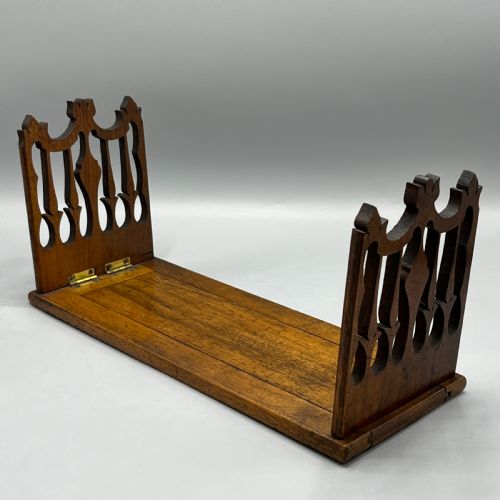


Folding Desktop Book Rack
A folding desktop book rack keeps your daily volumes orderly on a desk, bringing timber and brass together with clever mechanics.
Folding Desktop Book Rack
A folding desktop book rack provides an adjustable and sturdy home for volumes on a writing surface. When you search for a folding desktop book rack, you encounter extending book slides and novel rests designed to hold a row of books securely between upright ends.
The pieces seen here span the nineteenth century, including Victorian and Regency examples. Walnut, rosewood, coromandel, and ebonised wood form the primary bodies, often fitted with brass mounts or bone inlay.
Common forms include extending mechanisms that expand to fit a growing collection of texts. Tunbridge ware decoration, Jerusalem olive wood, and Kashmiri carvings appear alongside simpler polished timber designs.
Materials and construction methods
Cabinetmakers utilised dense hardwoods such as walnut, rosewood, and coromandel for durability and rich grain patterns. Boxwood and bone frequently provided contrasting inlay work or Tunbridge ware mosaic detailing across the surfaces.
Extending actions relied on sliding wooden channels or folding hinges fitted with brass mounts. Carved teak and olive wood appeared in regional pieces originating from Anglo-Indian workshops or Jerusalem.
Folding Desktop Book Rack Retail Price Guide 2026
Typical asking prices for folding desktop book rack among the pieces listed under this phrase on Sellingantiques today, from the lower quarter to the upper quarter. They describe what is for sale here now, not the wider market.
The selection includes regional variations such as Anglo-Indian carved teak and Jerusalem olive wood.
Assessing quality in desk accessories
The refinement of the extending action distinguishes finer examples from simpler desk accessories. Smooth movement in the sliding mechanism demonstrates precision in nineteenth-century woodworking and metalfitting.
The choice of timber and complexity of decoration separate standard pieces from exceptional ones. Elaborate Tunbridge ware mosaics or dense brass mounts indicate higher craftsmanship than plain ebonised surfaces.
Betjemanns
The Folding Desktop Book Rack Glossary
- Book slide
- An extending desk accessory designed to hold a row of books upright between two ends. These pieces expand and contract to accommodate varying numbers of volumes.
- Tunbridge ware
- Woodware decorated with mosaic patterns formed from tiny coloured wood blocks. This meticulous technique creates detailed geometric or pictorial designs.
- Coromandel
- A dense and heavily grained timber imported from Asia, valued for its dark brown colour and dramatic figuring. Cabinetmakers utilised it for high-end Victorian desk items.
- Ebonised wood
- Timber stained or painted to imitate ebony. This dark finish provided a sleek, uniform appearance popular during the nineteenth century.
- Novel rest
- A nineteenth-century term for an adjustable book holder or desk stand. These items supported reading material at a convenient angle for the user.
Folding Desktop Book Rack: Frequently Asked Questions
How do extending book slides work?
Extending book slides utilise sliding wooden sections or hinged linkages that expand and contract. This allows the user to adjust the length of the rack to fit the exact width of the books placed between the ends.
Brass mounts and tracks frequently aided the smooth movement of these extending parts.
What woods were used for nineteenth century book slides?
Cabinetmakers employed a variety of dense hardwoods including walnut, rosewood, and coromandel. Ebonised wood and olive wood also appeared frequently in the listings.
Details were often added using boxwood, bone, and specialised techniques such as Tunbridge ware mosaic work.
Where were these book racks used?
These book holders were placed on writing desks, tables, and home libraries to keep reference volumes close at hand. Their compact, folding designs made them practical for daily use.
Examples originating from Jerusalem or Anglo-Indian workshops indicate they also served as travel pieces or souvenirs.
How do I care for a wooden book slide?
Keep wooden book slides away from direct heat sources and strong sunlight to prevent the timber from drying out or warping. Dust them gently with a dry, soft cloth to protect the polished surface and brass mounts.
Avoid using harsh liquid cleaners, particularly on pieces with delicate inlay or Tunbridge ware decoration.