
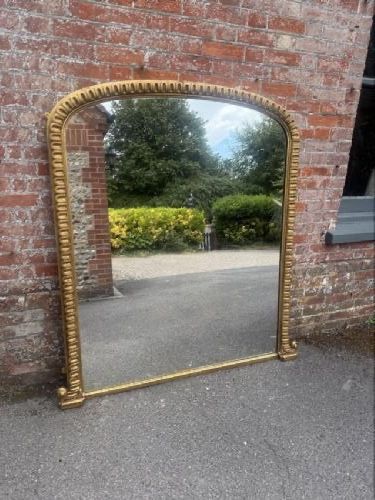

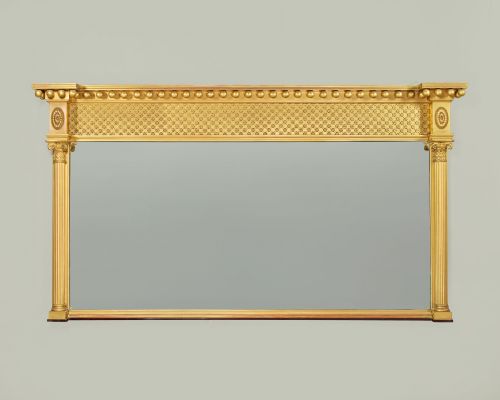


Fluted Gilt Mirror Frame
A fluted gilt mirror frame brings architectural presence and reflected light to a room, drawing the eye with its disciplined vertical lines.
Fluted Gilt Mirror Frame
When you search for a fluted gilt mirror frame, you are looking at wall mirrors and overmantels that date from the Regency period through to the Edwardian era. These pieces range from neat pier glasses designed for narrow wall spaces to large overmantel mirrors intended to sit above a fireplace.
The versions you are most likely to meet on this page belong to the nineteenth century, including specific items from the Regency, 1850, 1870, 1880, and 1905. Their forms encompass triptych overmantels and column-framed architectural glasses shaped in England.
How they were made
Maker's workshops built these frames using foundational woods such as pine, upon which they applied layers of gesso and composition plaster to build up the crisp relief of the fluting and architectural ribs. Carved wood details also appear across the nineteenth-century examples, providing structural depth beneath the decorative surface.
Gilding was achieved by applying gold leaf or gold paint over the prepared grounds, sometimes paired with ebonised sections to create high-contrast linear definition as seen in mid-century Regency pieces.
Many a nineteenth-century mirror frame still holds the faint scent of old pine and linseed oil behind its glass.
What varies in quality
Quality in a fluted gilt mirror frame rests upon the crispness of the architectural moulding and whether the fluting is hand-carved wood or moulded composition. Pierced or deeply ribbed column frames demonstrate a higher grade of craftsmanship than simpler cast plaster variants.
The integrity of the original gilding and the depth of the gold leaf application define the visual weight of the piece. Subtle contrasts, such as ebonised accents alongside the gilt finish, separate standard production from more considered decorative work.
The Fluted Gilt Mirror Frame Glossary
- Giltwood
- Wood that has been coated with gold leaf or gold powder. This surface finish gives the frame its characteristic metallic gleam.
- Gesso
- A plaster mix applied to a wood base to create a smooth surface for gilding. It holds sharp decorative details well.
- Pier glass
- A tall, narrow mirror designed to hang on the pier, the wall space between two windows. These often feature simple rectangular frames.
- Triptych overmantel
- A mirror divided into three distinct vertical glass panels within a single frame. This layout was popular for spreading light across a room above a fireplace.
- Composition
- A moulded mixture of whiting, resin, glue, and linseed oil pressed into shape. It was widely used for repetitive ornamental mouldings on nineteenth-century frames.
Fluted Gilt Mirror Frame: Frequently Asked Questions
How do I date a gilt mirror frame?
Dating relies on observing the combination of materials, construction methods, and stylistic cues present in the frame. Regency pieces often incorporate ebonised details and strict classical proportions, whereas later nineteenth-century examples might use heavier composition plaster mouldings.
Examining the backboards, fixings, and the silvering on the glass plate also provides clues to the manufacturing era, ranging from Regency origins up to Edwardian pieces.
Are these mirror frames made of solid gold?
No, the frames are formed from timber, gesso, or composition plaster and finished with a thin layer of gold leaf or gold paint. Solid gold would be far too heavy and structurally impractical for wall-hanging furniture.
The underlying pine or carved wood provides the necessary strength, while the exterior gilding delivers the bright, reflective appearance characteristic of the style.
How should I clean a gilt mirror frame?
Cleaning requires a soft, dry brush to gently remove dust from the recessed fluting and carved details without disturbing the gold leaf. Avoid liquid cleaners, abrasive cloths, or chemical solvents, as these can strip the delicate metallic finish or damage the gesso beneath.
For the mirror glass itself, apply a standard glass cleaner to a cloth rather than directly onto the glass, ensuring no moisture seeps into the frame joints.