

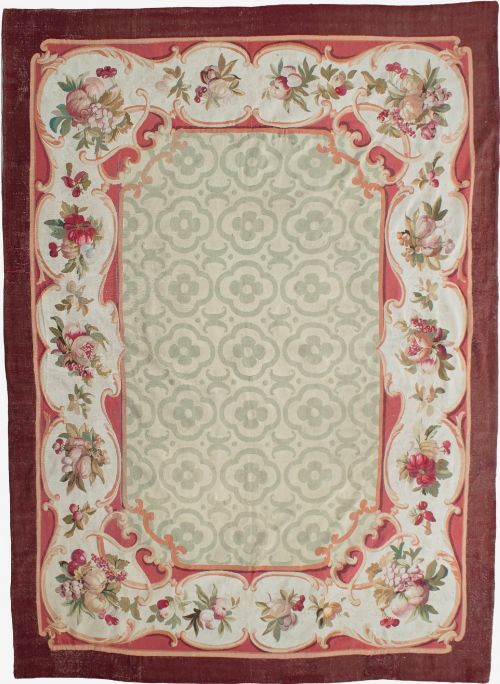


Floral Tapestry Floor Rug
A floral tapestry floor rug anchors a room with botanical colour and historical texture, offering timeless underfoot warmth.
Floral Tapestry Floor Rug
A floral tapestry floor rug brings together traditional botanical motifs and textile craftsmanship across varied historical periods. When searching for a floral tapestry floor rug, buyers encounter needlepoint rugs, flatweave kilims and knotted carpets that transform interior spaces. These textiles originate from diverse traditions including French neoclassical workshops, Bessarabian villages and Portuguese artisan centres.
The most common examples on this page span the nineteenth and twentieth centuries, featuring wool and cotton construction on canvas foundations. Pieces range from large French carpets to smaller area rugs and kilims showcasing distinct regional styles. Each floral tapestry floor rug reflects the aesthetic preferences of its era, from French Rococo curves to traditional Bessarabian patterns.
Materials and construction methods
These textiles rely on durable natural fibres such as wool and cotton, often worked onto sturdy canvas foundations. Artisans utilise needlepoint techniques and flatweave methods to build up dense, intricate floral patterns thread by thread. The combination of these materials ensures the structural integrity required for floor use over generations.
Weaving traditions dictate the specific handle and weight of each piece, whether it is a hand-knotted French carpet or a tightly woven kilim. The interaction between the wool pile or flatweave surface and the underlying cotton creates a stable textile designed to withstand daily foot traffic.
Floral Tapestry Floor Rug Retail Price Guide 2026
Typical asking prices for floral tapestry floor rug among the pieces listed under this phrase on Sellingantiques today, from the lower quarter to the upper quarter. They describe what is for sale here now, not the wider market.
Materials recorded across the inventory are strictly limited to wool, cotton and canvas.
Assessing craftsmanship and design
Quality in these textiles rests upon the precision of the needlework and the complexity of the botanical design. Superior pieces demonstrate meticulous colour gradation and tight, uniform stitching that holds its shape under pressure. Lesser examples often display simpler compositions and looser fibre density.
The sophistication of the stylistic execution, whether French neoclassical symmetry or traditional folk motifs, distinguishes finer specimens. Artisanal control over the wool and cotton materials dictates how crisply the floral details resolve across the surface of the rug.
The Floral Tapestry Floor Rug Glossary
- Aubusson
- A style of French carpet and tapestry traditionally woven without pile in imitation of high-warp tapestries. These pieces often incorporate classical architectural motifs and grand floral bouquets.
- Bessarabian Kilim
- A flatweave textile originating from the historical Bessarabia region, known for distinctive dark grounds and naturalistic floral sprays. These kilims utilise wool yarns to create robust, reversible floor coverings.
- Arraiolos
- A traditional Portuguese style of needlepoint embroidery applied to rugs and carpets. Artisans stitch wool onto a coarse linen or canvas backing using specialised tent stitches.
- Needlepoint Rug
- A textile created by working yarn through a stiff canvas mesh with a needle rather than a loom. This technique allows for painterly detail in floral designs.
- Flatweave
- A textile produced by interweaving warp and weft threads without creating a raised pile. These rugs lie thin on the floor and offer durable functionality.
Floral Tapestry Floor Rug: Frequently Asked Questions
Where should I place a floral tapestry floor rug?
These rugs suit low-traffic living rooms, studies or bedrooms where their textile structure receives protection from heavy wear. Placing them away from direct, harsh sunlight preserves the dyed wool and cotton fibres.
Pairing a quality underlay beneath the rug prevents slipping and cushions the fibres against hard flooring. This simple addition extends the working life of vintage needlepoint and flatweave pieces.
How do I clean a vintage wool rug?
Gentle surface brushing and occasional professional textile cleaning maintain the condition of historical floor coverings. Avoid vigorous scrubbing or soaking, which can weaken the canvas foundation and distort the wool yarns.
Promptly blot liquid spills with a clean, dry white cloth rather than rubbing the affected area. Keeping moisture levels low protects the integrity of both cotton and wool elements.
What is the difference between a kilim and a needlepoint rug?
A kilim is constructed as a flatweave textile where pattern is created by interlocking weft threads during the weaving process. It lacks a raised pile and lies completely flat on the floor.
A needlepoint rug involves stitching wool yarn directly through a pre-made canvas mesh using a needle. This method builds a textured surface that resembles embroidery rather than traditional weaving.