



Floral China Dinnerware
These floral china dinnerware sets bring hand-painted botanicals and transfer-printed patterns directly to the table, offering a tangible piece of historic dining culture.
Floral China Dinnerware
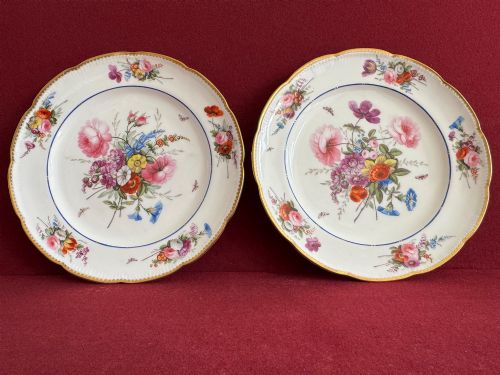
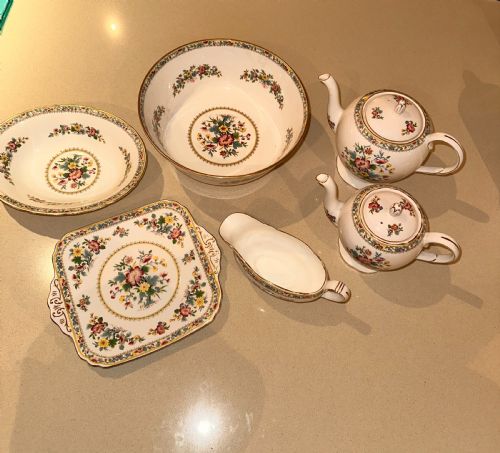
Floral china dinnerware comprises plates, bowls, platters, and complete services adorned with botanical motifs, floral sheet patterns, and hand-painted blossoms. When searching for floral china dinnerware, a buyer encounters everything from single cabinet plates to large multi-piece services spanning the Regency, Victorian, and Edwardian periods.
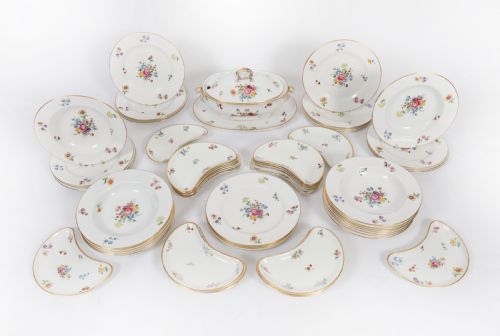
The pieces on this page range from small children's services and soup bowls to expansive sixty-piece and one-hundred-piece dinner services. Production origins span traditional English potteries like Minton, Spode, and Coalport alongside continental makers such as Müller Volkstedt and Limoges.
How they were made
Potters utilised fine porcelain, earthenware, ceramic, and ironstone as the structural bodies for these services. Shaping involved throwing or moulding before the application of glazes and enamel colours.
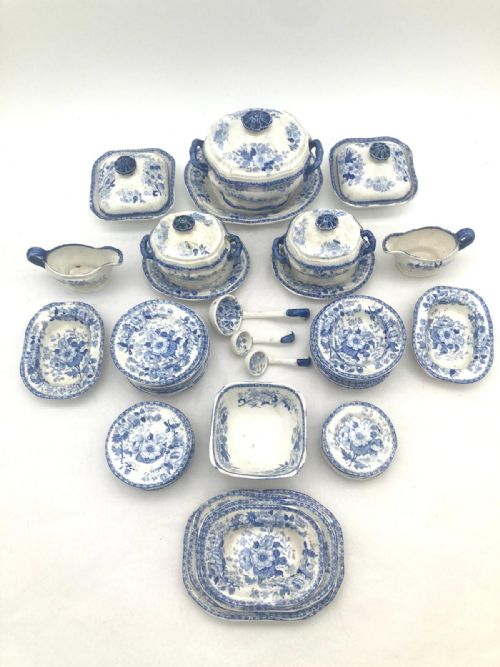
Decoration relied heavily on hand-painting and blue and white transfer printing to apply the intricate floral designs. Artisans frequently enhanced select details using gold leaf and gilt accents.
Floral China Dinnerware Retail Price Guide 2026
Typical asking prices for floral china dinnerware among the pieces listed under this phrase on Sellingantiques today, from the lower quarter to the upper quarter. They describe what is for sale here now, not the wider market.
Even tiny hands enjoyed botanical dining, as demonstrated by the nineteenth-century child's service found in the listings.
What varies in quality
Quality rests upon the fineness of the ceramic body and the precision of the artistry involved in the floral decoration. Hand-painted botanical plates command greater attention for their individual brushwork compared to standard transfer-printed wares.
The preservation of original gilding and enamel vibrancy distinguishes superior examples. Maker attribution also plays a role, with established factories achieving greater consistency in glaze application and firing.
Nantgarw porcelain·Minton·Spode·Copeland·Booths·Coalport·Masons ironstone·Müller Volkstedt MV Co·Wedgwood·Limoges·Elkin & Newbon·Royal Worcester
The Floral China Dinnerware Glossary
- Porcelain
- A hard, white, translucent ceramic body fired at high temperatures. It forms the refined base for much of the finest nineteenth-century dinnerware.
- Ironstone
- A durable type of earthenware patented in the nineteenth century. It provides strength and resilience for heavy-use dinner services.
- Transfer printing
- A method of applying complex decorative patterns from a copperplate onto ceramic surfaces via tissue paper. This technique allowed for consistent reproduction of floral motifs across large services.
- Gilt
- A thin layer of gold applied to the rim or surface details of ceramic pieces. It adds a reflective metallic finish to complement the floral painted scenes.
- Enamel
- A glassy substance fused to the ceramic surface during firing to impart vibrant colours. It is used to render naturalistic floral hues.
Floral China Dinnerware: Frequently Asked Questions
How do I use antique dinner services?
Many buyers choose to use these historic services for special occasions, treating dining as an immersive historical experience. Careful hand washing helps preserve the delicate glazes and hand-painted details during modern use.
Alternatively, larger services can be displayed across cabinetry or sideboards when not in active service. Mixing individual plates with plain modern settings allows for a subtle integration into contemporary dining.
How do I tell Regency dinnerware apart from Victorian pieces?
Regency pieces often display finer neoclassical forms with delicate floral arrangements and refined gilding. The bodies tend toward high-translucency porcelain produced before mid-century industrial scaling.
Victorian services frequently embrace heavier ironstone bodies, bolder transfer-printed floral sheet patterns, and larger set configurations. The decorative palette also expands into richer, more varied enamel tones as the nineteenth century progresses.
Can I mix different floral china patterns together?
Assembling a table setting from various makers and periods creates a collected aesthetic rooted in traditional English dining habits. Matching colour palettes, such as blue and white transfer prints or gilt-edged porcelain, helps unify disparate pieces.
Sticking to similar eras ensures that the weight of the ceramic and the scale of the floral motifs complement one another. This approach allows collectors to build functional sets gradually without waiting for a complete service to appear.
What does a part dinner service include?
A part dinner service contains a surviving subset of an originally larger suite of plates, platters, and bowls. These configurations allow buyers to acquire matching wares without committing to a full service of one hundred pieces.
Parts of services often result from centuries of attrition, leaving behind robust groups of dinner plates or soup bowls. They remain practical for daily dining or smaller gatherings while retaining the uniformity of the original workshop.