


Flemish Revival Cabinet
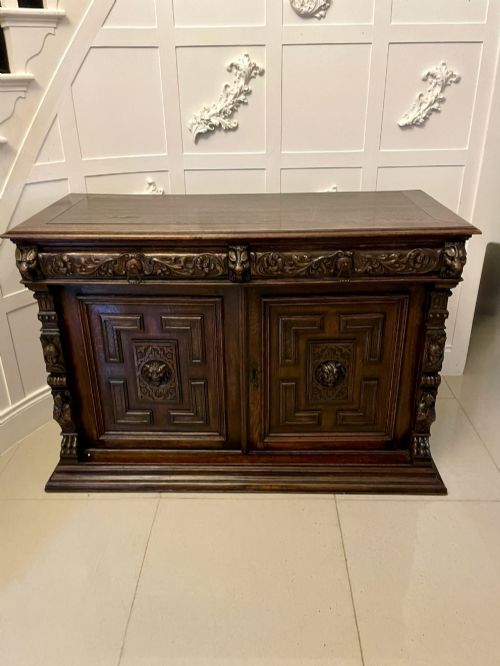
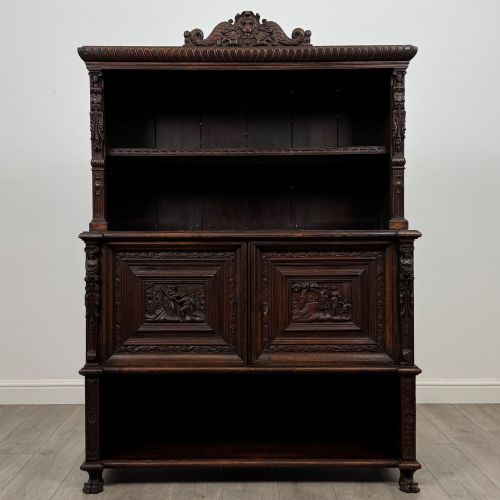
These flemish revival cabinet examples bring architectural weight and rich carved detail into a room, offering both presence and storage.
Flemish Revival Cabinet
A flemish revival cabinet draws on sixteenth and seventeenth-century northern European motifs, translated into nineteenth-century forms such as sideboards, buffets, and cabinets on stand. You are most likely to encounter substantial pieces fashioned from oak during the Victorian era, particularly around eighteen eighty.
Makers of the period utilised walnut alongside the dominant oak to build these heavy storage forms. The overall design relies on deep relief carving and balanced proportions to echo older Renaissance traditions.
Materials and construction methods
Cabinetmakers relied heavily on solid oak and walnut, selecting timber capable of supporting deep, sculptural carving across doors, panels, and friezes. Panels were often framed to accommodate natural wood movement over time.
Metal hardware played a functional and decorative role, with brass and iron utilised for hinges, handles, and keyplates. Stained glass panels also appear in doors, adding colour and texture to the upper sections of the furniture.
Distinguishing quality in carving and form
The distinction between ordinary and exceptional pieces lies in the depth and crispness of the carved ornamentation. Superior examples feature undercut details and expressive figural work, such as lion masks, rather than shallow, mechanical stamping.
Proportion and structural integrity separate robust pieces from heavier, awkward constructions. Better proportioned cabinets balance large cornices and deep bases with well-integrated hardware and intact glass elements.
The Flemish Revival Cabinet Glossary
- Cabinet on stand
- A form comprising a primary enclosed storage section elevated on a distinct open or framed base. This layout creates vertical presence while maintaining floor clearance beneath.
- Renaissance Revival
- A nineteenth-century design movement that reinterpreted classical sixteenth-century motifs, including columns, pilasters, and strapwork. It forms the stylistic foundation for much of this furniture.
- Stained glass
- Coloured glass joined by lead caming to form decorative patterns or pictorial scenes within cabinet doors. It filters light into the interior compartments.
- Lion mask
- A decorative carved motif depicting the face of a lion, frequently employed on period furniture as drawer pulls, bracket supports, or central door ornaments.
Flemish Revival Cabinet: Frequently Asked Questions
What is a flemish revival cabinet?
A flemish revival cabinet is a nineteenth-century storage piece inspired by earlier northern European Renaissance design. These items typically feature heavy timber construction and deep relief carving.
They serve as focal points in large rooms, combining historicist decoration with practical shelving and enclosed storage space.
How were these cabinets used originally?
Historically, these pieces functioned as principal storage furniture in dining rooms, halls, and reception rooms. They held tableware, linens, and household provisions while displaying decorative objects.
Their substantial surfaces and mirror backs also provided a platform for presenting silver and glassware during formal gatherings.
How do I care for a nineteenth-century oak cabinet?
Protect the wood by maintaining stable indoor humidity levels and keeping the furniture away from direct heat sources. Regular dusting with a dry, soft cloth preserves the carved details.
Apply traditional wax sparingly when the surface appears dry, avoiding modern silicone-based polishes that can damage the antique finish.
How can I tell the period of these pieces?
Dating relies on examining construction techniques, joinery, and material choices alongside stylistic markers. Nineteenth-century examples often combine machine-prepared lumber with hand-finished carving.
Hardware such as brass hinges and iron locks provides additional clues, matching the manufacturing standards typical of the Victorian era and the eighteen eighties.