

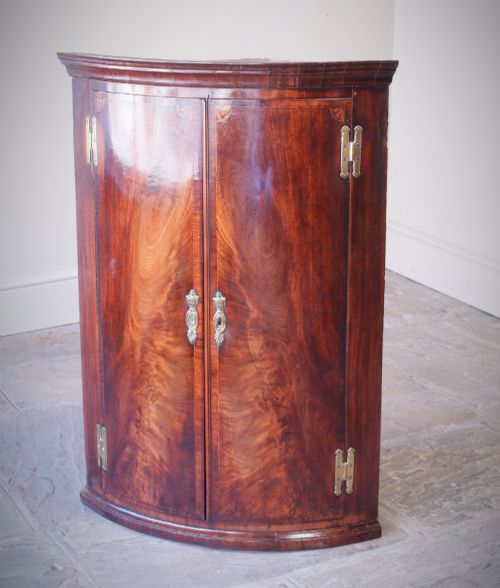
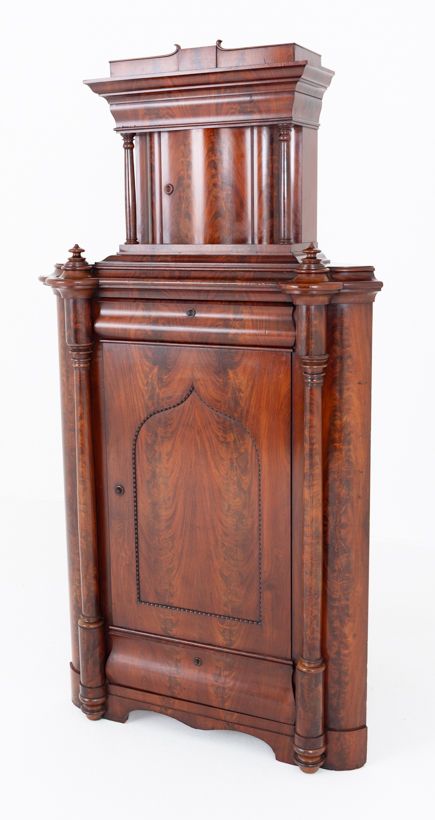


Flamed Mahogany Corner Unit
A flamed mahogany corner unit brings warmth and architectural presence to an awkward room space using deeply figured timbers.
Flamed Mahogany Corner Unit
A flamed mahogany corner unit occupies the often neglected junction of two walls, turning empty angles into useful display or storage space. These pieces typically take the form of corner cabinets or corner cupboards designed to fit snugly against intersecting walls.
The pieces listed here span the eighteenth century, the nineteenth century, and the Edwardian period, alongside a later twentieth century Georgian style example. Buyers will encounter both hanging and standing formats, with bow fronted profiles appearing frequently among the selection.
Origins range from formal eighteenth century Georgian workshops to Biedermeier interpretations and substantial country house furniture. The fundamental purpose remains consistent across these eras: concealing storage or showcasing possessions within a triangular footprint.
How they were made
Cabinet makers utilised dense timber stocks, employing flame mahogany veneer to create striking grain patterns across flat and curved surfaces. Solid mahogany also forms the primary structure on specific pieces, giving robust support to the carcass and internal shelving.
Decorative enhancements relied upon contrasting boxwood inlay to define borders and panels. Hardware such as brass fittings provides functional hinging and key escutcheons, whilst select examples incorporate glazed doors for display purposes.
Flamed Mahogany Corner Unit Retail Price Guide 2026
Typical asking prices for flamed mahogany corner unit among the pieces listed under this phrase on Sellingantiques today, from the lower quarter to the upper quarter. They describe what is for sale here now, not the wider market.
Materials across the selection include mahogany, flame mahogany veneer, brass, glass, boxwood inlay, and paint.
What varies in quality
Quality rests primarily in the selection of the timber and the rhythm of the figure across the door panels. A superior cabinet exhibits book matched flame veneer that creates a symmetrical, balanced pattern, whereas lesser examples show erratic or muted grain movement.
Architectural ambition also separates standard items from exceptional ones. Pieces featuring complex structural elements like broken arch pediments or fine boxwood stringing demonstrate a higher level of workshop skill than plain carcasses.
The Flamed Mahogany Corner Unit Glossary
- Flame mahogany veneer
- A thin slice of timber cut from the fork of the tree where branches meet the trunk. This method yields a dramatic, flame like figure prized for decorative cabinet fronts.
- Bow front
- A convex curved front facade that softens the rigid ninety degree angles of a room. This shape requires advanced woodworking skill to bend timber or shape solid wood accurately.
- Broken arch pediment
- A decorative triangular pediment at the top of a cabinet where the apex is left open or interrupted. It often holds a central finial and signals formal eighteenth century design.
- Boxwood inlay
- Narrow strips of pale yellowish boxwood embedded flush into the darker mahogany surface. This technique creates crisp geometric borders and linear contrast.
- Hanging corner cabinet
- A wall mounted version designed to be secured above floor level rather than resting upon a plinth or bracket feet. It saves valuable floor space in smaller chambers.
Flamed Mahogany Corner Unit: Frequently Asked Questions
What is a flamed mahogany corner unit?
A flamed mahogany corner unit is a fitted cabinet designed to utilise the 90-degree angle where two walls meet. These pieces use highly figured timber veneers to create striking visual patterns on their doors.
They function as both storage cupboards and display spaces, with formats ranging from wall-mounted hanging cabinets to tall standing cupboards.
How do I install a hanging corner cabinet?
Hanging corner cabinets require secure fixing directly into wall studs or solid masonry to support their considerable weight. Professional installation ensures the piece remains level and stable.
Because antique carcases are heavy, proper weight distribution prevents strain on the original hanging brackets and joints.
How do I tell Georgian from Edwardian examples?
Georgian examples usually exhibit heavier proportions, hand-cut dovetails, and architectural details like dentil cornices or broken arch pediments. The mahogany tends to have a deep, rich patina developed over centuries.
Edwardian pieces often display lighter construction, sometimes incorporating softer secondary timbers and machine-cut elements while emulating earlier classical styles.
Can I use a corner unit in a modern room?
These units integrate well into contemporary interiors by providing functional storage without consuming main wall space. The warm tones of the mahogany contrast effectively against neutral modern walls.
They serve practical purposes in dining rooms for glassware or in living areas for books and collections.